

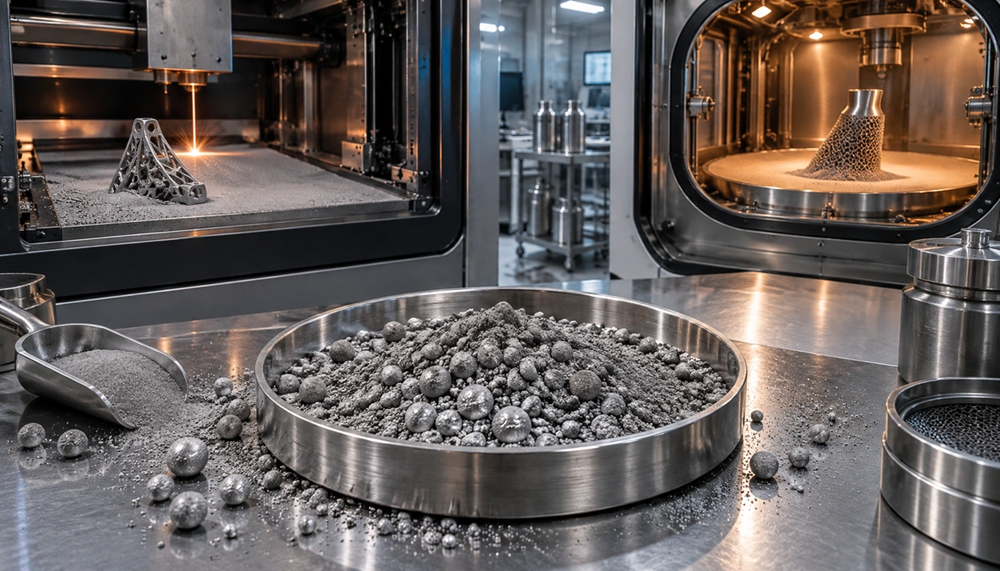
Titanium Powder can determine whether an implant or aerospace component succeeds before the first layer is built. LPBF and EBM just need different feedstock behavior, atmospheres, and build conditions. Titanium powder selection therefore plays a central role in quality, repeatability, and cost.
This piece compares titanium powder for 3d printing in titanium additive manufacturing and shows how titanium alloy powder choices shape LPBF and EBM results. It gets into ti6al4v powder, grade 23 titanium powder, EBM titanium powder, and electron beam melting titanium powder. Key considerations include particle size, chemistry, flowability, contamination, reuse, and certification. LPBF commonly uses 15–45 µm powder, while EBM can use 45–106 µm feedstock.
LPBF vs EBM: Why Titanium Powder Requirements Differ
The same titanium alloy powder can behave differently if a machine uses a different heat source or chamber condition. LPBF vs EBM needs more than matching the alloy. Particle size, spreading behavior, preheat response, and surface condition must suit the selected platform.
LPBF vs EBM Titanium Powder Specification Matrix
| Requirement | LPBF | EBM |
|---|---|---|
| Energy source | Focused laser | Electron beam |
| Build environment | Inert gas, commonly argon | High vacuum |
| Typical powder range | About 15 to 45 µm | About 45 to 106 µm |
| Powder-bed condition | Relatively cold before melting | Heated and in part sintered before melting |
| Main spreading concern | Uniform thin layers without poor flow | Stable raking and controlled interparticle bonding |
| Thermal behavior | High cooling rates and steep temperature gradients | Lower thermal gradients and a hot powder bed |
| Common powder description | LPBF titanium alloy powder | EBM titanium powder or electron beam melting titanium powder |
Reports describe a broader LPBF particle-size distribution of 10 to 63 µm, while EBM commonly uses powder from 45 to 105 µm. A representative EBM feedstock specification lists a D10 of 59 µm, a D50 of 78 µm, and a D90 of 106 µm. These ranges support different layer-deposition and beam-interaction conditions. Smaller particles can support finer layers and better surface detail, but too many fines reduce flowability and make uniform spreading harder.
Laser Melting in Argon vs Electron-Beam Melting in Vacuum
LPBF melts selected areas with a laser inside an inert-gas chamber. Manufacturers usually use argon with reactive titanium materials. The gas limits oxygen contamination during powder spreading and laser exposure. Many LPBF systems begin with a powder layer near ambient temperature, although the build plate can reach about 200 °C. The laser supplies concentrated energy that creates and solidifies each melt pool.
EBM uses an electron beam in a vacuum. The vacuum stops electrons from colliding with air molecules that could deflect the beam. It also reduces oxidation and contamination during processing. EBM chambers can operate near 0.5 Pa absolute pressure. This environment suits reactive titanium alloy powder, but it changes how particles receive and retain heat.
The two processes create different thermal histories even with the same Ti-6Al-4V powder. LPBF’s rapid cooling can produce a fine martensitic structure, but EBM’s hot powder bed reduces the chance of brittle martensite and supports greater ductility in processed Ti-6Al-4V. Titanium powder selection must match qualified machine settings, not just the alloy name.
How Powder Bed Preheating Changes Spreading and Build Conditions
EBM preheats each layer with a defocused electron beam before selective melting. The beam can heat and lightly sinter powder layers to temperatures near 1100 °C. This sintering creates particle-to-particle contact, improves electrical and thermal conductivity, and limits charged-particle clouds known as smoke. The powder must spread reliably before preheating and form controlled bonds afterward.
Preheating also lowers the temperature difference between the melt pool and surrounding powder. Lower thermal gradients reduce residual stress, distortion, warpage, and balling. Excessive sintering makes loose powder harder to remove, especially from internal features, and can increase surface roughness.
LPBF does not usually need this level of layer sintering. Its finer titanium powder for 3D printing must form a level layer under relatively cool conditions, so flowability and particle distribution strongly affect recoating. Smaller particles may improve surface finish, but powder at 20 µm or below can spread poorly because flowability declines. Titanium powder selection must account for the target geometry and the machine’s spreading method.
Choosing Ti-6Al-4V or Grade 23 Titanium Powder
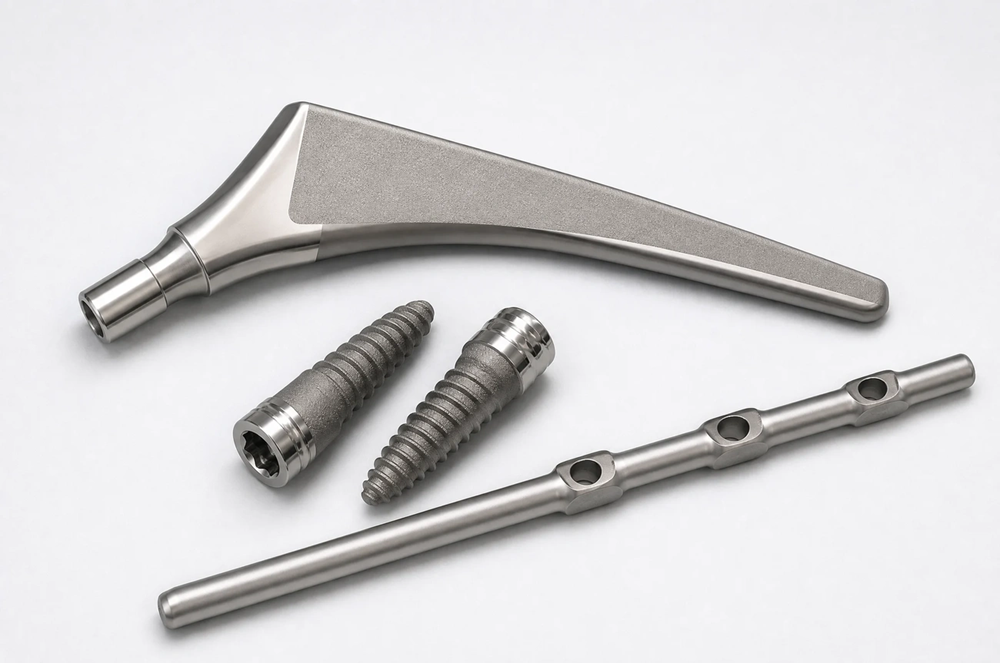
The selected process determines how the powder behaves, while the alloy grade sets the finished material’s chemical and mechanical limits. Buyers of titanium additive manufacturing powder should therefore compare Ti-6Al-4V powder by grade, application, and approval route instead of treating all titanium alloy powders as interchangeable.
Ti-6Al-4V Grade 5 vs Extra-Low Interstitial Grade 23
Grade 5 and Grade 23 use the same base alloy system: titanium with about 6% aluminum and 4% vanadium. Grade 23, also called Ti-6Al-4V ELI, has tighter limits on interstitial elements such as oxygen, nitrogen, carbon, and hydrogen. Its lower impurity content improves ductility, fracture toughness, and fatigue crack growth performance. Grade 5 generally offers slightly higher strength.
The material specification for Grade 23 titanium powder sets maximum oxygen at 0.130%, nitrogen at 0.050%, carbon at 0.080%, and hydrogen at 0.013%. These limits matter because interstitial pickup can make printed Ti6al4v powder more brittle and change its mechanical performance. Grade 23 is commonly chosen when damage tolerance, fatigue resistance, or long-term tissue contact drives the design.
Grade 5 remains suitable for high-strength structural applications when standard Ti-6Al-4V chemistry meets design and regulatory requirements. Grade 23 is often a better starting point for implant and dental applications because its purity supports biocompatibility and toughness. Titanium powder selection should therefore start with the required material specification, not price or particle size alone.
Matching Alloy Chemistry to Aerospace and Implant Requirements
Aerospace parts often need a high strength-to-weight ratio, corrosion resistance, and consistent performance under stress. Both Grade 5 and Grade 23 can support aerospace applications, but the chosen grade must meet the component’s damage-tolerance, fatigue, and qualification requirements. Grade 23 is specified when lower interstitial content and greater toughness provide the required performance margin.
Medical implants have requirements that do not apply to every aerospace component. ASTM F136 identifies Ti-6Al-4V ELI for implant-related material use, and Grade 23 is also associated with ISO 5832-3. Its elastic modulus ranges from 105 to 116 GPa, compared with typical human bone values of 10 to 20 GPa. The alloy’s corrosion resistance and biocompatibility support bone integration in applications such as bone fixation devices, joint replacements, and dental components.
The powder must also suit the qualified manufacturing route. A supplier may provide Grade 23 titanium powder for LPBF, EBM titanium powder, or electron beam melting titanium powder with different size distributions and process pedigrees. The nominal alloy may be the same, but machine settings, the thermal cycle, and the post-processing route determine which properties require validation.
Separating Powder Certification from Finished-Part Approval
A powder certificate confirms feedstock characteristics. It may document chemical composition, particle-size distribution, morphology, flow behavior, density, and lot identity. ASTM F2924 addresses Ti-6Al-4V powder requirements, while ASTM F3001 covers Ti-6Al-4V parts made through powder-bed fusion.
Neither certificate alone approves a finished aerospace or medical part. Qualification evaluates the material, machine, process parameters, post-processing, inspection, and test results. Certification then confirms compliance with an authority’s requirements and provides traceability to approved conditions.
A supplier’s powder certificate should therefore be checked against the machine’s qualified material specification and the part’s governing standard. Test builds must establish density, mechanical properties, surface condition, and repeatability for the intended orientation and post-processing route. This distinction prevents teams from mistaking a compliant powder lot for an automatically approved component.
Titanium Powder Properties That Matter for LPBF and EBM
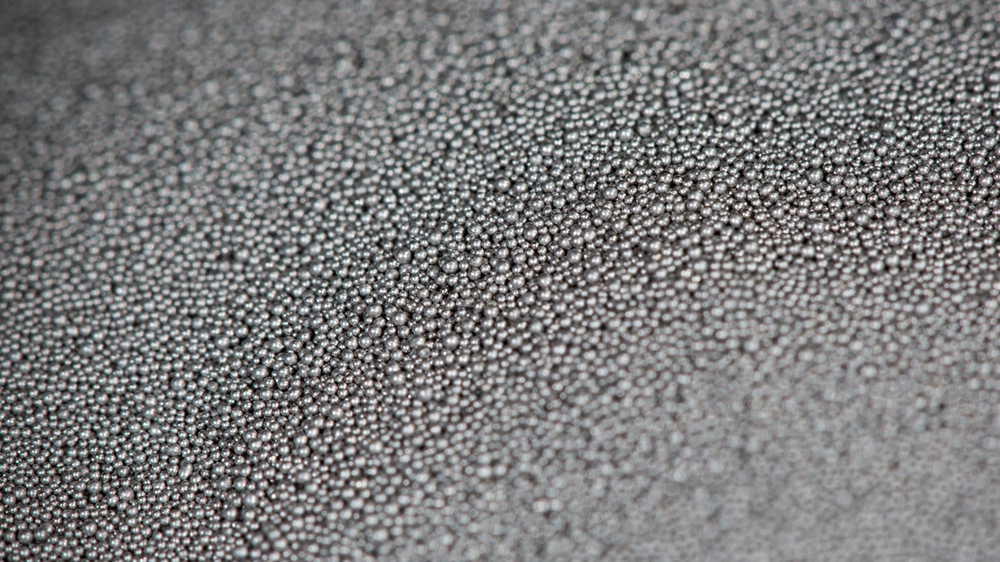
Powder geometry often determines whether a qualified alloy spreads evenly enough to support repeatable melting. Particle size distribution, shape, surface condition, density, internal porosity, and chemistry matter in titanium additive manufacturing. These properties interact, so titanium powder selection should assess the full powder profile instead of relying on one certificate value.
Typical Particle Sizes: 15–45 µm for LPBF vs 45–106 µm for EBM
LPBF commonly uses a 15–45 µm distribution, while EBM titanium powder usually falls within 45–106 µm. Fine LPBF powder supports thin layers and detailed surfaces, but its higher specific surface area makes it more sensitive to oxygen. Smaller particles also experience stronger interparticle forces, which can cause agglomeration and reduce flow. EBM’s coarser electron beam melting titanium powder usually flows more easily and suits its spreading conditions, although the selected range must match the machine’s qualified settings.
Particle size distribution affects apparent density and powder-bed density. A broad distribution can fill gaps between larger particles with smaller ones, but too many fines increase cohesion. NIST testing found that a wider distribution with a substantial fraction near the effective layer thickness achieved higher powder-bed density than powder with more fine particles.
Sphericity, Satellites, and Their Effect on Powder Flow
Spherical titanium alloy powder reduces interparticle friction and supports consistent movement through a recoater or raking system. Irregular or elongated particles, along with satellites and agglomerates, disrupt that movement. Gas atomisation can create satellites when fine particles strike larger particles that have only partly solidified. These attached particles impair free flow. Then, morphology assessment should cover more than a simple size measurement because methods that assume spherical particles cannot fully describe shape.
Particle size, surface condition, material, and the processing environment also affect flowability. Dynamic flow testing better reflects LPBF spreading than a single funnel result because it measures powder movement under conditions closer to a build cycle. A highly spherical grade 23 titanium powder with a finer distribution can flow better than a less suitable powder that has a nominally acceptable range.
Packing Density and Internal Particle Porosity
Packing density determines how uniformly particles fill each deposited layer. A suitable distribution balances flow and void filling, while poor packing leaves spaces that can lead to incomplete consolidation. Apparent density and tap density offer useful indicators, but they do not always predict the density achieved during actual spreading.
Internal particle pores create another source of defects. High-pressure gas atomisation can trap gas in molten droplets and leave pores that may remain even after hot isostatic pressing, reducing fatigue performance. Helium pycnometry found equivalent skeletal density and, therefore, equivalent internal porosity in tested EIGA and plasma-atomised Ti-6Al-4V powders.
Plasma Atomisation vs EIGA: Powder Quality and Production Trade-offs
Plasma atomisation melts pre-alloyed wire with plasma torches and produces highly spherical particles, with more than 40% fine powder yield for Ti-6Al-4V. EIGA melts a rotating pre-alloyed bar in an induction coil, then inert gas breaks up the melt stream. Its ceramic-free route reduces refractory contamination, while bar feedstock can simplify alloy supply and limit oxygen pickup.
Tests found statistically equivalent morphology, density, contamination, and oxygen-related performance in EIGA and plasma-atomised samples. EIGA showed better flowability despite its finer distribution. The choice between these methods should reflect powder yield, chemistry, contamination control, and machine-specific spreading results rather than the process name alone.
Controlling Titanium Powder Contamination and Reuse
Oxygen Pickup During Storage, Handling, and Recovery
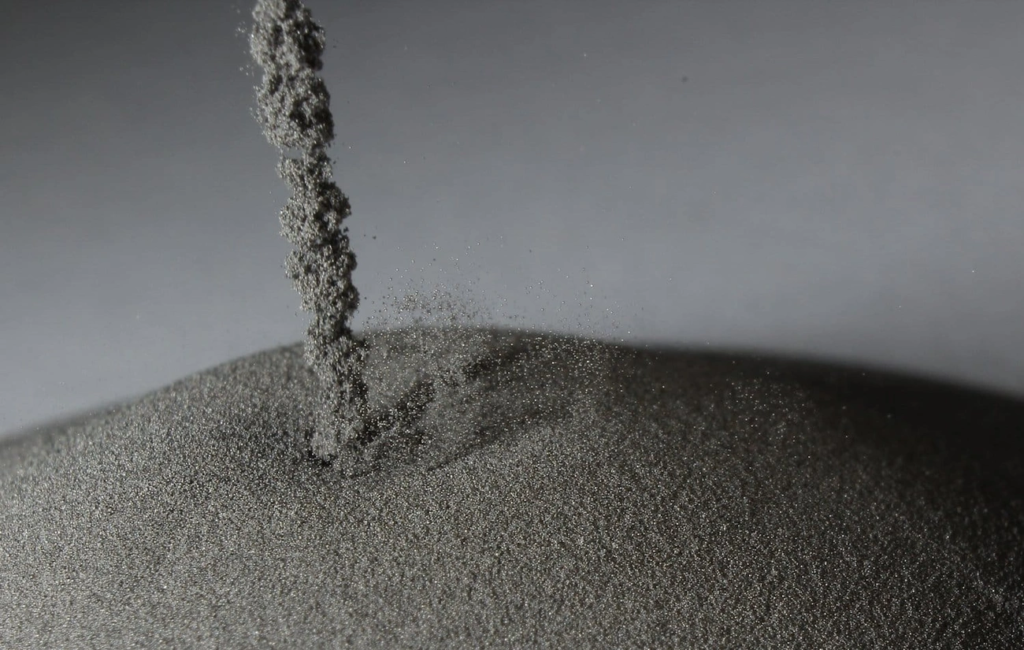
Unused titanium powder can absorb moisture and oxygen when exposed between builds, then oxidize during heating. LPBF may receive oxygen from impure argon, while EBM may be exposed to helium impurities. Reuse requires a controlled atmosphere and documented cycle limits because oxidation alters morphology, particle-size distribution, and flowability.
Sieving, Sampling, and Lot Tracking Before Powder Reuse
Recovery should separate partially fused agglomerates, spatter, and powder near the melt region from acceptable feedstock. Sieving removes selected fractions but cannot remove oxidation or all contaminants. Collect samples before and after sieving, and record the mass, build position, sieve size, and reuse count. Numbered containers maintain lot traceability, and ASTM B215 provides a basis for sampling. Add virgin powder only after qualifying the used-to-virgin ratio and acceptance limits.
Combustible Titanium Powder: Safe Handling and Storage
Titanium powder is combustible and can ignite as airborne dust. Keep recovery equipment clean, dry, grounded, and suitable for reactive powder. Use an inert atmosphere where required. Store powder in sealed containers in cool, ventilated areas away from ignition sources and incompatible chemicals. Use non-sparking tools and approved collection equipment. Never use an ordinary vacuum cleaner by default. NFPA 484 addresses combustible metals. Do not apply water or carbon dioxide to burning titanium.
Qualifying Titanium Powder and Comparing Total Part Cost
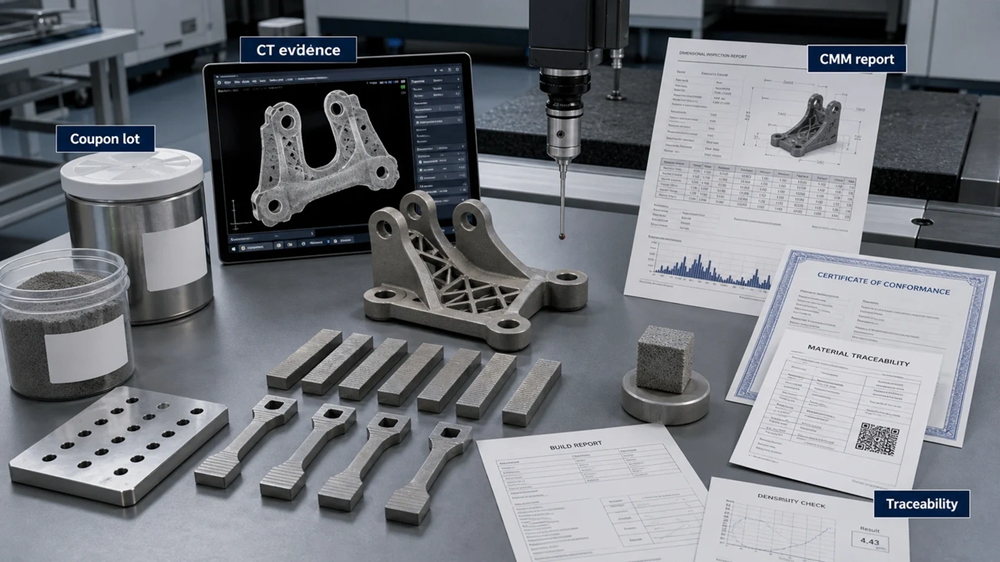
Qualification links the certificate to the machine recipe and finished part. Compare D10, D50, D90, flowability, morphology, porosity, chemistry, and reuse history against the selected LPBF or EBM titanium powder’s settings. A certificate cannot replace calibration.
Powder Data Against the Machine’s Qualified Material Settings
Test Builds to Check Density, Surface Finish, and Mechanical Properties
Use test builds that reflect the intended geometry, positions, and orientations. Measure density, surface finish, porosity, and tensile properties against acceptance limits. An LPBF study measured relative density from 97.64% to 99.81% as power, speed, and hatch spacing changed. Record process data.
ASTM F2924 and F3001: Requirements Beyond the Powder Certificate
ASTM F2924 covers Ti-6Al-4V powder-bed-fusion components. ASTM F3001 covers Ti-6Al-4V ELI produced through full-melt LPBF or EBM. It also adds requirements for manufacturing plans, machine qualification, traceability, powder analysis, inspection, and mechanical properties. Used powder requires documented proportions, reuse counts, sieving, and chemistry.
Cost Comparisons Beyond Powder Price
Compare total cost, not powder price alone. Include usable yield, recovery, HIP, machining, inspection, testing, labor, and rejected builds. A cheaper titanium alloy powder can raise costs if poor packing creates porosity or requires extra processing. Track virgin-to-used ratios and lot results because reuse reduces purchases but adds handling.
Conclusion
Successful titanium additive manufacturing requires matching the powder to the full process rather than choosing a familiar alloy. LPBF and EBM need different particle sizes, spreading behavior, thermal conditions, and atmospheres, while Grade 5 and Grade 23 meet distinct performance requirements. Powder morphology, flowability, internal porosity, chemistry, and contamination control directly affect density, fatigue, repeatability, and safety. Careful sieving, storage, reuse tracking, and machine-specific test builds turn a powder certificate into reliable production evidence. Buyers should also compare total part cost, including HIP, machining, inspection, and rejected builds. The right titanium powder meets technical, regulatory, and economic requirements together.
FAQs
Q1. How do titanium powder requirements differ between LPBF and EBM?
LPBF typically uses finer powder, about 15–45 µm, while EBM commonly uses 45–106 µm powder. Particle size, flowability, and chemistry must match the machine’s qualified settings.
Q2. How is titanium protected from oxidation during printing?
LPBF typically uses an inert argon atmosphere, while EBM operates under vacuum to reduce oxidation. Controlled storage, handling, and recovery also help limit oxygen pickup.
Q3. Why do LPBF and EBM produce different residual stresses in titanium parts?
LPBF’s rapid cooling creates steep temperature differences that can increase residual stress. EBM preheats the powder bed, reducing temperature differences and helping limit stress and distortion.
Q4. What tests help confirm the quality of printed titanium parts?
Test builds should check density, porosity, surface finish, and tensile properties. They should reflect the intended part’s geometry, build orientation, and post-processing route.
Q5. Is cheaper titanium powder always more economical?
No. Poor flow or packing can increase defects, rejected builds, and processing costs. Compare total part cost, including powder yield, recovery, hot isostatic pressing (HIP), machining, and inspection.