

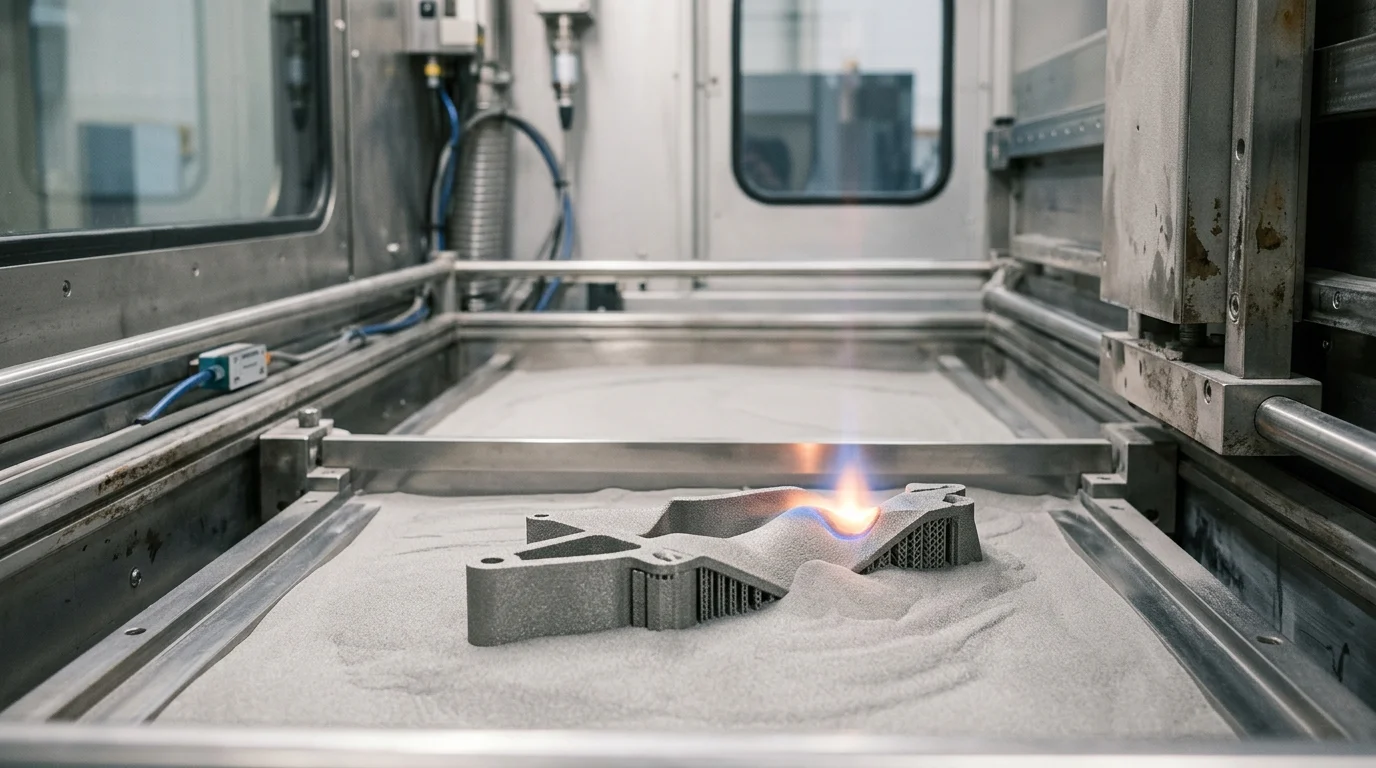
Metal powder additive manufacturing is moving beyond prototype labs and into qualified production lines because it solves two persistent problems at once: geometric limitation and expensive tooling. By pairing precision powders with laser fusion, binder jetting, sintering, and post-HIP treatments, manufacturers can produce dense titanium, stainless steel, and cobalt-chrome components with complex channels, lattices, and consolidated assemblies. The business case is especially strong where alloy costs are high, lead times are long, or customization matters, such as aerospace structures, medical implants, and industrial fluid systems. This article explains the core processes, material considerations, performance benchmarks, and production trade-offs that determine whether the technology is commercially viable.
Why Powder Metallurgy 3D Printing Is Becoming a Production Strategy
The intersection of traditional powder metallurgy (PM) and additive manufacturing (AM) has catalyzed a profound shift from rapid prototyping to full-scale industrial production. By leveraging established sintering mechanisms alongside digital toolpaths, manufacturers can bypass the severe geometric constraints and tooling amortization costs inherent in conventional press-and-sinter or metal injection molding (MIM) workflows. This evolution enables agile manufacturing paradigms where part complexity no longer dictates production feasibility or capital expenditure.
What Powder Metallurgy 3D Printing Means
Powder metallurgy 3D printing encompasses technologies that utilize fine metal powders as feedstocks, relying on either localized thermal energy to fuse particles in situ or chemical binders to create a “green” part that undergoes subsequent debinding and sintering. Unlike directed energy deposition (DED), powder-bed and binder-based PM AM systems achieve remarkable microstructural homogeneity. Modern platforms utilizing gas-atomized spherical powders—typically 15 to 45 µm in diameter—routinely achieve relative densities exceeding 99.5% in fully optimized Laser Powder Bed Fusion (L-PBF) or post-HIP sinter-based parts. These match or surpass the mechanical properties of wrought equivalents. However, handling these fine metal powders requires strict operational caveats, including specialized personal protective equipment (PPE) and environmental controls to mitigate flammability and toxicity hazards.
This hybrid discipline bridges the digital flexibility of 3D printing with the metallurgical rigor of legacy powder processing. It allows engineers to design complex internal cooling channels, weight-saving lattice structures, and topologically optimized geometries without the need for bespoke molds or multi-axis machining setups.
Where It Creates Commercial Value
The commercial viability of this technology emerges most strongly in applications demanding high complexity, aggressive part consolidation, or highly responsive supply chains. The aerospace and medical sectors leverage PM 3D printing to manufacture lightweight titanium (Ti-6Al-4V) structural components and patient-specific cobalt-chrome orthopedic implants. In aerospace, this drastically reduces the buy-to-fly ratio from typical 15:1 margins down to nearly 1.5:1, saving immense material costs on expensive alloys.
Furthermore, automotive and industrial fluid power companies increasingly utilize high-throughput binder jetting for mid-volume production runs of stainless steel (such as 316L or 17-4 PH) components. By eliminating tooling lead times that historically span 8 to 16 weeks, organizations can iterate designs rapidly and initiate low-volume production within days. This effectively decouples manufacturing readiness from tooling capital expenditure, accelerating time-to-market and lowering the barrier to entry for complex product innovations.
Processes, Materials, and Post-Processing
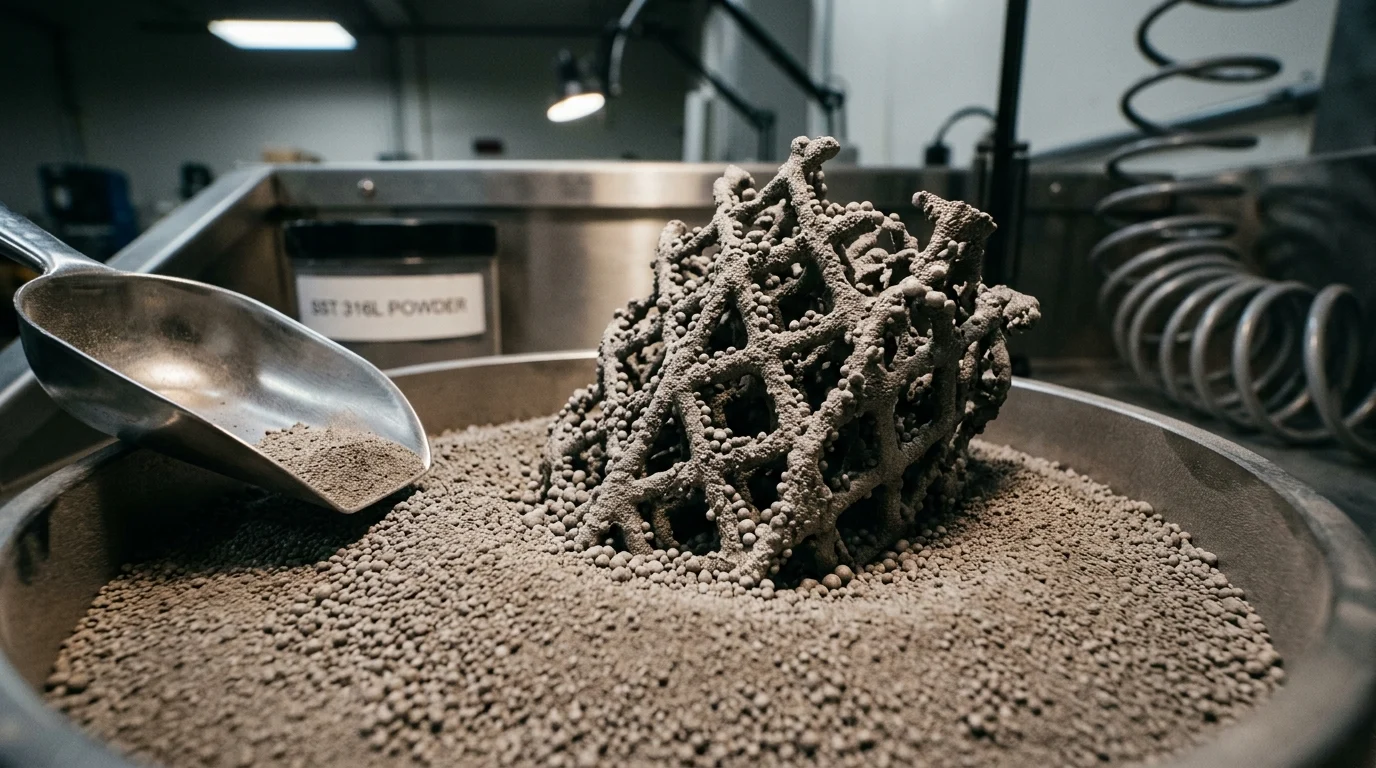
Navigating the technical landscape of powder metallurgy additive manufacturing requires a precise understanding of available modalities, feedstock characteristics, and the critical thermal processing steps that dictate final part integrity. Selecting the correct combination ensures both structural reliability and economic efficiency.
Choosing the Right Process Route
The primary technological divergence lies between fusion-based and sinter-based processes. Laser Powder Bed Fusion (L-PBF) utilizes high-powered lasers to melt powder layers between 20 µm and 60 µm thick. This yields fully dense, net-shape parts immediately after the build cycle, albeit with extreme cooling rates (often exceeding 10^5 K/s) that generate high residual stresses. These stresses necessitate immediate stress-relief annealing and extensive support structure removal.
Conversely, Metal Binder Jetting (MBJ) and Metal Fused Filament Fabrication (MFFF) rely on a polymer binder to shape the metal powder into a green part. These sinter-based routes offer significantly higher volumetric build rates—often exceeding 5,000 cm³/hour for multi-nozzle MBJ systems. While this reflects idealized vendor specifications and may not represent sustained effective throughput when factoring in recoating and post-processing time, these methods completely eliminate thermally induced residual stresses during the printing phase. This makes them highly competitive for larger batches of smaller, complex components where fusion-based AM would be cost-prohibitive due to slow build speeds and support removal requirements.
Managing Powders, Sintering, and Heat Treatment
For sinter-based modalities, managing the transition from a fragile green state to a fully dense metallic component is the most critical engineering challenge. In high-binder feedstock systems like MFFF, green parts typically contain 40% to 60% binder by volume, whereas MBJ parts contain significantly less. Regardless of the exact volume, binders must be carefully extracted via catalytic, solvent, or thermal debinding to prevent blistering or cracking. The subsequent sintering phase in a controlled-atmosphere furnace induces isotropic linear shrinkage, typically ranging from 15% to 22%. This necessitates highly accurate predictive compensation algorithms during the digital design phase to maintain dimensional tolerances.
| Process Category | Typical Layer Thickness | Max Volumetric Build Rate | Post-Print Linear Shrinkage | Primary Use Case |
|---|---|---|---|---|
| Laser Powder Bed Fusion | 20 – 60 µm | 50 – 150 cm³/hr | < 1% | High-stress aerospace, medical implants |
| Metal Binder Jetting | 35 – 100 µm | > 5,000 cm³/hr | 15 – 22% | Mid-volume automotive, industrial parts |
| Metal Fused Filament | 100 – 200 µm | 20 – 50 cm³/hr | 15 – 20% | Jigs, fixtures, low-volume tooling |
Post-sintering, components often undergo Hot Isostatic Pressing (HIP) at pressures exceeding 100 MPa and temperatures near 1,200°C (for steels) to close residual internal micro-porosity. This is followed by standard heat treatments, such as solution annealing and aging, to achieve target yield strengths and fatigue resistance.
Building a Manufacturing Decision Framework
Integrating powder metallurgy 3D printing into an existing industrial portfolio requires a rigorous, data-driven framework to evaluate both technical feasibility and economic justification against legacy manufacturing methods like CNC machining, casting, or traditional pressing.
Screening Parts and Validating Feasibility
The initial screening phase must objectively assess component geometry, material requirements, and the intended operational environment. Ideal candidates exhibit high geometric complexity, such as internal fluid routing manifolds or consolidated multi-part assemblies, which are economically unfeasible to machine or cast. Engineers must strictly evaluate bounding box constraints; for instance, binder jetting is highly effective for components under 150 mm in maximum dimension, as larger parts face severe sagging and distortion risks during the liquid-phase sintering process.
Furthermore, surface finish requirements play a critical role in feasibility.
Key Takeaways
- Select gas-atomized spherical powders, often in the 15 to 45 µm range, to improve flowability, layer uniformity, and final part density.
- Use optimized laser powder bed fusion or post-HIP sinter-based processing when applications require relative densities above 99.5%.
- Evaluate additive manufacturing for titanium aerospace parts where reducing buy-to-fly ratios from roughly 15:1 to near 1.5:1 can create major material savings.
- Choose binder jetting for mid-volume stainless steel components when eliminating 8- to 16-week tooling lead times is a business priority.
- Plan for residual stress management in L-PBF because 20 to 60 µm layers and cooling rates above 10^5 K/s can require heat treatment or HIP.
- Implement powder-specific PPE, ventilation, and environmental controls before production because fine metal powders can present flammability and toxicity hazards.
Frequently Asked Questions
What is powder metallurgy-based additive manufacturing?
It is metal part production using fine powders that are either fused layer by layer or bound into a green part and then debound and sintered. It combines digital design freedom with established powder processing and metallurgical control.
Which metal powders are commonly used?
Common feedstocks include Ti-6Al-4V titanium, stainless steels such as 316L and 17-4 PH, cobalt-chrome, and other gas-atomized spherical powders. Many systems use fine powder sizes around 15 to 45 µm for stable spreading and high density.
How dense can printed metal parts become?
Optimized laser powder bed fusion and post-HIP sinter-based routes can routinely exceed 99.5% relative density. With proper parameters and post-processing, mechanical performance can match or surpass some wrought equivalents.
When is this process commercially valuable?
It is most valuable for complex geometries, part consolidation, lightweight structures, patient-specific implants, and low- to mid-volume production where tooling cost or lead time would otherwise slow development.
How does it reduce aerospace material waste?
For expensive alloys such as titanium, additive routes can reduce buy-to-fly ratios from about 15:1 to near 1.5:1 by building closer to final shape and avoiding extensive machining waste.
More Resources
Titanium 3D Printing-JHMIM
3D Printed Architectural Model –Source:RJ Models