

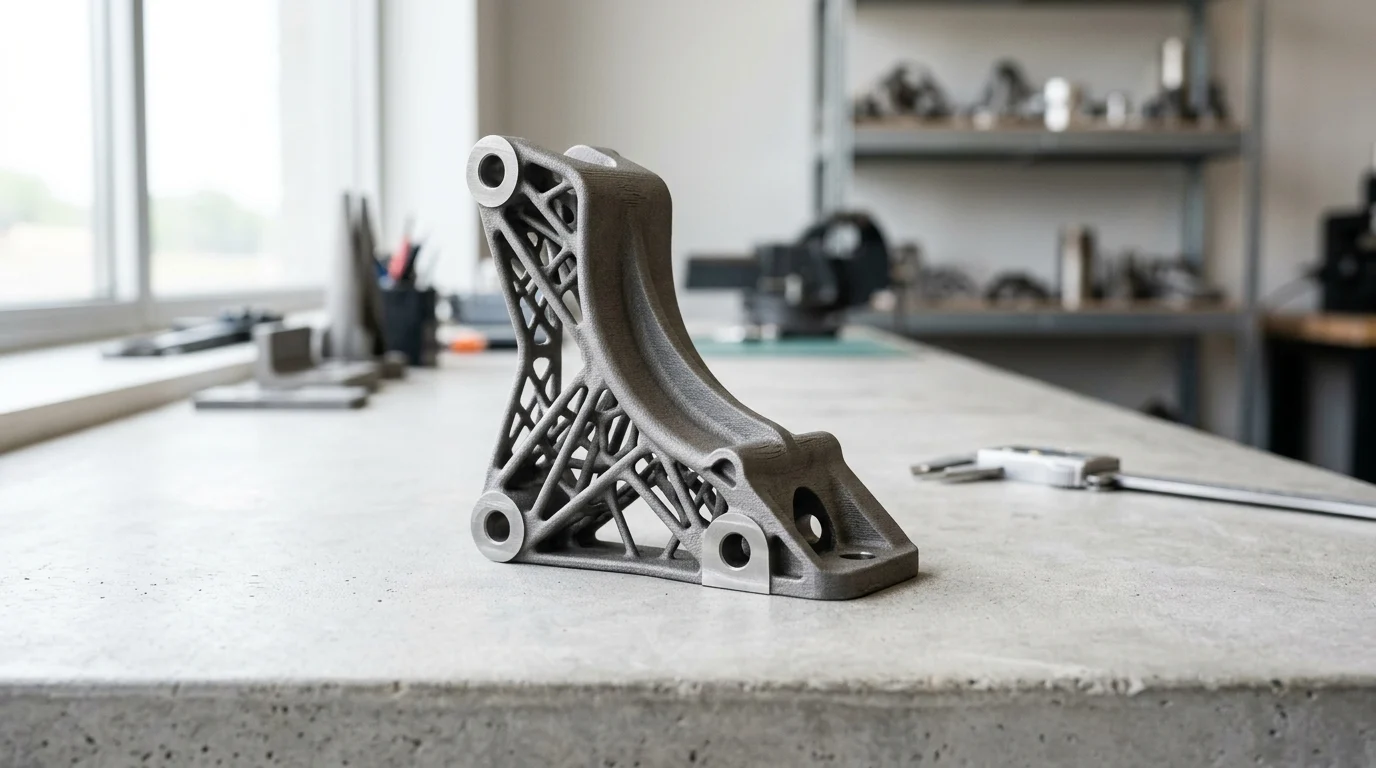
Titanium is already valued for its high strength-to-weight ratio, corrosion resistance, and biocompatibility—but additive manufacturing changes what engineers can do with it. With modern laser and electron beam systems, printed Ti-6Al-4V can deliver tensile strengths above 1,100 MPa, making it competitive with wrought material and often stronger than cast alternatives. The real question is not simply whether printed titanium is strong, but what kind of strength it delivers, how ductility and fatigue behave, and which process controls make the difference. This article explains the key strength metrics, powder and oxygen requirements, post-processing needs, and how 3D printed titanium compares with machined and cast forms.
Why 3D Printed Titanium Is Strong
Additive manufacturing (AM) has fundamentally shifted the paradigm of titanium component fabrication. Rather than compromising structural integrity for geometric complexity, contemporary 3D printed titanium achieves mechanical properties that rival, and occasionally exceed, those of conventional forms. This strength stems from rapid solidification dynamics inherent to laser and electron beam processes, which yield fine microstructures characterized by high-strength martensitic phases.
Key Strength Metrics
The baseline for evaluating titanium strength is typically the workhorse aerospace and medical alloy, Ti-6Al-4V (Grade 5). In its as-built state via Laser Powder Bed Fusion (LPBF), 3D printed Ti-6Al-4V frequently exhibits an Ultimate Tensile Strength (UTS) exceeding 1,100 MPa and a Yield Strength (YS) above 1,000 MPa. These metrics comfortably surpass the ASTM F136 minimums required for surgical implants. The exceptional tensile strength is a direct result of the rapid cooling rates (up to 10^6 K/s) during the LPBF process, which induce a diffusionless transformation into a fine, acicular alpha-prime martensitic microstructure. However, this high tensile strength often comes at the expense of ductility, with as-built elongation typically hovering between 6% and 8% before any thermal post-processing is applied to balance the mechanical profile.
Alloys, Powder Quality, and Printing Methods
Achieving these robust metrics requires stringent control over precursor materials and the fusion environment. Powder bed systems utilize highly spherical, gas-atomized powders, generally restricted to a tightly controlled particle size distribution (PSD) of 15–45 micrometers for LPBF and 45–105 micrometers for Electron Beam Melting (EBM). The choice of printing modality dictates the thermal history and resultant strength. EBM maintains a high ambient build chamber temperature (approximately 700°C), resulting in in-situ stress relief and a coarser, more ductile alpha-beta microstructure directly out of the machine. Conversely, LPBF’s rapid cooling induces high residual stresses that require immediate stress-relief annealing. Across all methods, managing atmospheric purity is paramount; maintaining oxygen content below 0.20% during printing is critical to prevent interstitial embrittlement, which would otherwise drastically reduce the fatigue strength of the final titanium component.
How It Compares with Machined and Cast Titanium
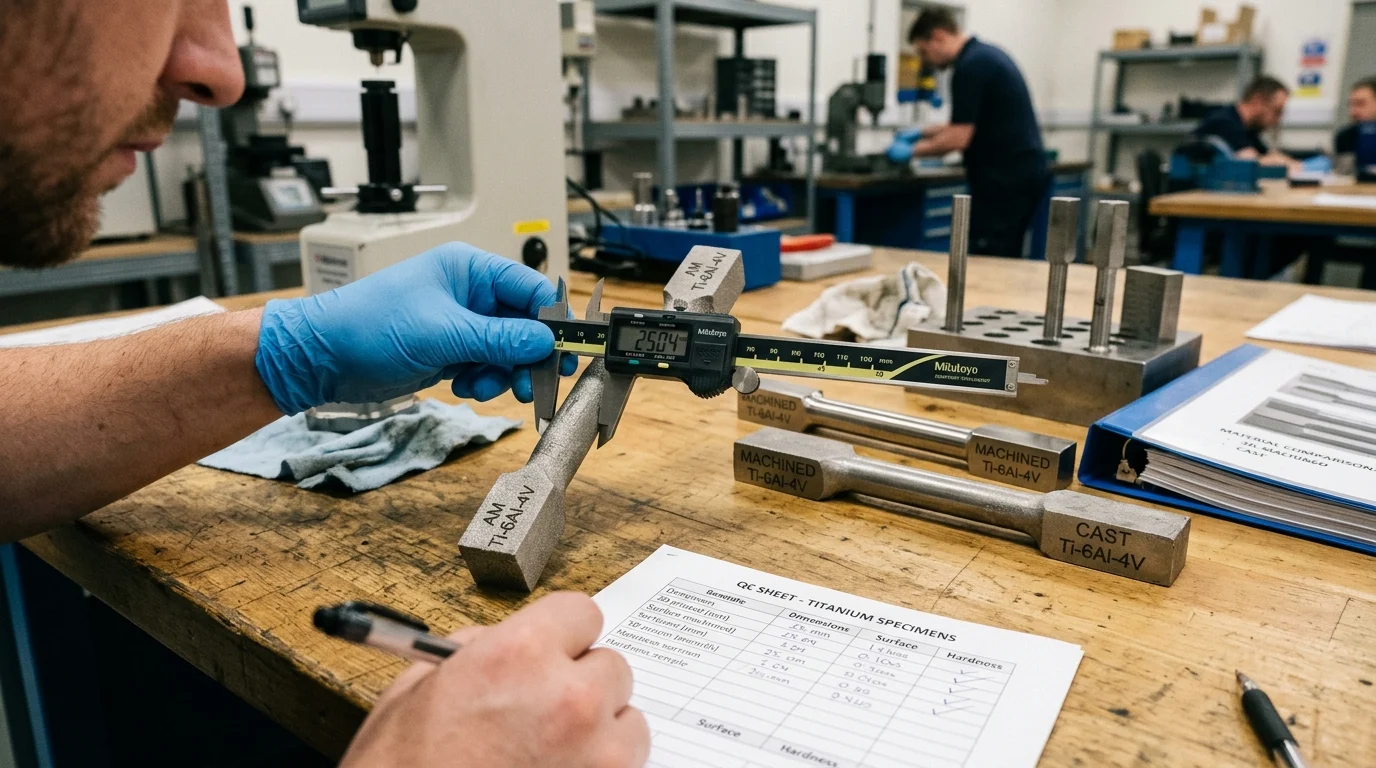
Engineers must evaluate 3D printed titanium not in isolation, but against established wrought and cast baselines. While wrought titanium represents the historical gold standard for fatigue resistance and ductility, AM titanium routinely outperforms cast equivalents and competes closely with machined billets.
Mechanical Property Comparisons
The microstructural differences between manufacturing methods directly dictate mechanical performance. Wrought titanium features a highly uniform, equiaxed grain structure, whereas AM titanium exhibits columnar grains that grow epitaxially aligned with the build direction. Despite these microstructural variations, post-processed AM titanium matches or exceeds the tensile properties of conventional equivalents.
| Manufacturing Method | Ultimate Tensile Strength (MPa) | Yield Strength (MPa) | Elongation (%) |
|---|---|---|---|
| Investment Cast (Ti-6Al-4V) | 860 | 760 | 8 – 10 |
| Wrought / Machined Billet | 930 – 1000 | 860 – 910 | 10 – 15 |
| LPBF (As-Built) | 1100 – 1250 | 1000 – 1100 | 6 – 8 |
| LPBF (Stress Relieved & HIP) | 930 – 1050 | 860 – 950 | 12 – 16 |
As the data indicates, fully post-processed AM titanium mirrors wrought properties closely, while offering superior tensile strength and ductility compared to traditional investment casting.
Effects of Orientation, Porosity, Surface Finish, and Heat Treatment
The layer-by-layer nature of additive manufacturing introduces mechanical anisotropy, meaning the strength of the titanium varies depending on the Z-axis build orientation versus the X/Y plane. To mitigate this directionality and address internal micro-porosity, Hot Isostatic Pressing (HIP) is a mandatory post-process for highly stressed components. By subjecting the printed part to argon gas at 920°C and 100 MPa for two to three hours, internal voids are collapsed, reducing structural porosity to less than 0.1% and transforming the brittle alpha-prime martensite into a ductile alpha-beta mixture. Furthermore, surface finish plays a critical role in dynamic strength. As-built AM titanium surfaces exhibit high roughness (typically Ra 10–15 µm), which acts as a massive stress concentrator and drastically reduces fatigue life. Machining, isotropic superfinishing, or chemical milling must be employed to achieve an Ra below 0.8 µm for cyclically loaded applications.
When It Is Strong Enough for Production
Transitioning from prototyping to end-use production requires proving that 3D printed titanium can sustain operational loads over its intended lifecycle. The threshold for defining a component as strong enough depends entirely on rigorous qualification frameworks and the economic viability of the application.
Qualification and Testing Steps
Highly regulated sectors rely on standardized frameworks, such as ASTM F2924 for powder bed fusion of Ti-6Al-4V, to guarantee lot-to-lot structural consistency. Qualification protocols demand extensive destructive testing alongside advanced non-destructive testing (NDT) methodologies. High-resolution industrial computed tomography (CT) scanning is universally utilized to inspect for subsurface anomalies, detecting lack-of-fusion defects or trapped gas pores down to 50 micrometers in diameter. For dynamic applications, such as aerospace turbine blades or load-bearing orthopedic implants, high-cycle fatigue (HCF) testing is conducted up to 10^7 cycles. This ensures the material can endure prolonged cyclic loading without initiating crack propagation. Only when the statistical lower bounds of these rigorous material tests comfortably exceed the engineering design allowables is an AM titanium part certified for critical flight or surgical implementation.
Choosing Between 3D Printed and Conventional Titanium
The decision to specify 3D printed titanium over machined billet hinges heavily on the buy-to-fly ratio and the necessity of geometric complexity. Traditional CNC machining of aerospace bulkheads can result in a buy-to-fly ratio of 15:1, meaning 93% of the premium titanium block is milled away as scrap. Advanced AM processes can reduce this ratio to 1.5:1. For low-volume production runs (e.g., MOQs of 1 to 500 units) that incorporate internal conformal cooling channels or topology-optimized lattice structures impossible to machine, 3D printed titanium is the only viable structural option.
Key Takeaways
- LPBF 3D printed Ti-6Al-4V can exceed 1,100 MPa ultimate tensile strength and 1,000 MPa yield strength in the as-built condition.
- As-built printed titanium is very strong but often has lower ductility, commonly around 6% to 8% elongation before heat treatment.
- Use stress relief or annealing after LPBF printing to reduce residual stress and improve toughness, ductility, and dimensional stability.
- Choose powder specifications carefully, with typical LPBF particle sizes of 15–45 micrometers and EBM powders around 45–105 micrometers.
- Keep oxygen content below about 0.20% during printing to avoid embrittlement and protect fatigue performance.
- For critical aerospace or medical applications, compare tensile strength, yield strength, elongation, porosity, fatigue data, and certification before selecting printed titanium.
Frequently Asked Questions
Is 3D printed titanium as strong as machined titanium?
Yes, especially after proper heat treatment and finishing. LPBF Ti-6Al-4V can reach ultimate tensile strengths above 1,100 MPa, often exceeding wrought or machined titanium in tensile strength, though machined billet may still offer better ductility and fatigue performance.
Why is 3D printed titanium so strong?
Rapid cooling during laser powder bed fusion creates a fine alpha-prime martensitic microstructure, which raises tensile and yield strength. The process can cool at rates up to 10^6 K/s, producing very strong but initially less ductile titanium parts.
What is the typical strength of 3D printed Ti-6Al-4V?
As-built LPBF Ti-6Al-4V commonly exceeds 1,100 MPa ultimate tensile strength and 1,000 MPa yield strength. These values are higher than many cast titanium parts and meet or exceed many aerospace and medical performance expectations.
Does 3D printed titanium need heat treatment?
Usually, yes. LPBF titanium often has high residual stress and limited ductility, so stress relief or annealing is used to improve toughness, dimensional stability, and elongation while maintaining high strength.
Is 3D printed titanium good for medical implants?
Yes, when produced under validated controls. Ti-6Al-4V printed by LPBF can surpass ASTM F136 minimum strength requirements, and additive manufacturing also enables porous implant structures that support bone integration.