

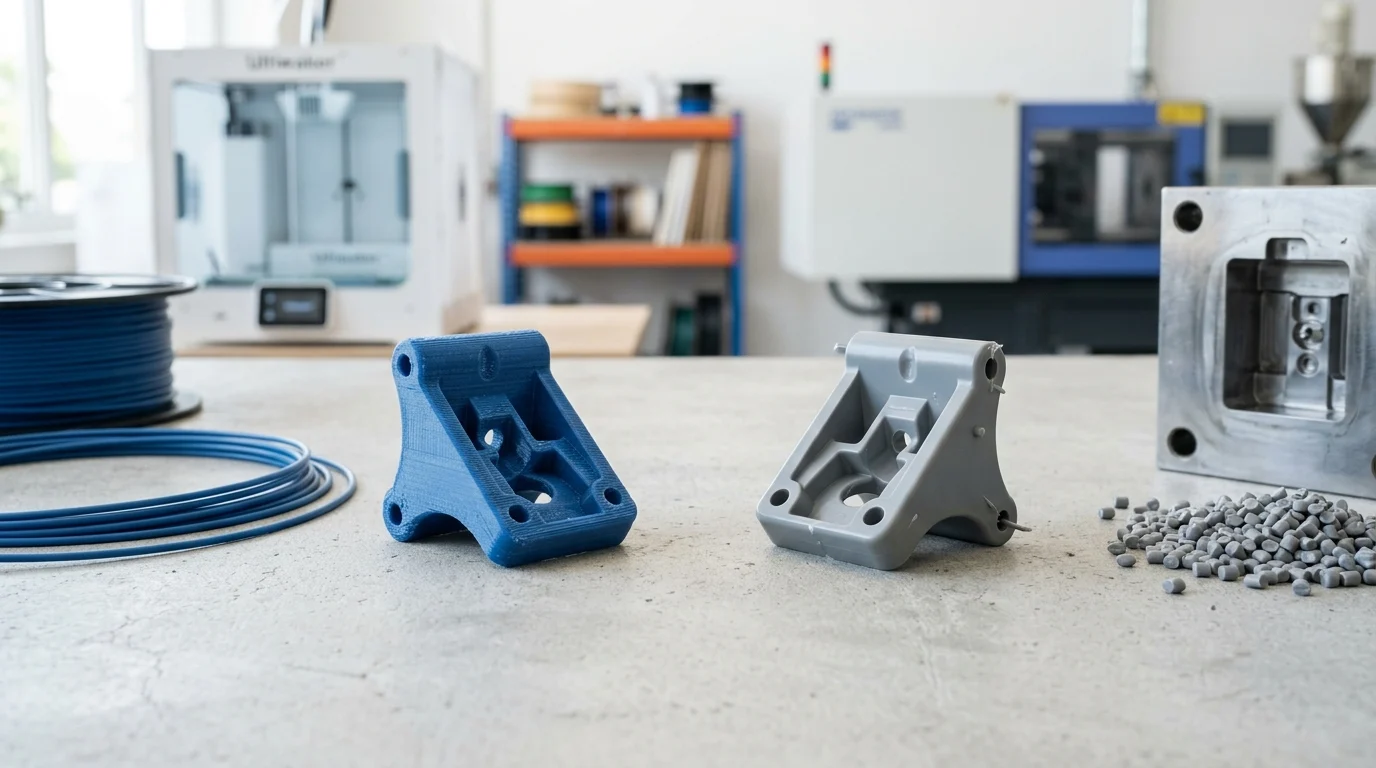
Choosing between additive manufacturing and molded production is no longer a simple question of prototype versus mass production. Tooling costs, material prices, machine time, inventory risk, and design-change frequency can all shift the breakeven point. A part that looks expensive to 3D print at first may be cheaper once mold costs, minimum order quantities, warehousing, and revision cycles are included. Conversely, injection molding can deliver a much lower unit cost when volumes are high and the design is stable. This guide compares the major cost drivers behind both methods so engineering, sourcing, and product teams can make a more data-aware manufacturing decision.
How to Compare 3D Printing Costs
Accurately comparing the costs of 3D printing and traditional injection molding requires a clear analytical framework. Historically, injection molding has been the standard for mass-producing polymer components. However, driven by supply chain shifts and digital inventory models, teams must now analyze the total cost of ownership across a product’s lifecycle to find the breakeven point between these two manufacturing methods.
Define the Cost Comparison Scope
A comprehensive cost comparison must incorporate capital expenditures (CAPEX), such as machine depreciation and tooling, alongside operational expenditures (OPEX), which include raw materials, energy, maintenance, and labor. For instance, injection molding requires an upfront investment in molds. While illustrative costs vary widely by region and vendor, tooling typically ranges from $5,000 for simple aluminum molds to over $100,000 for multi-cavity steel production molds.
The scope must also account for inventory carrying costs. While some molders offer low-volume runs of 100 to 1,000 units using softer tooling, traditional high-volume injection molding often requires minimum order quantities (MOQs) of 10,000 units or more to justify setup costs, leading to warehousing expenses. In contrast, 3D printing enables just-in-time manufacturing, reducing or eliminating these storage fees.
Set Baseline Assumptions
To generate a valid comparison, establish baseline assumptions for part geometry, materials, and logistics. A standard baseline might assume a 50-cubic-centimeter part (weighing roughly 50 grams) made from standard thermoplastics like ABS or PA12 (Nylon). Variables such as required dimensional tolerances, surface finish, and anticipated defect rates (typically 1–2% for mature molding) must be standardized. Keep in mind that strict quality or certification requirements—such as tolerances tighter than ±0.1 mm—can quickly shift the economic advantage back to injection molding.
By fixing these variables, teams can isolate the true cost differences driven by the manufacturing methods. Additionally, account for the product’s expected lifecycle. If a component will undergo three design revisions over two years, the model must include the cost of modifying a mold three times, compared to the zero-cost digital file updates of 3D printing.
Key Cost Drivers in 3D Printing
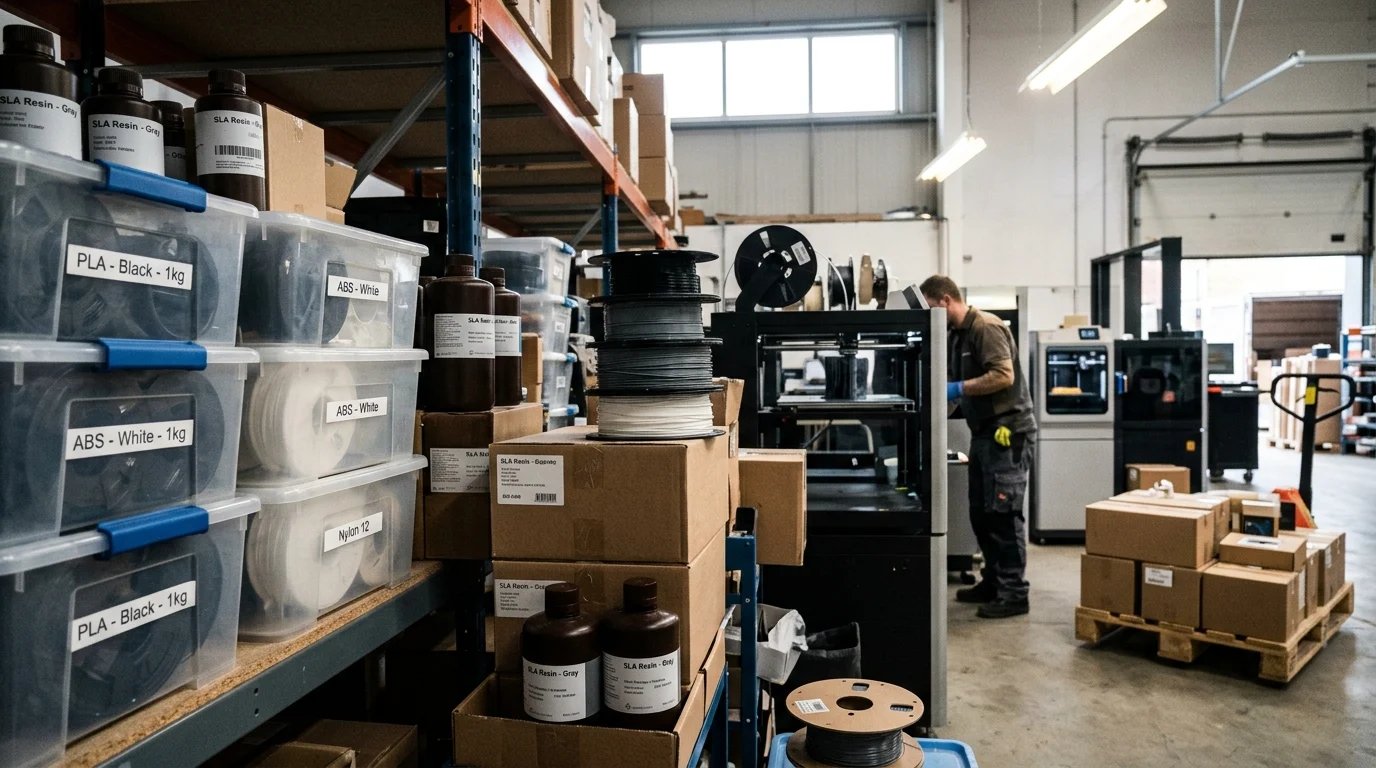
The economic profile of 3D printing diverges sharply from traditional manufacturing. Additive manufacturing expenses are heavily distributed across direct operational inputs, resulting in a more linear cost curve compared to molding’s heavy upfront capital requirements.
Tooling, Materials, Labor, and Machine Time
Additive manufacturing economics are dictated primarily by machine time, raw materials, and post-processing labor. Industrial 3D printing materials command a premium; as an illustrative range, Selective Laser Sintering (SLS) PA12 powder often costs between $40 and $80 per kilogram, whereas equivalent injection molding nylon pellets cost roughly $3 to $5 per kilogram (prices vary by vendor and volume).
Machine time is another critical driver, as the depreciation of industrial additive systems must be amortized over the build cycle. Fortunately, per-unit costs can drop significantly by batching or nesting multiple parts in a single build. Labor costs in 3D printing can be high due to manual support removal and surface finishing, sometimes accounting for 20% to 30% of the total unit cost, though this shrinks as post-processing automation improves. Energy consumption is also a factor, as maintaining thermal equilibrium in high-temperature build chambers requires steady power.
Cost Comparison for Prototypes and Production
When transitioning from prototyping to low-volume production, cost dynamics shift. For prototypes and iterations under 100 units, the absence of tooling generally makes 3D printing more cost-effective. However, as production scales, the high throughput and low marginal material costs of injection molding quickly overtake additive methods.
The table below illustrates the fundamental cost differences between standard industrial 3D printing and traditional injection molding.
| Cost Factor | 3D Printing (SLS/FDM) | Injection Molding |
|---|---|---|
| Upfront Tooling | $0 | $5,000 – $100,000+ |
| Material Cost (per kg) | $40 – $80+ | $3 – $5 |
| Setup Time | 1 – 2 hours | 2 – 4 weeks (Tooling) |
| Marginal Unit Cost | High (Linear) | Low (Decreases at scale) |
| Breakeven Volume (3DP vs. IM) | 1,000 – 10,000 units | N/A |
When 3D Printing Is More Cost-Effective
Determining the optimal manufacturing process requires identifying the specific production thresholds where the higher per-unit costs of additive manufacturing are offset by its lack of tooling, flexibility, and capacity for customization.
Compare Costs by Production Volume
The decision between these two methods frequently hinges on the production volume breakeven point. Because 3D printing incurs a relatively flat cost per part and injection molding features a steep initial cost that drops as volume increases, the two cost curves inevitably intersect. For standard polymer components, this breakeven threshold typically falls between 1,000 and 10,000 units.
Using our 50-gram baseline part, if a production run is projected at 2,500 units and the tooling cost for molding is $15,000, the amortized tool cost alone adds $6.00 to each molded part (plus material and processing). If the 3D printed equivalent costs $5.00 per unit total (e.g., $2.50 for materials and $2.50 for machine time), additive manufacturing remains the more cost-effective choice for that volume. Beyond strict unit economics, this analysis must incorporate risk. Committing to a $30,000 mold for a product that fails to capture market share results in unrecoverable sunk costs, making 3D printing an effective financial hedge for unproven products.
Evaluate Design Complexity and Lead Time
Beyond pure volume, geometric complexity and time-to-market play decisive roles in the cost-effectiveness equation. In injection molding, complex features such as undercuts, internal channels, or non-uniform wall thicknesses necessitate multi-part molds with side-actions or lifters, which can inflate tooling costs by 50% to 100%. 3D printing, by contrast, handles intricate geometries without any cost penalty, as the process builds parts layer by layer regardless of internal complexity.
Lead time is equally critical. Fabricating a production-grade injection mold typically takes two to four weeks, delaying market entry.
Key Takeaways
- Compare total cost of ownership, not just unit price, by including tooling, machine depreciation, materials, labor, energy, maintenance, logistics, and inventory carrying costs.
- Injection molding tooling can range from about $5,000 for simple aluminum molds to over $100,000 for multi-cavity steel molds, so volume assumptions strongly affect breakeven analysis.
- 3D printing is best suited for low-volume production, prototypes, and parts with likely design revisions because file updates avoid repeated mold modification costs.
- Injection molding becomes more attractive when production volumes are high enough to spread tooling costs across thousands of parts and take advantage of low-cost pellets.
- Material pricing can shift the economics significantly, with SLS PA12 powder often costing $40–$80 per kilogram versus roughly $3–$5 per kilogram for injection molding nylon pellets.
- Standardize geometry, material, tolerance, finish, defect rate, and lifecycle expectations before comparing 3D printing and injection molding costs.
Frequently Asked Questions
When is 3D printing more cost-effective than injection molding?
3D printing is usually more cost-effective for prototypes, low-volume runs, frequent design revisions, and just-in-time production because it avoids mold tooling and large inventory commitments.
When does injection molding become cheaper?
Injection molding often becomes cheaper at higher volumes because tooling costs are spread across thousands of parts, while per-unit material and cycle costs remain low.
How much can injection molding tooling cost?
Tooling can range from about $5,000 for simple aluminum molds to more than $100,000 for multi-cavity steel production molds, depending on complexity, cavity count, and durability.
Why are 3D printed parts often more expensive per unit?
Industrial 3D printing materials and machine time are costly. For example, SLS PA12 powder may cost $40–$80 per kilogram, compared with roughly $3–$5 per kilogram for molding-grade nylon pellets.
How do design changes affect the cost comparison?
Design changes favor 3D printing because digital files can be updated with little or no tooling cost, while injection molding may require expensive mold modifications or replacement.