

Choosing among commercially pure titanium Grades 1 through 4 is not just a specification exercise—it directly affects forming limits, wall thickness, corrosion performance, fabrication cost, and service reliability. These unalloyed grades share titanium’s signature protective oxide film, but small changes in interstitial elements, especially oxygen and iron, create major differences in strength and ductility. Grade 1 is highly formable, Grade 2 is the industrial workhorse, and Grade 4 offers the highest strength in the CP family. This guide compares the grades through practical engineering criteria, including corrosion behavior, yield strength, standards, and selection trade-offs, so buyers and designers can match the material to the application without overspending or under-specifying.
Why Compare Commercially Pure Titanium Grades 1-4
Commercially Pure (CP) titanium encompasses four distinct grades—Grades 1, 2, 3, and 4—that represent the unalloyed category of this advanced material. While they share a foundational titanium matrix, the subtle variations in their interstitial elements fundamentally alter their mechanical behavior and suitability for specific industrial applications.
Selecting the correct CP grade is a critical engineering decision. Misunderstanding the distinctions between these four grades can lead to catastrophic structural failures, premature corrosion, or unnecessary material expenditures in industries ranging from chemical processing to aerospace manufacturing.
Commercial stakes
The financial implications of material selection in unalloyed titanium are substantial. Although market volatility affects exact pricing, CP titanium typically ranges from $15 to $25 per kilogram depending on the grade, form, and market conditions. Grade 2 serves as the industrial workhorse, benefiting from economies of scale, while Grades 1, 3, and 4 often command premiums due to lower production volumes and specialized processing requirements.
Over-specifying a project by demanding Grade 4 when Grade 2 suffices results in direct capital waste and increased machining costs. Conversely, under-specifying by selecting Grade 1 for a high-pressure vessel will lead to wall-thickness bloat, negating the primary lightweight advantage of titanium and driving up total system weight and cost.
Core performance trade-offs
The core performance trade-off across CP titanium grades is the inverse relationship between yield strength and ductility. As the grade number increases from 1 to 4, the material becomes progressively stronger but less formable.
For example, Grade 1 offers a minimum yield strength of approximately 170 MPa, providing maximum ductility for severe forming operations. In contrast, Grade 4 delivers a minimum yield strength of 483 MPa, rivaling some alloyed metals, but at the cost of significantly reduced elongation. Engineers must balance these metrics against the specific fabrication methods and load-bearing requirements of the end product.
What Defines CP Titanium Grades 1-4
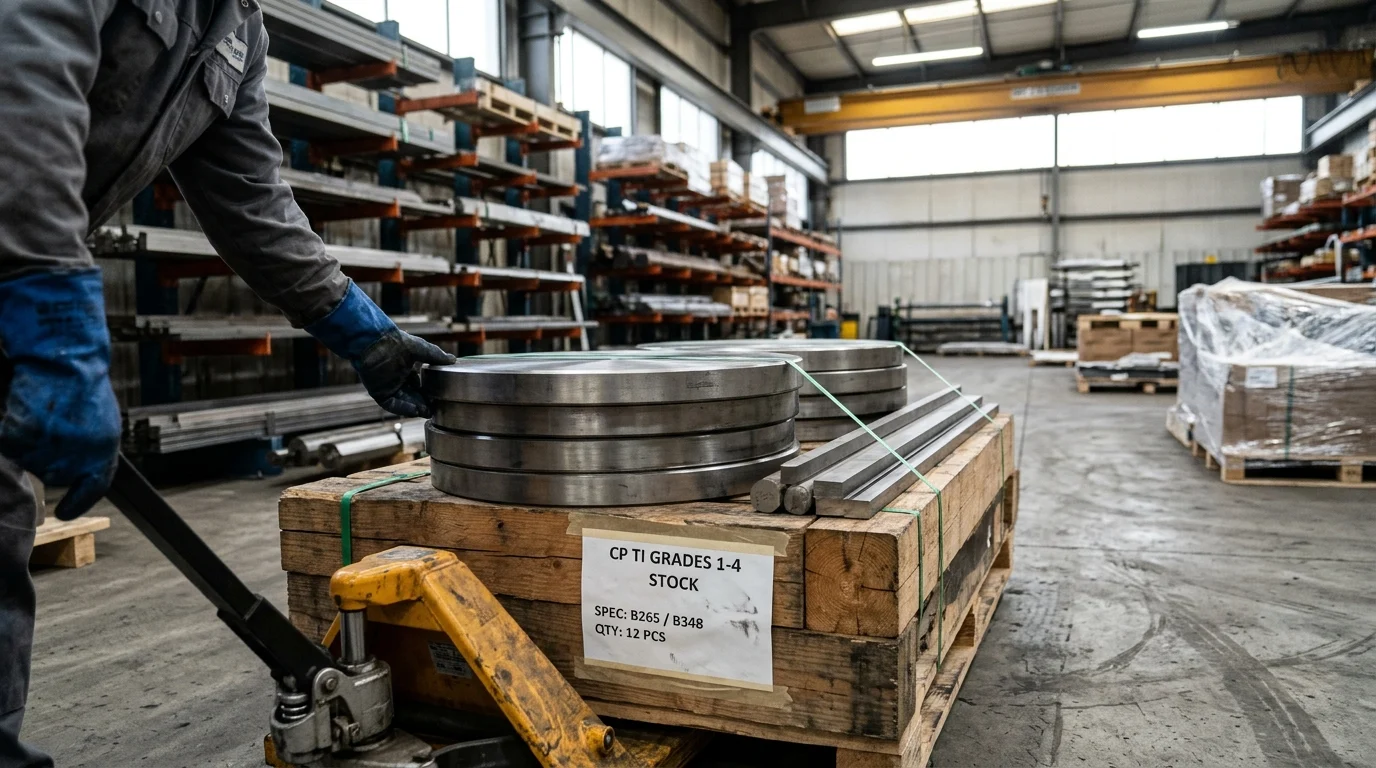
The classification of Commercially Pure titanium is governed by strict metallurgical standards, most notably ASTM B265 for strip, sheet, and plate, and ASTM B348 for billet and bar. Unalloyed titanium is not entirely free of other elements; rather, it relies on precisely controlled trace impurities to achieve targeted mechanical properties.
Chemistry and standards
The chemistry of CP titanium is defined by the absence of intentional alloying additions like aluminum or vanadium. Instead, the material’s properties are dictated by the presence of interstitial elements: oxygen, iron, carbon, nitrogen, and hydrogen.
Among these, oxygen and iron are the primary strengthening agents. Nitrogen and carbon are kept to strict maximums (typically 0.03% and 0.08%, respectively, across all four grades) to prevent embrittlement. Strict compliance with these chemical thresholds ensures predictable behavior during machining, welding, and service.
Key composition limits
Oxygen content is the single most critical variable defining the four CP grades. It acts as an interstitial solid solution strengthener. Grade 1 features the strictest oxygen limit at a maximum of 0.18%, ensuring high purity and softness. As the grades progress, the allowable oxygen content increases, reaching a maximum of 0.40% in Grade 4.
Iron content follows a similar upward trajectory, controlled to a maximum of 0.20% in Grade 1 and stepping up to 0.50% in Grade 4. The interplay between oxygen and iron limits dictates the final microstructural stability and the resulting mechanical limits of the titanium.
Grade progression from 1 to 4
The progression from Grade 1 to Grade 4 demonstrates a systematic increase in tensile strength and a corresponding decrease in elongation. The following table outlines the standard ASTM chemical limits and minimum mechanical properties that define this progression.
| Grade | Max Oxygen (%) | Max Iron (%) | Min Yield Strength (MPa) | Min Elongation (%) |
|---|---|---|---|---|
| Grade 1 | 0.18 | 0.20 | 170 | 24 |
| Grade 2 | 0.25 | 0.30 | 275 | 20 |
| Grade 3 | 0.35 | 0.30 | 380 | 18 |
| Grade 4 | 0.40 | 0.50 | 483 | 15 |
Corrosion Resistance Comparison
Commercially Pure titanium is highly regarded for its exceptional corrosion resistance, particularly in oxidizing, neutral, and mildly reducing environments. This resistance is not inherent to the bulk metal itself, but rather to the reactive nature of titanium surfaces when exposed to oxygen.
Passive film behavior
The corrosion immunity of CP titanium relies entirely on the spontaneous formation of a dense, highly adherent, and self-healing titanium dioxide (TiO2) passive film. When exposed to moisture or air, this oxide layer forms instantaneously, typically reaching a thickness of 1 to 2 nanometers.
This passive film remains thermodynamically stable across a broad pH range of 2 to 12. If mechanically damaged, the film will regenerate within milliseconds provided that trace amounts of oxygen or moisture are present in the service environment, making CP titanium exceptionally durable in dynamic fluid systems.
Environment-specific risks
Despite its robust passive film, CP titanium is not universally immune to corrosion. The material faces severe vulnerability in highly reducing acid environments, such as concentrated hydrochloric (HCl) or sulfuric (H2SO4) acids, where the passive oxide layer cannot regenerate without the addition of oxidizing inhibitors.
Furthermore, unalloyed titanium is susceptible to crevice corrosion in hot chloride solutions. When temperatures exceed 70°C (158°F) in tight crevices (such as under gasketed flanges in seawater applications), localized pH drops can initiate aggressive pitting. In such high-temperature chloride environments, engineers must often pivot from CP grades to palladium- or ruthenium-alloyed titanium (e.g., Grade 7 or Grade 11).
Corrosion ranking by grade
While Grades 1 through 4 are often treated as functionally equivalent in their corrosion resistance, minor distinctions exist. Generally, corrosion resistance slightly decreases as the concentration of interstitial impurities (iron and oxygen) increases.
Consequently, Grade 1 exhibits marginally superior resistance compared to Grade 4, particularly in borderline reducing conditions where higher iron content can act as localized cathodic sites, accelerating anodic dissolution. However, for the vast majority of industrial applications—including seawater cooling, chlor-alkali processing, and pulp bleaching—the corrosion performance of all four CP grades is considered practically identical.
Mechanical and Fabrication Differences
The varying concentrations of interstitial elements across Grades 1 through 4 directly dictate the mechanical limits and preferred fabrication methodologies for each grade. Understanding these fabrication constraints is essential for optimizing manufacturing workflows and minimizing defect rates.
Strength and ductility
The mechanical spectrum of CP titanium ranges from highly ductile to moderately high-strength. Grade 1 is the softest and most ductile, making it the premier choice for deep drawing, cold forming, and applications requiring severe deformation, such as the pressing of plate heat exchanger profiles.
Grade 4 sits at the opposite end of the unalloyed spectrum. Its high yield strength (minimum 483 MPa) makes it suitable for aerospace airframe components, surgical implants, and hydraulic tubing where high strength-to-weight ratios are required without the need for complex alloying.
Forming and machining behavior
Forming and machining behaviors shift dramatically across the grades. Grades 1 and 2 feature excellent cold formability. However, titanium exhibits a relatively low modulus of elasticity (approximately 105 GPa), which results in significant springback during cold forming that must be compensated for in tooling design.
As the grade increases, cold forming becomes more difficult. Grade 4 often necessitates hot forming to prevent cracking and manage springback. The table below illustrates the typical fabrication parameters across the unalloyed grades.
| Grade | Nominal Cold Bend Radius (Thickness) | Recommended Hot Forming Temp (°C) | Relative Machinability |
|---|---|---|---|
| Grade 1 | 2T | Not typically required | High |
| Grade 2 | 2.5T | 150 – 250 | Moderate |
| Grade 3 | 3T | 200 – 300 | Moderate-Low |
| Grade 4 | 5T | 250 – 400 | Low |
Welding considerations
All four CP titanium grades are readily weldable using Gas Tungsten Arc Welding (GTAW/TIG) or Plasma Arc Welding (PAW) processes. The critical requirement for welding titanium is absolute protection from atmospheric gases (oxygen, nitrogen, and hydrogen).
At temperatures above 427°C (800°F), titanium becomes highly reactive and will absorb atmospheric gases, leading to severe embrittlement. Therefore, trailing shields and inert gas backing (using ultra-pure argon or helium) are mandatory. Intermixing CP grades during welding is metallurgically acceptable; however, the resulting weld metal mechanical properties will generally reflect those of the higher-strength filler wire used.
How to Choose the Right CP Titanium Grade
Selecting the optimal Commercially Pure titanium grade requires a systematic evaluation of mechanical demands, environmental exposure, and supply chain realities. An optimal choice balances performance specifications with procurement logistics.
Service environment requirements
The first filter in the selection process is the physical demand of the service environment. For equipment requiring complex stamping or explosive cladding—such as chemical reactor linings or desalinization heat exchangers—Grade 1 is the definitive choice due to its superior ductility.
If the application involves pressure vessels, piping systems, or marine hardware where a balance of moderate strength, excellent corrosion resistance, and good weldability is required, Grade 2 is the universally accepted industry standard. Grade 3 and Grade 4 are reserved for applications where mechanical loading is the primary concern, such as in medical instrumentation or aerospace brackets.
Availability and cost factors
Supply chain dynamics heavily influence material selection. Grade 2 accounts for over 50% of all unalloyed titanium consumed globally. This dominance results in high market availability, extensive inventory at service centers, and lower Minimum Order Quantities (MOQs), which typically hover around 500 kg for custom mill runs.
Conversely, Grades 1, 3, and 4 are considered specialty or niche grades. Procurement of these materials often involves longer lead times—frequently extending to 10 to 14 weeks for mill production—and higher MOQs. Engineers must factor these availability constraints into project timelines, as specifying Grade 3 for a minor component may cause disproportionate procurement delays.
Final selection guidance
Final selection hinges on optimizing the strength-to-formability ratio while respecting budget constraints. When standard corrosion resistance is required, default to Grade 2 unless a specific mechanical limit forces a deviation.
If Grade 2 lacks the yield strength required to keep pressure vessel wall thicknesses within weight or cost targets, upgrading to Grade 3 or Grade 4 is justified. However, procurement teams must verify that the manufacturing facility possesses the tooling and expertise to manage the larger bend radii and potential hot-forming requirements associated with these higher-strength unalloyed grades.
Key Takeaways
- Select Grade 1 when severe forming or maximum ductility is required, because its minimum yield strength is about 170 MPa and it has the lowest oxygen limit.
- Use Grade 2 as the default industrial choice when you need a practical balance of corrosion resistance, weldability, availability, formability, and cost.
- Choose Grade 4 only when the design requires high unalloyed titanium strength, as its minimum yield strength is about 483 MPa but its ductility is significantly lower.
- Avoid over-specifying CP titanium because choosing Grade 4 when Grade 2 is sufficient can increase raw material cost and machining difficulty.
- Verify ASTM standards such as ASTM B265 for sheet and plate or ASTM B348 for bar and billet before ordering CP titanium material.
- Treat oxygen and iron content as critical specification points because these interstitial elements largely determine the strength and formability differences among Grades 1-4.
Frequently Asked Questions
What is the main difference between CP titanium Grades 1, 2, 3, and 4?
The main difference is controlled oxygen and iron content. As grade number increases, yield strength rises and ductility falls. Grade 1 is the softest and most formable, while Grade 4 is the strongest but least formable.
Which commercially pure titanium grade has the best formability?
Grade 1 has the best formability because it has the lowest oxygen content and the lowest strength. It is preferred for deep drawing, complex forming, and applications where maximum ductility matters more than load-bearing strength.
Is Grade 2 titanium the best general-purpose choice?
Yes, Grade 2 is often the best general-purpose CP titanium grade. It balances corrosion resistance, weldability, formability, availability, and cost, making it common in chemical processing, marine hardware, heat exchangers, and industrial equipment.
How much stronger is Grade 4 titanium than Grade 1?
Grade 4 has a minimum yield strength of about 483 MPa, compared with roughly 170 MPa for Grade 1. That makes Grade 4 nearly three times stronger in yield strength, but it is less ductile and harder to form.
Do all CP titanium grades resist corrosion well?
Yes, all CP titanium grades have excellent corrosion resistance because they form a stable protective oxide film. In many environments their corrosion performance is similar, so selection often depends more on strength, formability, fabrication method, and cost.