

Titanium has long been prized for its strength, corrosion resistance, and low density, but its cost and machining difficulty have limited broader adoption. Additive manufacturing changes that equation by turning titanium powder into near-net-shape components with less waste, faster iteration, and far greater design freedom. For engineers and procurement teams, the opportunity is not simply to print metal parts—it is to rethink weight, geometry, lead time, and lifecycle cost. This article examines where titanium 3D printing outperforms machining, how prototype priorities differ from production controls, and why material quality, process capability, and post-processing determine whether a printed part is truly ready for demanding applications.
Strategic Value of Custom 3D Printed Titanium Parts
Custom 3D printed titanium parts represent a major advancement in advanced manufacturing, combining high-performance material properties with unmatched geometric freedom. Titanium alloys, particularly Grade 5 (Ti-6Al-4V), deliver exceptional strength-to-weight ratios, yielding typical tensile strengths of 895 to 1,000 MPa alongside extreme corrosion resistance. Historically, the high cost of raw titanium and the extreme difficulty of machining it restricted its use to the most demanding aerospace and medical applications.
Additive manufacturing (AM) subverts these traditional fabrication constraints by building components layer-by-layer. By converting raw titanium powder into near-net-shape parts, this methodology fundamentally alters the economic equation of titanium procurement, reducing material waste and enabling performance-driven designs that were previously impossible to fabricate.
When Titanium Additive Manufacturing Outperforms Machining
The decision to transition from conventional subtractive machining to additive manufacturing hinges heavily on the buy-to-fly ratio. In traditional aerospace manufacturing, machining a complex titanium bracket can incur a buy-to-fly ratio of 15:1, meaning 15 kilograms of expensive titanium billet are purchased and machined away to yield a single 1-kilogram part.
Additive manufacturing slashes this ratio to approximately 1.5:1, drastically reducing the ecological footprint of production. However, it is critical to note that titanium powder typically costs significantly more per kilogram than wrought billet. This raw material premium partially offsets the buy-to-fly waste savings, making a comprehensive total-cost analysis essential. While 3D printing bypasses traditional machinability barriers—such as the rapid tool wear caused by titanium’s abrasiveness and low thermal conductivity—these material economics must be weighed carefully against conventional methods.
Prototype Priorities vs Production Requirements
Navigating the product lifecycle from prototype to mass production demands distinct manufacturing strategies. During the prototyping phase, the primary priority is rapid iteration. Titanium AM compresses initial print times from a conventional 8 to 12 weeks for forged or cast blanks down to just 1 to 3 weeks, allowing engineering teams to test physical, functional prototypes in real-world conditions. However, this 1-to-3-week window represents only the as-printed state; post-processing steps such as support removal, heat treatment, and CNC finishing add significant time to the total production lead time before a part is truly field-ready.
Transitioning from iterative prototypes to full-scale production introduces strict requirements for mechanical repeatability and statistical process control (SPC). Production-grade titanium AM requires locked-down parameters to ensure that critical dimensions achieve a Process Capability Index (Cpk) of 1.33 or greater. While prototypes can occasionally tolerate minor dimensional variations, mass production mandates rigorous powder lifecycle management and comprehensive traceability to guarantee that the ten-thousandth part performs exactly like the first.
Materials and Printing Processes
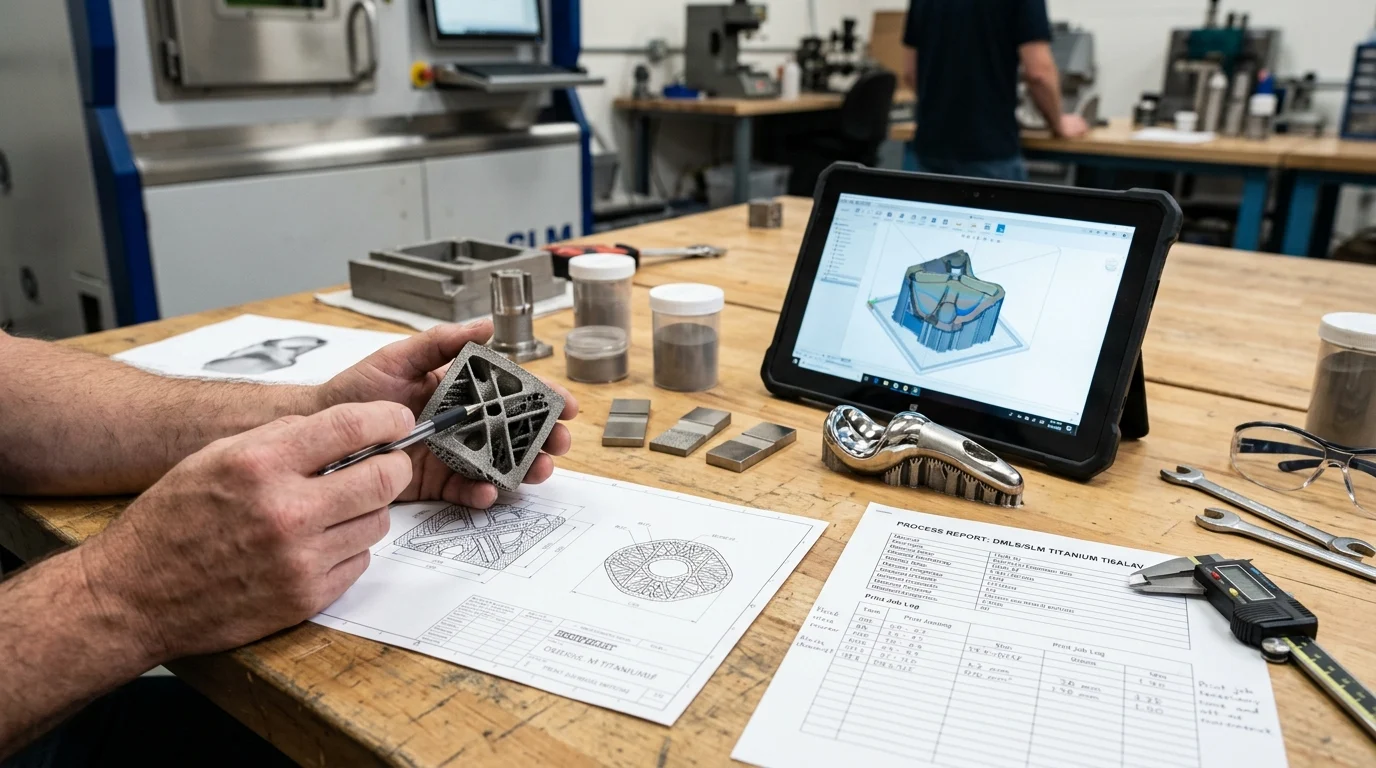
The foundation of any successful titanium AM project lies in the precise control of raw materials and the selection of the appropriate printing technology. Particle size distribution (PSD) and powder morphology are critical for ensuring consistent flowability and dense layer packing during the build process.
To optimize melt pool dynamics and prevent print defects, typical PSDs are tightly controlled. For instance, powder particles are generally sifted to between 15 and 45 µm for laser-based processes, while electron beam systems utilize a coarser distribution of 45 to 105 µm.
Titanium Alloys and Powder Specifications
Ti-6Al-4V remains the dominant titanium alloy in the additive sector, available in standard Grade 5 and high-purity Grade 23 (ELI – Extra Low Interstitial). Grade 23 restricts oxygen content to strictly below 0.13%, a critical threshold that significantly improves ductility and fracture toughness, making it the default choice for medical implants and dynamically loaded aerospace components.
Beyond the standard Ti-6Al-4V variants, specialized alloys are gaining traction for extreme environments. For high-temperature applications reaching up to 500°C, alloys like Ti-6242 (Titanium-6Aluminum-2Tin-4Zirconium-2Molybdenum) are increasingly specified. This material offers superior creep resistance and high-temperature stability compared to standard grades, though it requires highly tuned laser parameters to prevent micro-cracking during the rapid cooling phase of the print.
Laser Powder Bed Fusion vs Electron Beam Melting
The two primary technologies for printing custom titanium parts are Laser Powder Bed Fusion (LPBF) and Electron Beam Melting (EBM). LPBF utilizes high-power fiber lasers in an inert argon or nitrogen atmosphere. It produces excellent feature resolution and finer surface finishes but generates high residual stresses due to rapid thermal gradients. Consequently, parts typically undergo stress relief annealing. While this is often performed with parts still attached to the build plate to prevent distortion, some workflows allow parts to be removed via wire EDM or sawing prior to heat treatment, depending on the geometry and support strategy.
Conversely, EBM operates in a high vacuum environment at elevated bed temperatures (often exceeding 700°C). This hot process acts as an in-situ annealing treatment, resulting in virtually stress-free parts with slightly rougher surface finishes. EBM is highly favored for bulky, crack-prone geometries and orthopedic implants where porous surface structures are desired for bone in-growth.
| Process Characteristic | Laser Powder Bed Fusion (LPBF) | Electron Beam Melting (EBM) |
|---|---|---|
| Energy Source | High-power fiber lasers (e.g., 400W–1000W) | Electron beam (e.g., 3kW–6kW) |
| Build Environment | Inert gas (Argon) | High vacuum |
| Operating Temperature | Cold bed (approx. 100°C – 200°C) | Hot bed (approx. 700°C – 800°C) |
| Typical Layer Thickness | 30 to 60 µm | 50 to 100 µm |
| As-Printed Surface Finish (Ra) | 5 to 15 µm | 15 to 30 µm |
| Residual Stress | High (requires stress relief annealing) | Low (virtually stress-free as-built) |
Design, Quality, and Compliance
Unlocking the true economic and functional value of 3D printed titanium requires a fundamental departure from traditional subtractive design constraints. Design for Additive Manufacturing (DfAM) principles leverage advanced topology optimization and generative design algorithms to distribute material strictly along load paths.
When applied correctly to titanium components, DfAM routinely achieves mass reductions of 30% to 50% while maintaining or even exceeding the baseline stiffness and yield strength of legacy machined counterparts.
Design for Additive Manufacturing and Tolerances
While additive manufacturing offers immense geometric freedom—allowing for internal channels and complex lattices—designers must respect specific process tolerances, physical limits, and build-volume constraints to ensure printability. Standard as-printed dimensional tolerances for titanium LPBF typically range from ±0.1 mm to ±0.2 mm, or ±0.2% of the feature size, whichever is greater.
Overhangs represent a critical design constraint. Unanchored geometries generally require sacrificial support structures if the build angle drops below 45 degrees relative to the build plate. Additionally, minimum viable wall thicknesses usually hover between 0.3 mm and 0.4 mm, dictated by the laser spot size and the thermal dissipation characteristics of the surrounding powder bed.
Inspection, Testing, and Certification Requirements
Stringent inspection and testing protocols are mandatory for mission-critical titanium parts, as internal defects can catastrophically compromise fatigue life. Aerospace applications demand strict compliance with AS9100 and Nadcap certifications, while medical device manufacturing must adhere to ISO 13485 and FDA 21 CFR Part 820 quality systems.
Because traditional visual inspection cannot evaluate internal part density, non-destructive testing (NDT) is routinely employed. X-ray computed tomography (CT) scanning is the industry standard for high-end titanium AM, capable of detecting internal lack-of-fusion voids and gas porosity as small as 50 µm, ensuring compliance with rigorous structural integrity specifications.
Process Comparison for Engineering Decisions
Selecting between additive manufacturing and conventional methods requires a clear understanding of the trade-offs in precision, cost, and lead time. Additive manufacturing excels in geometric complexity and rapid deployment for low-to-medium volume runs, bypassing the tool wear issues inherent to cutting titanium. Conversely, 5-axis CNC machining remains superior for the high-volume production of simple geometries and achieving sub-micron surface finishes.
| Engineering Metric | 5-Axis CNC Machining (Titanium) | Additive Manufacturing (Titanium LPBF) |
|---|---|---|
| Geometric Complexity | Limited by tool access and fixturing | High (constrained by build volume and support needs) |
| Material Utilization | Low (70% – 95% waste) | High (<10% waste) |
| Minimum Wall Thickness | ~1.0 mm (prone to chatter and deflection) | 0.3 mm to 0.4 mm |
| Standard Dimensional Tolerance | ±0.01 mm to ±0.05 mm | ±0.1 mm to ±0.2 mm (as-printed) |
| Lead Time for Complex Geometries | 6 to 12 weeks | 1 to 3 weeks (as-printed) |
Workflow from Concept to Finished Part
The journey from a digital CAD concept to a fully functional titanium component involves a highly integrated digital thread and rigorous physical execution. Standardized file formats, such as 3MF or STEP, transfer native geometric data and structural metadata directly to the slicing software.
Within the slicer, algorithms generate precise laser toolpaths. For titanium alloys, laser hatch spacing is typically calibrated between 80 and 120 µm, ensuring optimal volumetric energy density to achieve complete material melting without inducing excessive vaporization.
Requirements Definition and Print Preparation
Before the physical print begins, manufacturing engineers must define the optimal build orientation. This pre-production step is crucial for minimizing the volume of sacrificial support structures, which are typically targeted to account for less than 20% of the total part volume as a conservative benchmark to control material costs and post-processing labor.
Build orientation also dictates the thermal gradient during printing. Because properties in the Z-axis (build direction) can differ slightly from the X and Y axes, orienting the part to align its primary load-bearing vectors with the strongest material axes is essential for maximizing mechanical isotropy.
Production Controls for Repeatability and Traceability
Titanium is highly reactive with oxygen, nitrogen, and hydrogen at elevated temperatures, making atmospheric control during the build paramount. Production controls dictate that oxygen levels in the build chamber must remain strictly below 1,000 ppm. Pushing levels below 100 ppm is a common target for highly critical components to prevent the formation of a brittle, oxygen-enriched “alpha case” layer on the part’s surface.
Modern titanium AM systems utilize advanced in-situ monitoring to guarantee traceability. Machine sensors capture melt pool emission data and thermal imaging at frequencies exceeding 10 kHz, documenting the integrity of every single layer. This data forms a comprehensive digital twin of the build, proving that the thermal history remained within validated process windows.
Post-Processing, Heat Treatment, and Machining
As-printed titanium components are rarely ready for immediate use and require an extensive sequence of post-processing. To mitigate the high residual stresses generated during LPBF, parts typically undergo stress relief annealing at approximately 800°C for 2 hours in an argon-purged furnace before they are separated from the build plate via wire EDM.
To eliminate internal microporosity and achieve greater than 99.9% theoretical density, Hot Isostatic Pressing (HIP) is frequently applied. This process subjects the titanium parts to 100 MPa of argon gas pressure at temperatures between 900°C and 920°C. Finally, critical mating surfaces, threads, and bearing interfaces are CNC machined to achieve the required surface roughness values (Ra) below 0.8 µm, blending the geometric freedom of AM with the precision of subtractive manufacturing.
Supplier Selection and Buying Decisions
Securing a reliable supply chain for custom 3D printed titaniumm parts](https://titanium-supplier.com/) requires evaluating manufacturing partners far beyond their hardware specifications. Buyers must assess a supplier’s machine park capacity, vertical integration for post-processing, and the robustness of their quality management systems.
Commercial viability often hinges on production flexibility. Procurement teams should seek out AM facilities capable of accommodating Minimum Order Quantities (MOQs) as low as 1 for custom, rapid-iteration prototypes, while possessing the parallel machine infrastructure required to scale to higher volumes. However, scaling to 10,000 or more units annually requires careful planning around machine throughput limits and post-processing bottlenecks, distinguishing AM high-volume production from conventional mass-production methods like stamping or casting.
Sourcing Criteria for Aerospace, Medical, and Industrial Parts
Sourcing criteria vary significantly by industry application but universally demand strict lot traceability. Suppliers producing FDA-regulated medical implants or flight-critical aerospace brackets must track the lineage of every part, from the specific powder batch certificate of analysis to the final heat-treatment cycle chart.
Buyers must also audit a supplier’s powder handling and recycling limits.
Key Takeaways
- Use titanium additive manufacturing when part complexity, weight reduction, or a high buy-to-fly ratio can offset the higher cost of titanium powder.
- Grade 5 Ti-6Al-4V is a leading choice for custom printed parts because it combines 895 to 1,000 MPa tensile strength with strong corrosion resistance.
- Plan prototype schedules around the full workflow, because a 1-to-3-week print window does not include support removal, heat treatment, machining, or inspection.
- Move from prototype to production only after locking build parameters, powder controls, and inspection methods to achieve repeatable dimensions and performance.
- Target a Cpk of 1.33 or higher for critical production dimensions when qualifying titanium additive manufacturing for mass production.
“Want to optimize your blueprint for lower production costs? Read our comprehensive [Titanium 3D Printing DFM & Cost Optimization Guide].“
Frequently Asked Questions
When is titanium 3D printing more cost-effective than machining?
It is often more cost-effective for complex, lightweight parts with high buy-to-fly ratios, such as aerospace brackets. Additive manufacturing can reduce material waste from about 15:1 to roughly 1.5:1, though titanium powder costs more than billet.
Which titanium alloy is commonly used for 3D printed parts?
Grade 5 titanium, also known as Ti-6Al-4V, is widely used because it offers high strength, low weight, and excellent corrosion resistance, with typical tensile strength around 895 to 1,000 MPa.
How long does it take to prototype a custom titanium 3D printed part?
Initial as-printed titanium prototypes can often be produced in 1 to 3 weeks, compared with 8 to 12 weeks for forged or cast blanks. Post-processing, inspection, heat treatment, and CNC finishing add time.
Can 3D printed titanium parts be used in mass production?
Yes, but production requires locked process parameters, powder traceability, repeatable post-processing, and statistical process control. Critical dimensions often target a Cpk of 1.33 or higher for consistent performance.
Why is powder quality important in titanium additive manufacturing?
Powder particle size distribution, shape, and flowability affect layer packing, melt pool stability, density, and defect risk. Poor powder control can lead to porosity, inconsistent dimensions, or reduced mechanical performance.