

Key Takeaways
Revolutionary 3D printed lattice structures are transforming titanium bike manufacturing by creating frames that are both lighter and stronger than traditional solid designs.
• Dramatic weight reduction: Lattice structures achieve titanium bike frames weighing just 1.2-1.4 kg with 50% average mass reduction while maintaining exceptional strength.
• Strategic material placement: Topology optimization places titanium only where structural support is needed, eliminating waste and maximizing strength-to-weight ratios.
• Advanced manufacturing precision: Laser Powder Bed Fusion technology creates complex lattice geometries with micrometer precision, achieving tensile strengths of 1035 MPa.
• Superior durability: Titanium’s virtually unlimited fatigue life combined with lattice design delivers frames that withstand millions of stress cycles without failure.
• Premium investment: While costly at $6,000-$12,000 for complete builds, these advanced frames offer professional-grade performance and lifetime durability.
The technology represents a paradigm shift from traditional solid titanium construction to intelligent, algorithm-driven designs that optimize every gram of material for maximum performance benefit.
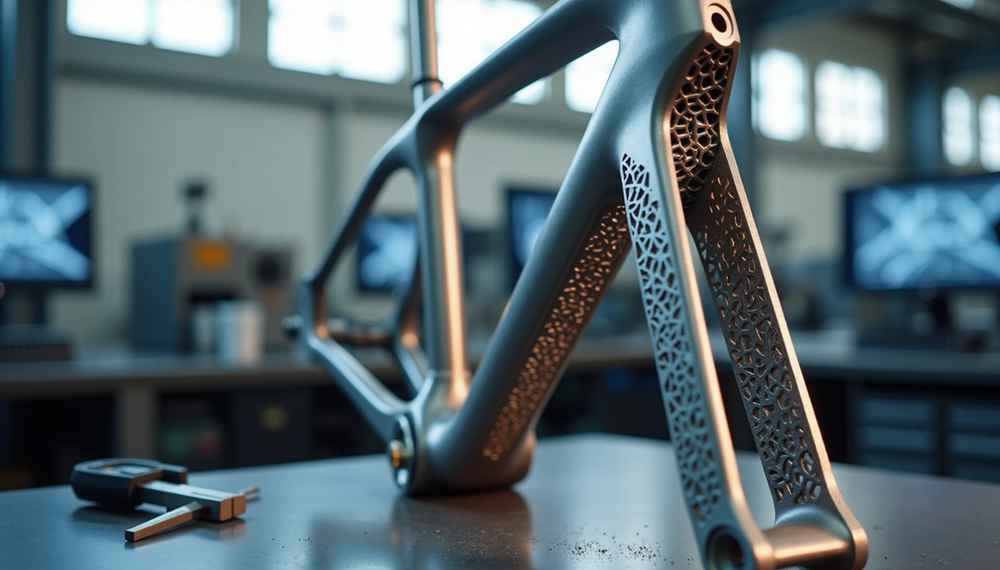
A 3D printed lattice structure revolutionizes titanium bike manufacturing by creating frames that weigh just 1.2 kilograms while maintaining exceptional strength. Titanium has long been valued for its corrosion resistance and fatigue strength, but traditional manufacturing methods have limited design possibilities. Lattice structures have high specific strength and stiffness and enable engineers to place material only where structural support is needed, so this reduces waste and maximizes efficiency.
3D printing lattice structures offers design freedom through topology optimization. Manufacturers can create complex geometries impossible with conventional methods. This piece explores how lattice structure 3D printing transforms titanium bike frames and looks at the manufacturing process, performance benefits and ground applications that make these advanced bicycles both lighter and stronger.
What Are 3D Printed Lattice Structures in Titanium Bikes
Defining Lattice Structure 3D Printing for Bicycle Frames
Lattice structures function as internal frameworks in additive manufacturing. They’re composed of interconnected beams, plates, or surfaces that replace dense solid interiors. These cellular materials consist of unit cells—the simple repeatable building blocks that determine how forces flow through the structure. The size, shape, and orientation of these unit cells influence stiffness and shock absorption. They also affect performance characteristics in bicycle frames.
Manufacturers design lattice geometries to cut weight while maintaining frame strength. Engineers place intricate internal patterns within tubes and joints instead of using solid titanium throughout the whole component. Advanced CAD software and generative design tools generate these structures, factoring in cell configuration and load directions. They also account for expected loads.
How Lattice Patterns Differ from Traditional Solid Titanium
Traditional solid titanium components possess dense interiors. This results in heavier parts that consume more material. Lattice designs replace this solid mass with networks of struts or plates. They form cellular structures that minimize mass without compromising rigidity. Performance changes with this fundamental shift.
Metal additive manufacturing achieves 95%-98% material use as leftover powder gets recycled. Lattices retain critical load paths with a fraction of the material and improve strength-to-weight ratios. Research demonstrates that adding a second lattice with X-shaped cross-sections through tubes and joints spreads compression loads better. This makes structures 50% stronger than cast magnesium alloys of the same density. Internal lattice structures distribute energy more efficiently and enhance shock absorption capabilities compared to solid prints.
Types of 3D Lattice Structures Used in Bike Manufacturing
Bicycle components employ several distinct lattice types. Each brings unique mechanical properties:
- TPMS (Triply Periodic Minimal Surface) lattices such as gyroid or Schwarz P excel in distributing loads uniformly in multiple directions. Gyroid structures feature wave patterns that divide space into two non-overlapping volumes and offer isotropic strength from all directions
- Beam or strut-based lattices include diamond patterns built from interconnected beams. These allow fine-tuning of localized stiffness while retaining structural integrity under directional forces
- Honeycomb structures provide lightweight solutions based on 2D repeating patterns with solid performance in specific orientations
- Stochastic lattices mimic the randomness of biological tissues and enhance energy dissipation
Bike manufacturers now integrate these lattice types inside joints and dropouts. They also use them in frame components to achieve optimal strength-to-weight ratios.
How Lattice Structures Reduce Weight While Increasing Strength
Topology Optimization in Titanium Frame Design
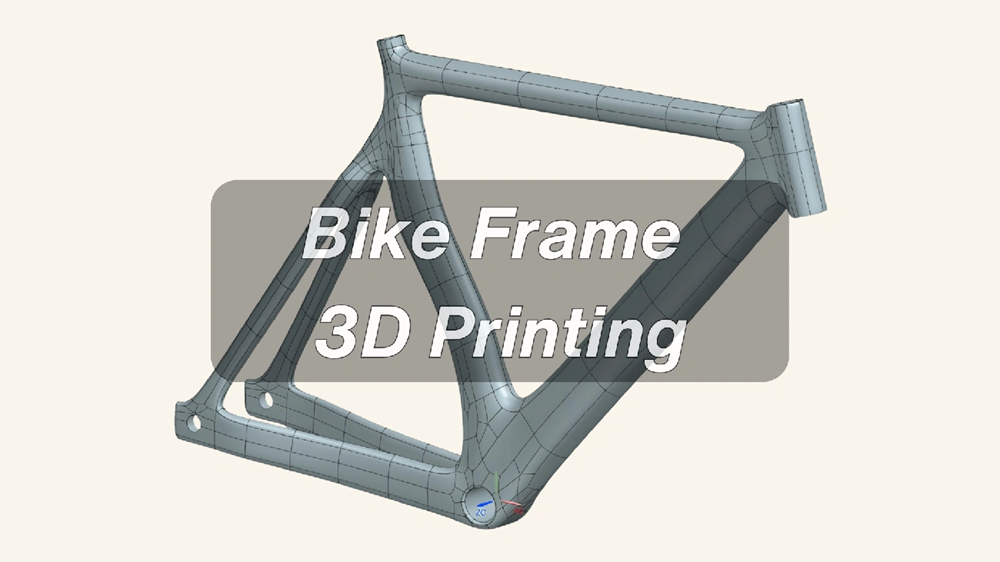
Topology optimization uses algorithmic models to determine optimal material placement within defined design spaces. Software tools like Inspire analyze loads and supports to generate layouts that achieve performance targets while minimizing mass. The process integrates finite element analysis. Each segment gets tested for rigidity and compliance before redundant material gets removed. Engineers mesh the design space with finite elements. Iterative calculations then determine which elements remain solid and which become void. This results in structures that concentrate material along primary load paths.
Material Distribution Patterns for Maximum Load-Bearing
3D printing lattice structures allows precise control over material placement through density variation. Manufacturers adjust lattice cell size, strut thickness and pattern locations to customize characteristics like stiffness and vibration response. Honeycomb and TPMS lattices positioned inside joints reduce weight without compromising rigidity. Varying lattice density in different frame sections allows engineers to create stiffer bottom brackets. Rear triangles maintain compliance for improved comfort. This targeted distribution places titanium only where structural demands need it.
Strength-to-Weight Ratio Improvements in 3D Printed Frames
Combining topology optimization with 3D printing achieves full-frame weights of just 1.4 kg. Performance tests reveal tensile strengths reaching 1035 MPa, yield strengths of 998 MPa and elongation at break of 13.5%. These mechanical properties exceed those of forged titanium parts made conventionally. Design for additive manufacturing techniques generate average mass reductions of 50% in components. Projects have achieved 81% mass reduction in head tubes through optimized lattice integration.
Real-Life Weight Reduction Examples from Bike Manufacturers
Renishaw’s seat post bracket project demonstrates practical weight savings. The component dropped from 360 grams to 200 grams, a 45% reduction. The redesigned component kept full strength while eliminating material from non-critical areas. Another bike stem project incorporated internal lattice structures that reduced material usage while providing support for external walls during printing. These examples confirm that lattice structure 3d printing delivers measurable performance gains in production applications.
Manufacturing Process: Creating Lattice Structure Titanium Bike Frames
Metal 3D Printing Technologies for Titanium Lattice Structures
Laser Powder Bed Fusion (LPBF), also called Selective Laser Melting, dominates titanium bicycle production. A 200W laser melts titanium powder layer by layer at around 1,700°C. The process occurs under an inert argon atmosphere to preserve titanium purity and ensure optimal strength. Layer thickness ranges from 30 to 60 microns. This makes complex lattice geometries with micrometer precision possible. Ti-6Al-4V Grade 23 serves as the standard alloy and delivers yield strength around 784 MPa and tensile strength of 1137 MPa.
Design Software for Lattice Pattern Generation
Engineers use specialized software to generate 3D printing lattice structures within CAD models. CATIA Lattice Designer creates associative lattice patterns that update with design changes. NX Lattice Designer offers unit cell options that include convergent, implicit and imported designs. nTopology makes customized lattice population possible based on user-specific or simulation-driven data. These tools support TPMS structures like gyroids and provide direct links to finite element analysis for structural confirmation.
From CAD Model to Finished Bike Frame
QuantAM build preparation software imports custom geometries, determines optimal part orientation and generates support structures. The CAD geometry slices into over 2,500 layers. Multiple components print at once within single builds and reduce lead times by over 50%. Parts then undergo heat treatment under argon to relieve residual stress. CNC machining produces precision bearing features and threads. Surface finishing uses sandblasting or polishing to achieve desired esthetics.
Quality Control and Testing Methods
Manufacturers conduct test samples on every build to verify yield strength and elongation. Dimensional accuracy checks use coordinate measuring machines. Mid-range 3D scanners assess geometric conformity with STL models and achieve accuracy within 0.02 mm. Fatigue and impact testing confirm durability under load.
Practical Applications and Performance Benefits
Professional Racing Bikes with Lattice Frame Components
The J.Laverack Aston Martin .1R showcases titanium lugs with internal 3d printed lattice structures that boost stiffness and torsional stability. Complete bike weight starts from 7.5 kg. Each frame requires over 1,000 hours to create and includes more than 500 hours of CNC machining. Professional cyclists adopt 3d printing lattice techniques for custom time trial extensions and specialized components tailored to individual riding positions.
Custom Bike Parts Using 3D Printing Lattice Techniques
Bike stems with internal lattice structure 3d printing maintain strength while reducing material usage. Custom manufacturers like Métier Vélo and Bastion Cycles use 3d printed lattice structures in titanium lugs to control frame geometry with precision. These approaches eliminate welding and remove heat-affected zones that cause seam fatigue.
Durability and Fatigue Resistance in Real-Life Conditions
Titanium exhibits unlimited fatigue life and withstands millions of stress cycles without microfractures. The material is 45% lighter than steel while offering comparable strength. Natural corrosion resistance allows frames to maintain structural integrity without protective finishes.
Cost Considerations for Lattice Structure Bike Production
Frame-only prices range from USD 5,995 to USD 7,000. Complete builds reach USD 10,995 to USD 12,000. Standard titanium frames cost USD 2,000 to USD 5,000, with complete builds between USD 6,000 and USD 10,000.
Conclusion
3D printed lattice structures have changed titanium bicycle manufacturing and deliver frames that achieve remarkable strength-to-weight ratios through topology optimization and LPBF technology. Manufacturers place material only where structural loads require it. This results in frames weighing just 1.2 kilograms while maintaining durability. JHMIM Titanium houses three distinct production technologies under one roof and matches optimal manufacturing processes to each custom part for unmatched precision. Lattice structure 3D printing continues to redefine the limits in performance cycling, whether for professional racing applications or custom builds.
FAQs
Q1. What is the tensile strength of 3D printed titanium bike frames? 3D printed titanium bike frames using Ti-6Al-4V alloy typically achieve tensile strengths ranging from 950 to 1100 MPa, with yield strength between 850 and 1000 MPa. Some optimized frames have demonstrated even higher performance, with tensile strengths reaching 1035 MPa and yield strengths of 998 MPa, which are comparable to or exceed conventionally forged titanium components.
Q2. How much lighter are 3D printed lattice structure titanium frames compared to traditional frames? 3D printed lattice structure titanium frames can achieve weight reductions of approximately 50% on average compared to solid titanium components. Some manufacturers have produced complete frames weighing as little as 1.2 to 1.4 kilograms. Specific components like seat post brackets have shown 45% weight reduction, while head tubes have achieved up to 81% mass reduction through optimized lattice integration.
Q3. Are carbon fiber bike frames lighter than 3D printed titanium frames? Carbon fiber frames are generally lighter and stiffer than titanium frames at equivalent strength levels. However, 3D printed lattice structure titanium frames significantly narrow this gap by achieving complete bike weights starting from 7.5 kg while offering superior durability, virtually unlimited fatigue life, and natural corrosion resistance that carbon fiber cannot match.
Q4. How does generative design improve the strength of 3D printed bike components? Generative design uses topology optimization algorithms to determine optimal material placement within bike components. This process analyzes loads and supports to create layouts that concentrate material along primary load paths while removing redundant mass. The result is components that can be twice as strong and 20% lighter than traditionally manufactured parts, as material is placed only where structural demands require it.
Q5. What manufacturing technology is used to create lattice structure titanium bike frames? Laser Powder Bed Fusion (LPBF), also known as Selective Laser Melting, is the primary technology used for manufacturing lattice structure titanium bike frames. A 200W laser melts titanium powder layer by layer at approximately 1,700°C under an inert argon atmosphere, with layer thickness ranging from 30 to 60 microns to enable complex lattice geometries with micrometer precision.