

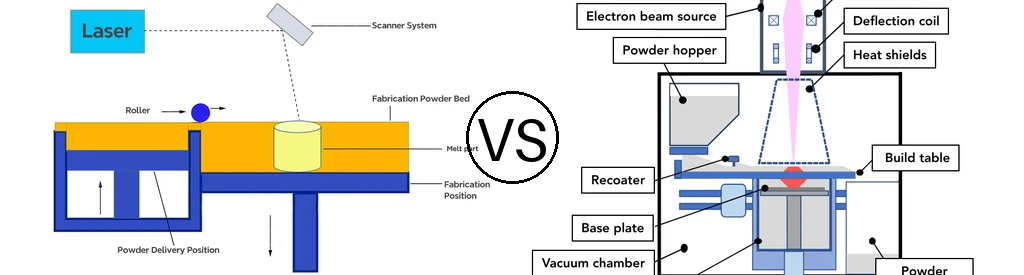
Selecting the appropriate metal additive manufacturing process directly dictates component performance, structural integrity, and unit economics. While technologies like Selective Laser Melting (SLM), Direct Metal Laser Sintering (DMLS), Electron Beam Melting (EBM), and Metal Binder Jetting (BJ) all build parts layer-by-layer, their thermal dynamics, metallurgical properties, and post-processing requirements differ substantially.
For high-performance alloys—particularly Titanium (Ti-6Al-4V Grade 5 and Grade 2)—understanding these trade-offs is essential for balancing mechanical strength against total production cost. This guide breaks down the core mechanisms, operational limits, and application profiles of each technology.
Understanding Powder Bed Fusion 3D Printing Technology
How Metal Powder Fusion Works
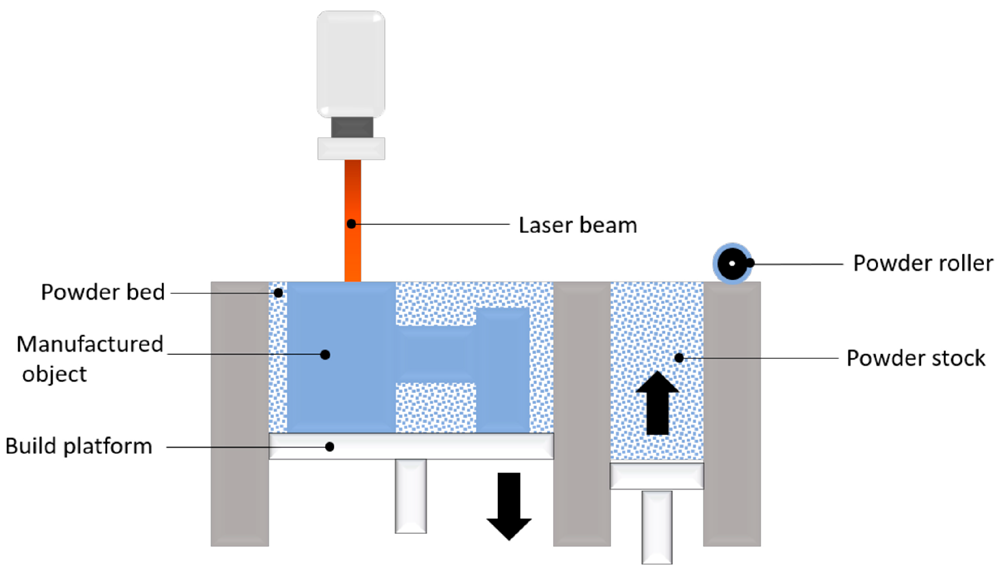
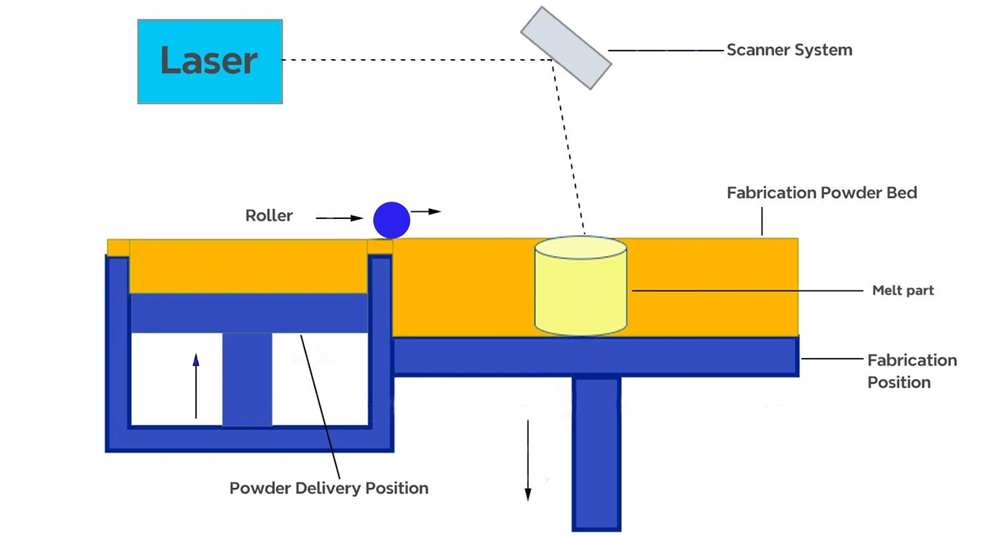
Powder Bed Fusion (PBF) serves as the primary category for high-density structural metal printing. The system distributes a thin layer of metallic powder across a build platform using a counter-rotating roller or recoating blade. A localized energy source—either a fiber laser or an electron beam—scans the cross-sectional geometry dictated by the CAD file, fully melting or sintering the powder particles together. Once a layer is completed, the build platform lowers by a set increment (typically 20 to 100 microns), and the process repeats until full height is reached.
Key Benefits of Powder-Based Methods
- Geometric Complexity: Enables internal cooling channels, topology-optimized structures, and consolidated multi-piece assemblies.
- Material Efficiency: Reduces the Buy-to-Fly ratio compared to conventional billet machining, leaving un-melted powder reusable after sieving.
- Mechanical Strength: Fully melted PBF components achieve near-wrought density (>99.5%), making them suitable for load-bearing structural parts.
Common Applications Across Industries
PBF methods dominate critical sectors including aerospace bracketry, turbomachinery components, custom medical implants, and specialized automotive brackets where weight reduction and material performance are paramount.
Selective Laser Melting (SLM): High-Precision Metal 3D Printing
SLM Process and Equipment Requirements
Selective Laser Melting utilizes one or multiple high-power Ytterbium fiber lasers operating inside a tightly sealed chamber. To prevent oxidation during the thermal cycle—especially critical when processing reactive metals like Titanium—the chamber is purged with inert Argon or Nitrogen gas to maintain oxygen levels below 100 ppm.
Materials Compatible with SLM Technology
SLM processes a broad spectrum of weldable alloys, including Titanium alloys (Ti-6Al-4V, Ti-6Al-4V ELI, Grade 2), Stainless Steels (316L, 17-4PH), Inconel superalloys (718, 625), and Aluminum alloys (AlSi10Mg).
Advantages: Geometric Freedom and Part Density
SLM achieves mechanical densities exceeding 99.8%. The focused laser spot size (typically 70–100 µm) provides high feature resolution, sharp corner radii, and fine surface finishes (Ra 6–10 µm), reducing the necessity for extensive finish machining on non-critical surfaces.
Limitations: Cost and Post-Processing Needs
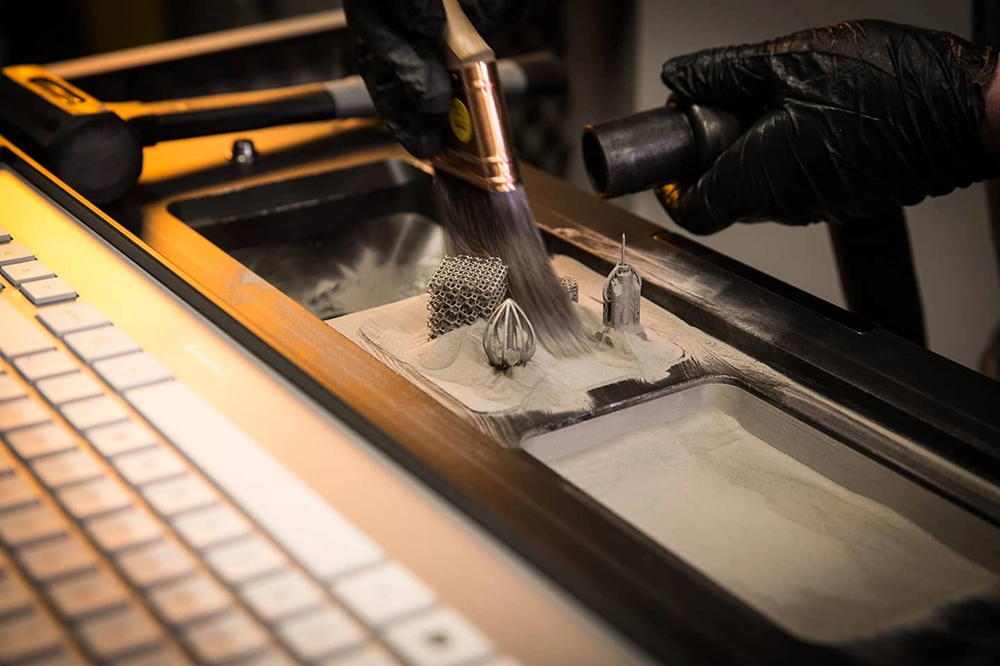
Rapid thermal gradients inherent to laser melting generate high residual stress within the build. Consequently, parts require robust anchor supports to prevent thermal warping. Post-processing typically involves stress-relief heat treatment in a vacuum furnace prior to wire EDM support removal.
Typical SLM Build Volumes and Layer Resolution
Standard industrial SLM systems offer build envelopes ranging from 250 x 250 x 300 mm up to multi-laser platforms exceeding 600 x 600 x 800 mm. Layer thickness is commonly tuned between 20 µm and 60 µm depending on the required balance between resolution and build rate.
Electron Beam Melting (EBM): Faster Builds with Different Trade-offs
How EBM Differs from Laser-Based Methods
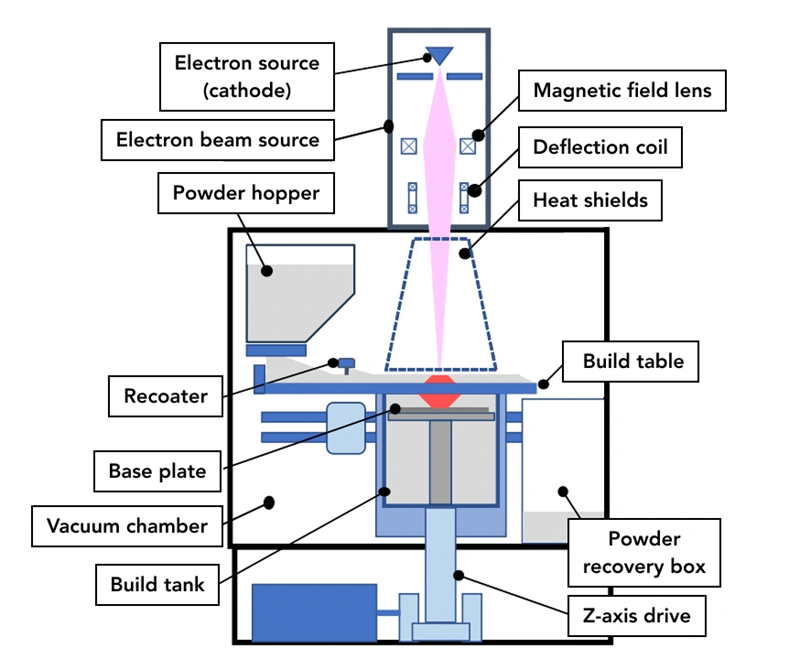
Electron Beam Melting replaces optical lasers with a high-energy electron beam focused by electromagnetic coils. Unlike SLM, EBM operates under a high vacuum environment, eliminating atmospheric contamination and gas entrapment entirely.
EBM Build Speed and Temperature Control
Before melting each layer, the electron beam rapidly scans the powder bed at high velocity to preheat the powder to elevated temperatures (600°C to 1000°C). Maintaining a high bed temperature throughout the build dramatically mitigates residual stresses, yielding parts that require minimal support structures and no post-build stress-relief annealing.
Material Selection: Conductive Metals Only
Because EBM relies on electrostatic charges, processed materials must be electrically conductive. EBM is overwhelmingly utilized for Titanium alloys (Ti-6Al-4V and Titanium Aluminide) and Cobalt-Chrome alloys, making it an industry benchmark for orthopedic joint implants and aerospace turbine blades.
Surface Finish and Resolution Considerations
EBM uses coarser metal powder (45–105 µm) and thicker layer heights (50–100 µm) than SLM. As a result, EBM components exhibit a rougher surface finish (Ra 20–30 µm) that resembles a fine sand casting, generally requiring CNC machining or electropolishing on mating faces.
Direct Metal Laser Sintering (DMLS): Industry Standard for Complex Parts
DMLS vs SLM: Key Differences, Similarities, and Terminology
In modern industrial terminology, DMLS and SLM describe virtually identical physical processes: laser powder bed fusion (PBF-LB). Historically, DMLS was trademarked by EOS and initially referenced liquid-phase sintering of alloy mixtures. Today, commercial DMLS systems achieve full melting of pre-alloyed powders, matching SLM in final mechanical properties and density.
DMLS Printing Workflow and Layer Formation
The workflow closely mirrors SLM: CAD slicing, inert gas chamber flooding, precision laser scanning, layer recoating, and post-build cooling down within the powder bed environment.
Supported Materials and Mechanical Properties
DMLS offers an extensive material portfolio, including Ti-6Al-4V, Cobalt-Chrome, Nickel Alloys, Tool Steels, and Aluminum. Tensile and yield strengths of fully heat-treated DMLS parts typically meet or exceed standard wrought material specifications (ASTM F1472 for Titanium Grade 5).
Post-Processing Requirements for DMLS Parts
Standard post-processing workflows include stress relief heat treatment, Hot Isostatic Pressing (HIP) to close internal micro-porosity, support structure cutoff, and final CNC machining of tight-tolerance interfaces.
Metal Binder Jetting: Scalable Production Without Laser Melting
Binder Jetting Process: Printing and Sintering
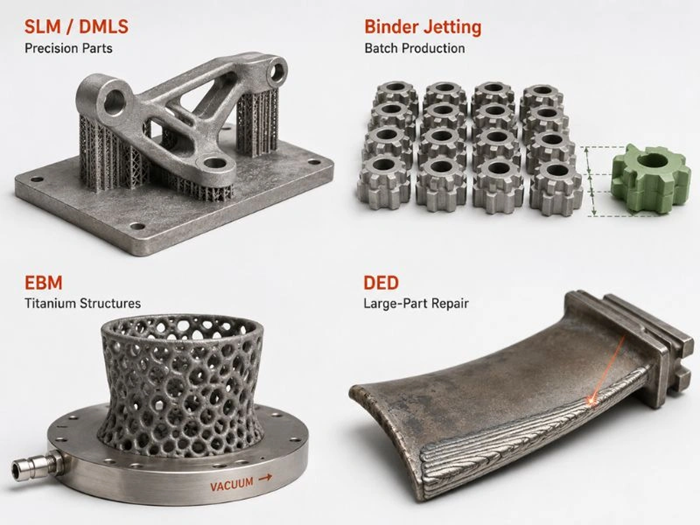
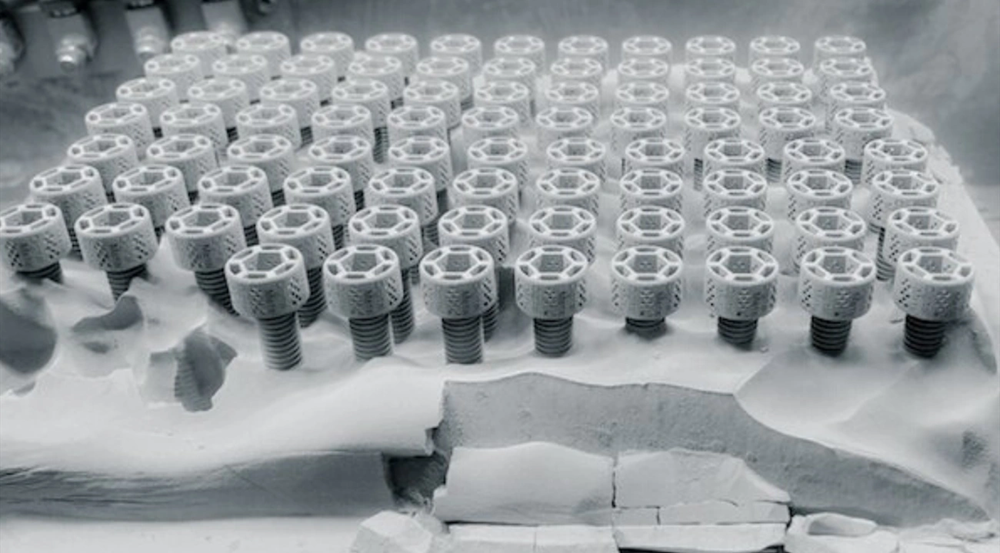
Metal Binder Jetting (BJ) separates the shaping stage from the thermal consolidation stage. A liquid binding agent is selectively deposited onto a powder bed via an inkjet print head to bind metal particles room-temperature. Once completed, the unbound “green part” is removed from the powder and cured, then transferred to a high-temperature furnace for binder burnout and liquid-phase/solid-state sintering.
Speed Advantages for Batch Production
Because the inkjet head prints entire passes across the build plate rapidly without waiting for thermal melt pools to solidify, Binder Jetting boasts significantly higher throughput than PBF systems, making it highly viable for medium-to-high volume batch runs.
Material Options and Part Density After Sintering
Common materials include 316L, 17-4PH stainless steels, tool steels, and emerging Titanium powders. Sintered parts reach 95%–98% theoretical density. To achieve >99% density for structural applications, secondary Hot Isostatic Pressing (HIP) or bronze infiltration is required.
Design Considerations: No Support Structures Needed
Unlike SLM or DMLS, the surrounding un-printed powder bed fully supports the green part during printing. This eliminates the need for rigid metallic support structures, drastically reducing post-processing labor and geometric constraints on internal overhangs.
Cost Comparison for Large Volume Manufacturing
Binder Jetting uses lower-cost MIM-grade metal powders and eliminates optical laser equipment costs. While furnace sintering introduces linear shrinkage (typically 15–20% requiring CAD compensation), per-part production costs dropped substantially at scale compared to PBF.
Comparing Metal 3D Printing Technologies: Which Method to Choose
Metal 3D Printing Technologies Comparison Matrix
| Process | Energy Source | Part Density | Surface Finish (Ra) | Production Volume | Titanium Suitability |
|---|---|---|---|---|---|
| SLM / DMLS | Fiber Laser | >99.8% | 6 – 10 µm | Low – Medium (Prototypes & Custom) | Excellent (High Precision) |
| EBM | Electron Beam | >99.5% | 20 – 30 µm | Medium Batch | Exceptional (Low Residual Stress) |
| Binder Jetting | Inkjet + Furnace Sintering | 95% – 98% (Post-HIP >99%) | 4 – 8 µm | High Batch Production | Developing (Cost-Effective) |
Precision and Accuracy: SLM and DMLS Lead
When tight dimensional tolerances (±0.05 mm) and delicate features are required, SLM and DMLS offer superior control over thermal distortion for small to mid-sized components.
Build Speed: EBM and Binder Jetting for Larger Parts
EBM offers accelerated build rates for thick-walled structural Titanium sections due to multi-beam scanning capabilities. For high unit volumes where unit speed matters over immediate density, Binder Jetting provides the highest throughput.
Titanium 3D Printing: Selecting the Right Process for Ti-6Al-4V Parts
For custom aerospace components or medical implants where fatigue resistance and metallurgical purity are critical, SLM/DMLS and EBM remain the industry standards for Titanium Grade 5 and Grade 2 processing. EBM excels in medical porous structures and stress-free structural components, whereas SLM/DMLS provides refined surface control for complex flow paths.
Cost Analysis: Equipment and Per-Part Expenses
Capital expenditure (CAPEX) for PBF machinery remains high. However, for low-volume, high-value Titanium components, PBF eliminates tooling expenses entirely. Binder Jetting presents lower per-part costs at scale, though furnace tooling and shrink-compensation modeling must be amortized over higher quantities.
Application-Specific Technology Selection
- Choose SLM / DMLS for: Precise aerospace brackets, medical devices, internal fluid channels, and high-stress structural parts.
- Choose EBM for: Heavy-section Titanium implants, aerospace structural nodes, and elevated-temperature superalloys.
- Choose Binder Jetting for: Small-to-medium complex structural hardware required in thousands of units without stringent fatigue life demands.
Conclusion
Selecting among SLM, DMLS, EBM, and Binder Jetting requires balancing dimensional tolerance, part density, thermal stress management, and volume expectations. Understanding these fundamental trade-offs ensures optimal material selection and cost control for modern additive manufacturing.
For engineering consultation, Design for Additive Manufacturing (DFAM) analysis, or custom quotation on precision Titanium components, contact the technical team at Titanium-Supplier.com.