

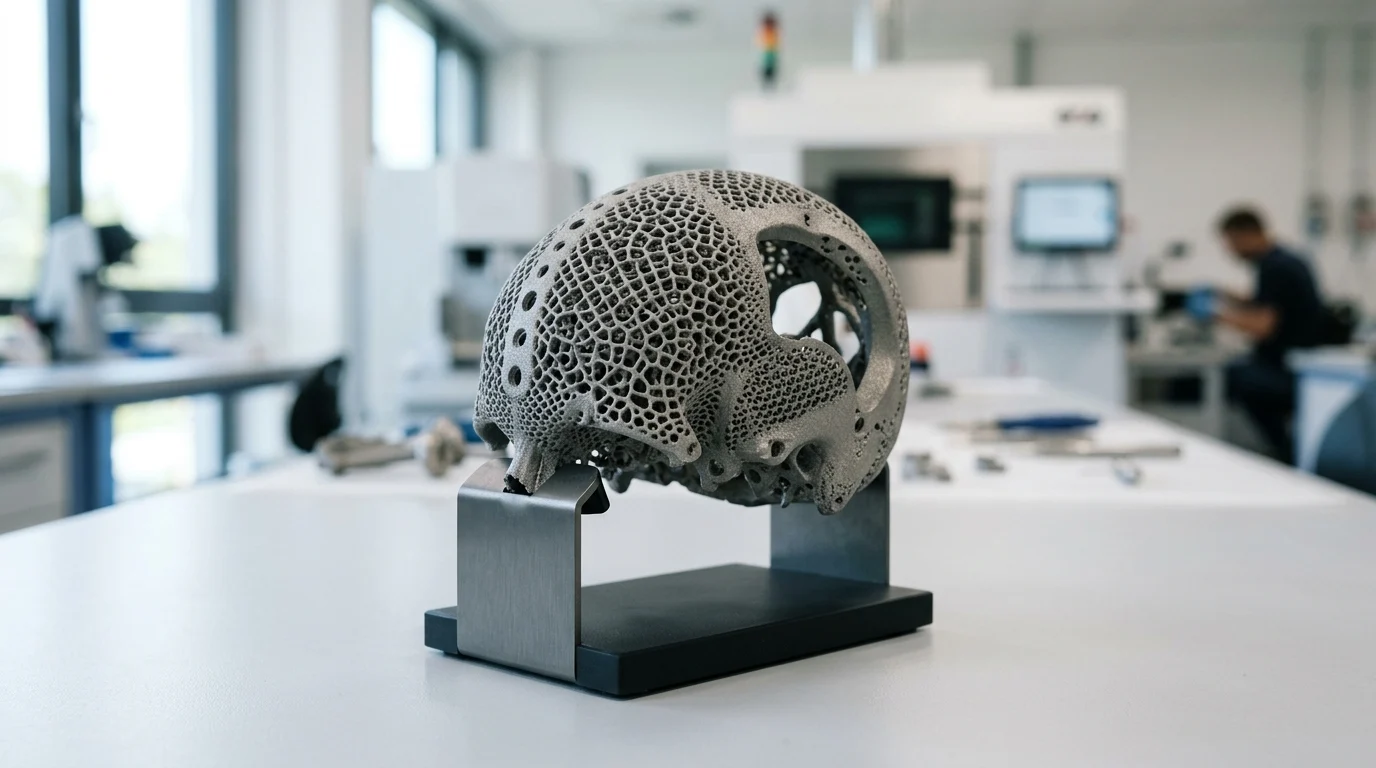
Titanium has been trusted in surgery for decades, but additive manufacturing is changing what clinicians can ask an implant to do. Instead of forcing anatomy to fit standardized hardware, engineers can now design patient-matched titanium structures with controlled porosity, bone-like stiffness, and complex fixation features that conventional machining cannot easily produce. This shift matters because implant geometry directly affects surgical planning, osseointegration, stress shielding, and long-term durability. The article explores how 3D printing is transforming orthopedic and craniomaxillofacial care, from digital workflows and Ti-6Al-4V ELI material selection to quality control, regulatory expectations, supply chain constraints, and the emerging technologies shaping the next generation of implants.
How 3D Printed Titanium Implants Are Reshaping Care
The integration of additive manufacturing into orthopedic and craniomaxillofacial surgery represents a fundamental shift in medical device fabrication. While titanium has long been the gold standard for implantology due to its exceptional biocompatibility and corrosion resistance, conventional manufacturing severely restricted its design potential. By enabling the production of highly complex, patient-specific geometries that are impossible to achieve via standard subtractive methods, 3D printed titanium implants(https://titanium-supplier.com) are fundamentally reshaping clinical outcomes and modern surgical workflows.
Definitions and Clinical Use Cases
At the core of this transformation is the ability to engineer implants that precisely mimic the biomechanical properties of human bone. Clinical use cases have rapidly expanded from standardized spinal fusion cages to complex, patient-matched acetabular cups, cranial plates, and massive segmental bone defect replacements utilized in orthopedic oncology. Producing these patient-specific implants requires a rigorous digital workflow: the process begins with high-resolution CT or MRI imaging, followed by anatomical segmentation, iterative CAD design, mandatory surgeon review and approval, and finally, secure file transfer to the 3D printer.
A critical advantage of additive manufacturing is the precise, voxel-level control over internal lattice structures. Design engineers can now program implants with customized trabecular geometries, reliably achieving targeted porosity ranges typically cited between 60% and 80%. This controlled porosity dramatically lowers the elastic modulus of the rigid titanium device so that it closely matches that of surrounding cortical and cancellous bone. By bridging this biomechanical gap, the implant significantly mitigates stress shielding—a phenomenon that causes bone resorption—and provides an optimized scaffold for rapid, long-term osseointegration.
Additive Manufacturing vs. Traditional Implant Production
Traditional implant production relies heavily on subtractive CNC machining or investment casting. While highly efficient for standardized, high-volume components, these legacy methods suffer from severe physical and economic limitations when addressing complex internal geometries or single-unit, patient-matched devices. In contrast, metal additive manufacturing—predominantly Laser Powder Bed Fusion (LPBF) and Electron Beam Melting (EBM)—builds components layer by layer directly from digital CAD files.
This layer-wise fabrication eliminates the need for expensive custom tooling and drastically reduces material waste, which is particularly critical when working with high-cost aerospace-grade titanium alloys. The operational divergence between these methodologies requires device manufacturers to completely rethink their production paradigm, shifting from rigid assembly lines to agile digital manufacturing cells.
However, this manufacturing revolution must be balanced against real-world limitations. The additive process can yield surface roughness that demands extensive and costly post-processing, and volumetric build rates remain relatively slow compared to high-speed machining. Manufacturers must also weigh the trade-offs between LPBF and EBM—such as LPBF’s finer surface finish versus EBM’s lower residual stress and vacuum build environment—while rigorously qualifying powder reuse cycles to maintain material integrity.
| Production Metric | Traditional Machining/Casting | 3D Printing (LPBF/EBM) |
|---|---|---|
| Geometric Freedom | Low to Moderate (limited by tool access) | Extremely High (internal lattices possible) |
| Tooling Costs | High (requires molds, custom fixtures) | Low (requires build plates and supports, but no custom molds) |
| Material Waste | High (up to 80% loss for specific complex geometries) | Low (unmelted powder is highly recyclable) |
| Custom Lead Time | 8 to 12 weeks | 2 to 3 weeks |
Key Technical, Quality, and Compliance Factors
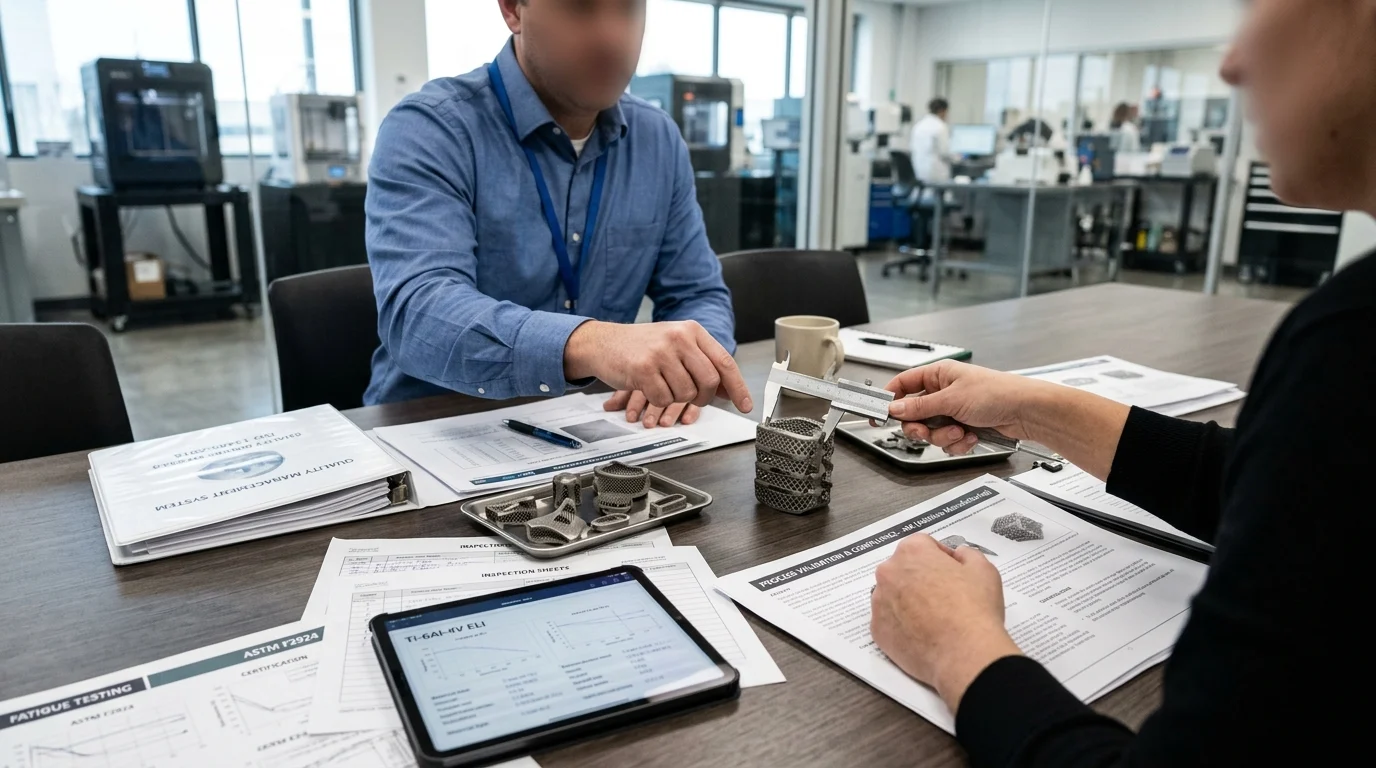
Transitioning from traditional manufacturing to 3D printed titanium implants necessitates rigorous adherence to specialized quality assurance and regulatory frameworks. Regulatory bodies globally, including the FDA under the 510(k) pathway and the European MDR, require comprehensive control over the entire additive workflow, from raw material procurement to final surface finishing.
Titanium Alloy Selection and Powder Quality
The foundation of any high-performance medical device lies in its base material properties. In additive manufacturing, Ti-6Al-4V ELI (Extra Low Interstitial, Grade 23) is the predominant titanium alloy utilized due to its exceptional strength-to-weight ratio and proven clinical biocompatibility. However, the mechanical integrity of the final printed implant is intrinsically linked to the chemical and physical characteristics of the precursor metal powder, which is typically produced via advanced plasma atomization.
For optimal performance in Laser Powder Bed Fusion systems, powder morphology must be highly spherical to ensure consistent flowability and uniform packing density across the build plate. Particle Size Distribution (PSD) is strictly controlled, typically reported in a range of 15 to 45 micrometers for standard LPBF applications, aligning with standards such as ASTM F3049. Furthermore, atmospheric exposure during handling must be aggressively minimized; oxygen content within the powder is maintained below strict industry thresholds (e.g., 0.13% per ASTM specifications) to prevent material embrittlement that could otherwise lead to catastrophic fatigue failure in load-bearing implants.
Validation, Traceability, Sterilization, and Biocompatibility
Validating an additive manufacturing process requires robust Installation, Operational, and Performance Qualification (IQ/OQ/PQ) protocols tailored specifically to the unique thermal dynamics of 3D printers. Unlike traditional machining, metal 3D printing induces significant residual thermal stresses that must be carefully mitigated. Hot Isostatic Pressing (HIP) is routinely employed, subjecting the titanium implants to elevated temperatures and extreme argon gas pressures to eliminate internal micro-voids, aiming to reliably achieve greater than 99.9% theoretical material density.
Rigorous traceability must be maintained down to the specific powder-batch level, utilizing digital threads that link machine sensor data to individual implant serial numbers. Prior to clinical application, these implants undergo rigorous sterilization validation—commonly via gamma irradiation or ethylene oxide (EtO)—and must pass exhaustive ISO 10993 biocompatibility testing. Patient-matched devices face additional regulatory hurdles, such as navigating custom device exemptions under FDA rules or the EU MDR’s stricter custom-device definitions. Because long-term clinical evidence gaps and potential implant failures carry litigation exposure, comprehensive post-market surveillance is essential. Documented failure modes—such as fatigue crack initiation at rough as-built surfaces, residual powder contamination, and lattice occlusion by soft tissue—must be rigorously monitored and mitigated through strict adherence to ISO/ASTM 52900 series standards.
Decision Guide for Hospitals, OEMs, and Suppliers
For original equipment manufacturers (OEMs), contract manufacturers, and advanced point-of-care hospital facilities, adopting 3D printed titanium implants requires a strategic realignment of supply
Key Takeaways
- Use 3D printed titanium implants for complex or patient-specific cases where internal lattices, anatomical fit, and reduced tooling needs offer clear advantages over machining or casting.
- Target porous implant architectures with roughly 60% to 80% porosity and 300–700 µm pore sizes when the goal is improved osseointegration and reduced stress shielding.
- Select Ti-6Al-4V ELI for many load-bearing implant applications and validate it against relevant standards such as ASTM F3001 for additively manufactured components.
- Plan for post-processing steps including stress relief, HIP, support removal, surface finishing, cleaning, passivation, inspection, and sterilization before estimating delivery timelines.
- Maintain full digital traceability from CT or MRI imaging through CAD approval, printing parameters, powder batch records, inspection results, and final implant release.
- Evaluate LPBF and EBM based on part requirements because LPBF can offer finer detail while EBM may reduce residual stress in a vacuum build environment.
Frequently Asked Questions
Why is titanium used for 3D printed implants?
Titanium offers strong biocompatibility, corrosion resistance, and high strength-to-weight performance. In medical additive manufacturing, Ti-6Al-4V ELI is widely used because it supports load-bearing applications and can be processed into complex porous structures.
How do 3D printed titanium implants improve bone integration?
Additive manufacturing can create porous lattice structures, often with 60% to 80% porosity and pore sizes around 300–700 µm. These features help reduce stress shielding and support vascularization, cell attachment, and long-term bone ingrowth.
What procedures use patient-specific titanium implants?
Common uses include spinal fusion cages, acetabular cups, cranial plates, trauma reconstruction, revision arthroplasty, and segmental bone defect repair after tumor resection. They are especially valuable when standard implants cannot match complex anatomy.
Are 3D printed titanium implants faster to produce than traditional implants?
They can be faster for custom cases because no molds or dedicated tooling are needed. However, lead time still depends on imaging, CAD design, surgeon approval, printing, post-processing, quality inspection, sterilization, and regulatory controls.
What standards apply to medical titanium implants?
Manufacturers commonly validate materials against standards such as ASTM F136 for wrought Ti-6Al-4V ELI and ASTM F3001 for additively manufactured Ti-6Al-4V ELI. Testing includes chemistry, tensile strength, fatigue, density, corrosion, and biocompatibility.