

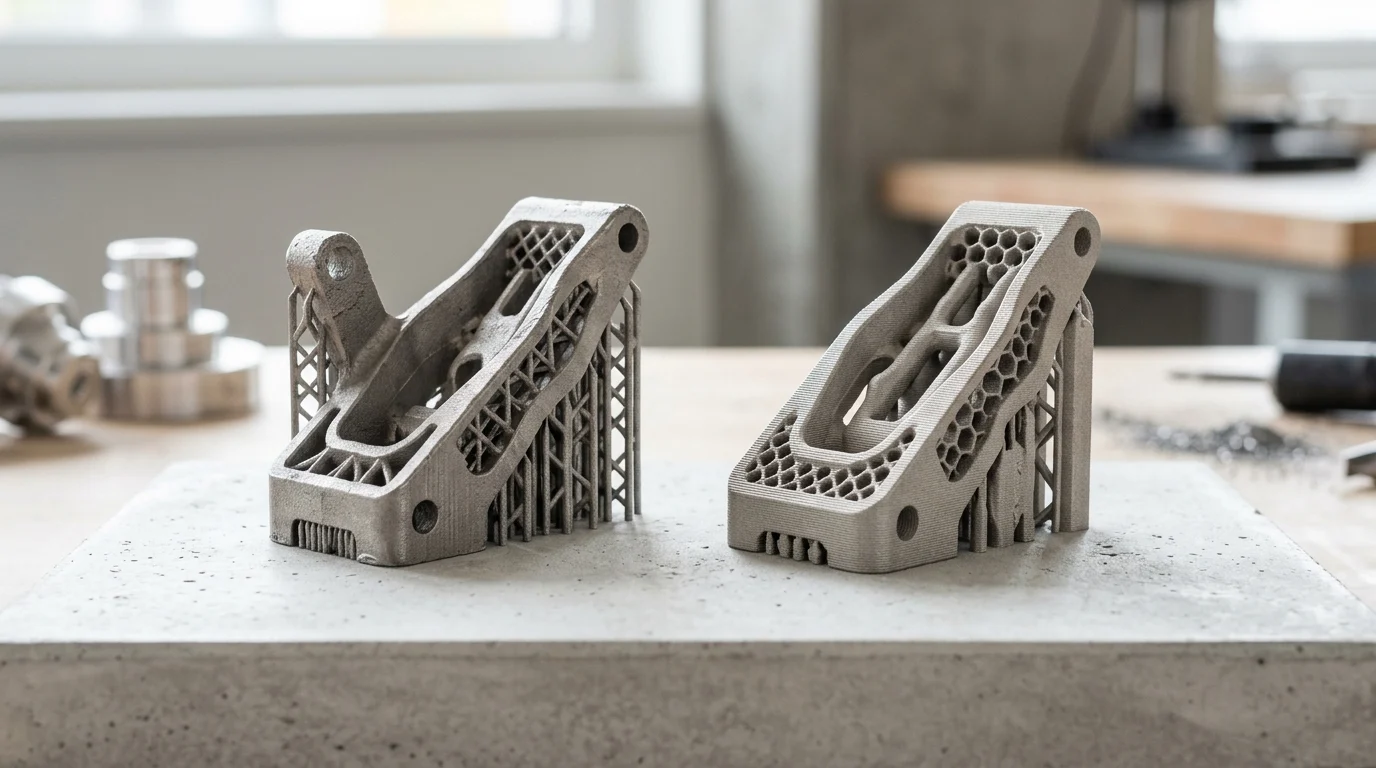
Metal additive manufacturing has moved well beyond prototypes, and material selection now directly affects part weight, fatigue life, cost, and qualification risk. Two alloys often compete for demanding printed components: precipitation-hardening stainless steel 17-4PH and Ti-6Al-4V titanium. Both can reach tensile strengths above 1,000 MPa, but they behave very differently in production. One offers high stiffness, hardness, and cost-effective durability; the other delivers exceptional strength-to-weight performance and biocompatibility at a much lower density. This comparison examines the practical engineering tradeoffs—mechanical properties, heat treatment, corrosion behavior, applications, and sourcing considerations—so designers can match the alloy to the real operating environment.
Why 3D Printed 17-4PH vs Titanium Matters
The industrial adoption of metal additive manufacturing (AM) has definitively shifted from rapid prototyping to end-use production. This transition is driven heavily by the maturation of laser powder bed fusion (LPBF) and binder jetting technologies, which now achieve metallurgical densities exceeding 99.5%. At the center of this manufacturing revolution are two highly capable alloys: 17-4PH stainless steel and Titanium, specifically the Ti-6Al-4V (Ti64) variant.
Selecting between these two metals requires engineers to balance thermodynamic properties, mechanical performance, and supply chain economics. While both materials offer excellent corrosion resistance and high ultimate tensile strengths, their distinct microstructural behaviors during the rapid heating and cooling cycles of the 3D printing process dictate entirely different post-processing and application strategies.
Key material definitions
17-4PH (UNS S17400) is a martensitic precipitation-hardening stainless steel characterized by its nominal composition of 17% chromium, 4% nickel, and 4% copper. In the additive manufacturing context, it offers an exceptional balance of toughness and high strength achievable through relatively simple, low-temperature heat treatments. The copper precipitates formed during aging give the alloy its signature hardness.
Titanium Ti-6Al-4V (UNS R56400), an alpha-beta titanium alloy, contains 6% aluminum and 4% vanadium. It is the undisputed workhorse of the titanium industry, revered for its extraordinary specific strength (strength-to-weight ratio) and biological inertness. When 3D printed, the rapid solidification often results in an acicular martensitic alpha-prime microstructure, which typically requires thermal processing to transform into a more ductile alpha-beta state.
Common industrial use cases
Industrial applications for these printed alloys diverge based on systemic operational requirements. 17-4PH is predominantly utilized in fluid handling, conformal-cooled injection mold tooling, marine hardware, and reusable surgical instruments. In these environments, high stiffness, resistance to caustic sterilization, and localized wear resistance are paramount.
Conversely, 3D printed Ti64 dominates the aerospace, defense, and medical implant sectors. Aerospace engineers leverage printed titanium for topology-optimized structural brackets, satellite housings, and engine components to minimize mass and maximize payload capacity. The medical sector heavily relies on printed Ti64 for orthopedic and spinal implants, utilizing the AM process to create engineered lattice structures that promote osseointegration.
Material Property Comparison
A rigorous comparison of physical and mechanical properties is the first step in differentiating 17-4PH and Ti64 for additive applications. While both can achieve ultimate tensile strengths (UTS) exceeding 1,000 MPa after appropriate heat treatments, their mechanical profiles diverge significantly in density, stiffness, and hardness.
| Property | 3D Printed 17-4PH (H900) | 3D Printed Ti-6Al-4V (Stress Relieved) |
|---|---|---|
| Density | 7.80 g/cm³ | 4.43 g/cm³ |
| Young’s Modulus (Stiffness) | 196 GPa | 114 GPa |
| Ultimate Tensile Strength | ~1,150 – 1,300 MPa | ~1,050 – 1,200 MPa |
| Yield Strength | ~1,050 MPa | ~950 MPa |
| Hardness | 40 – 45 HRC | 36 – 39 HRC |
Strength, density, and hardness
The most striking difference between the two materials is density. Titanium is roughly 43% lighter than 17-4PH, which directly translates to its superior specific strength. For dynamic systems where inertial mass is a constraint, Ti64 is the clear mathematical favorite.
However, 17-4PH offers a significantly higher Young’s Modulus (196 GPa compared to Ti64’s 114 GPa). This means 17-4PH is much stiffer and will undergo less elastic deformation under identical loads. Furthermore, 17-4PH can be age-hardened to achieve surface hardness levels up to 45 HRC, making it far superior to titanium in applications involving sliding friction or abrasive wear.
Heat treatment, orientation, porosity, and surface finish
The layer-by-layer nature of 3D printing introduces anisotropy, meaning material properties can vary depending on the build orientation (Z-axis vs. X/Y-axis). Heat treatment is mandatory to homogenize the microstructure and relieve residual stresses. 17-4PH typically undergoes a solution anneal followed by aging (e.g., Condition H900 at 482°C for 1 hour).
Ti64 requires stress relief immediately after printing, often while still attached to the build plate, to prevent warping or cracking. Because titanium is highly susceptible to internal voids during LPBF, high-performance parts usually undergo Hot Isostatic Pressing (HIP) at approximately 920°C and 100 MPa to collapse internal porosity and improve fatigue life. Both materials yield an as-printed surface roughness (Ra) of roughly 5 to 15 µm, necessitating CNC machining or mass finishing for critical mating surfaces.
When each material outperforms the other
Titanium outperforms 17-4PH whenever weight reduction is the primary design driver, or when the component must operate in highly corrosive environments like seawater or the human body. Its fatigue resistance, once HIPed, makes it ideal for cyclical aerospace loading.
17-4PH outperforms titanium when structural stiffness, wear resistance, and raw strength-to-cost ratios are prioritized. If a component must resist deflection under heavy static loads or endure repeated physical impacts—such as in industrial tooling or heavy machinery—the robust density and hardness of 17-4PH provide a more stable and durable solution.
Cost and Production Factors
The economic realities of printing 17-4PH versus Titanium often dictate material selection before engineering calculations even begin. Additive manufacturing shifts the cost paradigm away from pure material volume and toward powder chemistry, machine run time, and post-processing complexities.
Powder cost, machine time, and supports
Raw material costs vary drastically. High-quality spherical 17-4PH powder typically costs between $40 and $80 per kilogram, whereas aerospace-grade Ti64 powder ranges from $150 to over $300 per kilogram. Beyond powder cost, titanium demands a more controlled manufacturing environment.
Because molten titanium is highly reactive, it must be printed in a strictly controlled argon atmosphere with oxygen levels maintained below 0.1% to prevent embrittlement. This increases machine purge times and consumable gas costs. Additionally, support structure removal for titanium is notoriously difficult; the material’s tendency to gall and generate sparks requires specialized wet-cutting tools, whereas 17-4PH supports can often be removed more conventionally.
Sourcing, lead time, and availability
17-4PH is a highly commoditized alloy with a robust global supply chain, meaning powder availability is rarely an issue, and lead times for raw materials are short. Multiple atomization facilities produce consistent, high-yield batches of stainless steel powder.
The supply chain for titanium powder is tighter and heavily influenced by the aerospace and defense sectors. Sourcing certified Ti64 powder—especially grades requiring strict lot traceability like ELI (Extra Low Interstitial) Grade 23—can introduce longer lead times. Geopolitical factors also play a larger role in titanium availability, occasionally causing price volatility that manufacturers must absorb.
Additive manufacturing vs CNC machining
When comparing AM to traditional CNC machining, the “buy-to-fly” ratio is a critical metric. In traditional machining, aerospace titanium components often have a buy-to-fly ratio of 10:1 or worse, meaning 90% of the expensive raw material is milled away as scrap. Ti64 is also notoriously difficult to machine, causing rapid tool wear. AM reduces this ratio to roughly 1.2:1, easily justifying the high cost of titanium powder for complex geometries.
17-4PH is significantly easier and cheaper to machine conventionally. Therefore, justifying the use of AM for 17-4PH relies less on material waste reduction and more on the ability to produce geometries that are impossible to machine, such as internal conformal cooling channels in molds or highly integrated, consolidated assemblies.
Qualification and Risk Management
Ensuring part reliability in mission-critical applications requires navigating a complex landscape of metallurgical qualifications. Because LPBF creates the material and the final geometry simultaneously, quality control must address both the chemical composition of the final part and its physical integrity.
Standards, specifications, and test coupons
Regulatory bodies have developed specific standards for printed metals. For 17-4PH, ASTM F3301 governs the standard specification for powder bed fusion parts. For titanium, ASTM F3001 outlines the requirements for Ti-6Al-4V ELI (Extra Low Interstitial) produced via AM.
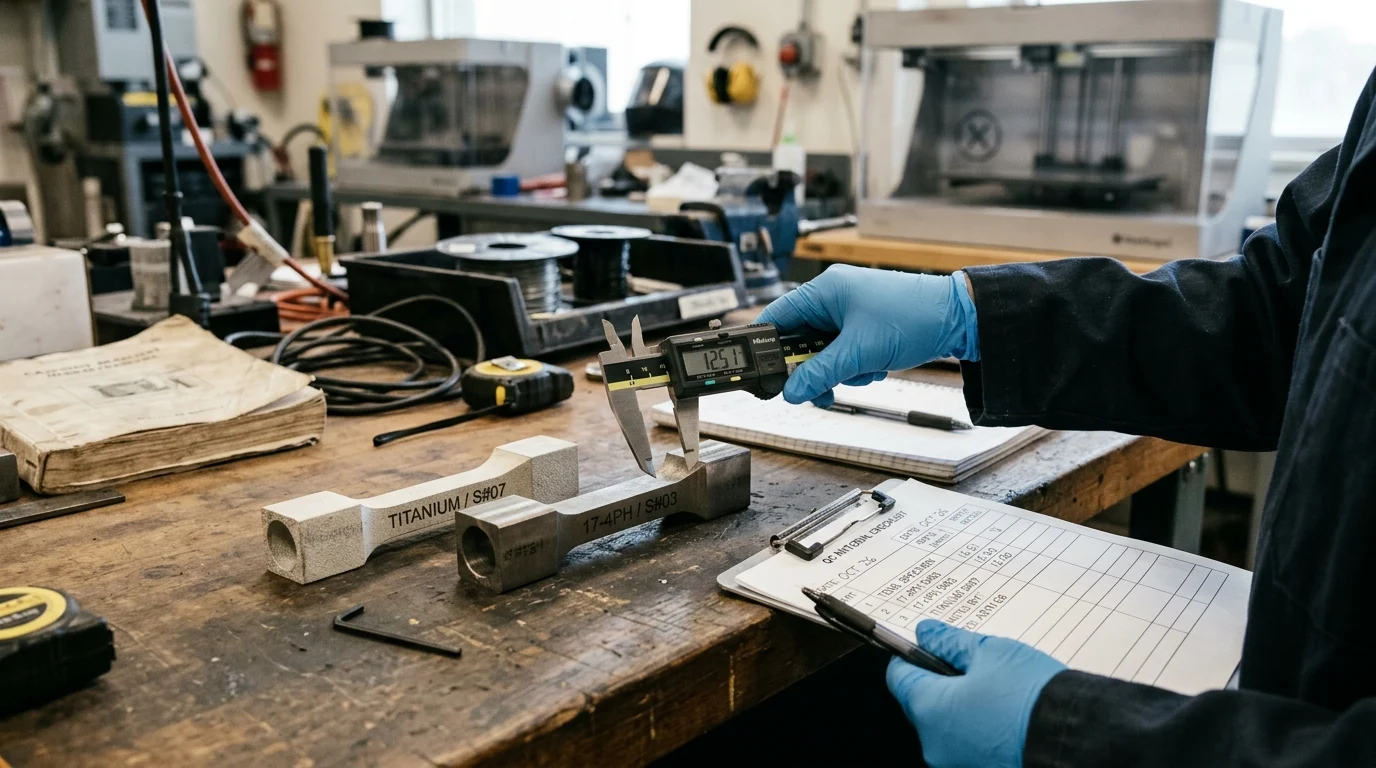
Compliance requires the simultaneous printing of test coupons alongside the production parts on the same build plate. These coupons are subjected to destructive testing to verify that the lot meets minimum thresholds. For example, aerospace standards for printed Ti64 typically demand a minimum elongation at break of >10% and a yield strength exceeding 860 MPa after heat treatment.
Design review and inspection steps
Non-destructive evaluation (NDE) is a mandatory step in the qualification pipeline. Due to the risk of lack-of-fusion defects or trapped gas, critical titanium aerospace parts are almost universally subjected to X-ray Computed Tomography (CT) scanning. CT scans are used to verify that internal porosity remains below a strict threshold, often mandated at <0.5% by volume.
For 17-4PH parts used in pressure vessels or high-load mechanical linkages, dye penetrant inspection (DPI) and magnetic particle inspection (MPI) are utilized to detect surface and near-surface micro-cracks. Dimensional inspection via coordinate measuring machines (CMM) or structured light scanning ensures that thermal distortion during printing and heat treatment remained within acceptable tolerances.
Critical failure modes
Understanding how these materials fail is crucial for risk management. For printed Ti64, fatigue failure initiated by subsurface pores or un-melted powder particles is the primary concern. Furthermore, if the build chamber’s shield gas is compromised, titanium will suffer from severe oxygen embrittlement, leading to catastrophic brittle failure under load.
For 17-4PH, a critical failure mode involves retained austenite. If the cooling rates during the printing process or subsequent heat treatments are not properly controlled, patches of austenite may remain in the martensitic matrix. This microstructural inconsistency can lead to variable hardness across the part, resulting in localized wear or premature yielding under stress.
Selection Guidance for Engineers
Synthesizing metallurgical data, economic constraints, and qualification requirements into an actionable engineering decision requires a structured approach. Engineers must evaluate the operating environment and the lifecycle budget of the component to determine the optimal material.
| Decision Driver | Preferred Material | Primary Justification |
|---|---|---|
| Specific Strength (Strength-to-Weight) | Titanium (Ti64) | 43% lower density with comparable UTS |
| High Stiffness / Low Deflection | 17-4PH Stainless | 72% higher Young’s Modulus (196 GPa) |
| Raw Material Cost | 17-4PH Stainless | Powder costs are roughly 70-80% lower |
| Biocompatibility | Titanium (Ti64) | Superior osseointegration and corrosion resistance in vivo |
| Wear & Abrasion Resistance | 17-4PH Stainless | Can be aged to 40-45 HRC; Ti64 is prone to galling |
Decision matrix for weight, strength, cost, and corrosion
The decision matrix above highlights the core trade-offs. If the mass budget is strictly capped—such as in drones, satellites, or motorsport components—the premium cost of titanium is almost always justified by the operational energy savings over the vehicle’s lifespan.
Conversely, if the application requires dimensional stability under heavy loads without space or weight constraints, 17-4PH is the superior choice. Its high stiffness prevents deflection, and its lower cost allows for more iterative prototyping and cheaper scale-up for industrial production runs.
Application examples
Consider a topology-optimized drone hinge: using Ti64 allows the hinge to withstand high dynamic flight loads while shaving critical grams from the airframe, directly increasing battery life and flight time. The complex, organic shape of the hinge justifies the additive process, while the material justifies the performance.
In contrast, consider a conformal-cooled insert for an injection mold. The insert must withstand thousands of cycles of clamping force and abrasive polymer flow. 17-4PH is the ideal candidate here; its hardness resists wear, its thermal conductivity manages the cooling channels, and weight is entirely irrelevant to the stationary mold’s performance.
Final material selection checklist
Before finalizing a material selection for a 3D printed component, engineers should execute a sequential checklist. First, verify the maximum operating temperature; Ti64 retains strength up to roughly 400°C, while 17-4PH is typically limited to 316°C before over-aging occurs. Second, evaluate the necessity of specific certifications (e.g., FDA approval for implants heavily favors Ti64).
Finally, assess the post-processing budget. If the geometry requires extensive support structures, the labor and tooling costs to remove them from titanium may exceed the cost of the print itself. By methodically weighing these quantitative thresholds against the unique capabilities of LPBF, engineering teams can fully exploit the performance envelopes of both 17-4PH and Titanium.
Key Takeaways
- Choose Ti-6Al-4V when weight is critical because its density is about 4.43 g/cm³, far below 17-4PH at roughly 7.80 g/cm³.
- Use 17-4PH when stiffness and hardness are priorities, since it offers about 196 GPa modulus and 40–45 HRC after H900 aging.
- Specify post-processing early because 17-4PH depends on precipitation aging, while printed Ti-6Al-4V often needs stress relief or heat treatment to improve ductility.
- Select printed titanium for aerospace and implant applications where high specific strength, biocompatibility, and lattice design capability justify the added cost.
- Consider 17-4PH for tooling, marine hardware, fluid systems, and reusable surgical instruments where durability and stainless corrosion resistance are more important than mass reduction.
Frequently Asked Questions
Which is lighter, 3D printed 17-4PH or Ti-6Al-4V?
Ti-6Al-4V is much lighter, with a density of about 4.43 g/cm³ versus 7.80 g/cm³ for 17-4PH. Choose titanium when weight reduction, payload efficiency, or high specific strength is a primary design goal.
Which alloy is stronger after heat treatment?
Both can exceed 1,000 MPa ultimate tensile strength after proper processing. 17-4PH in H900 condition can reach roughly 1,150–1,300 MPa, while stress-relieved Ti-6Al-4V is commonly around 1,050–1,200 MPa.
Is 17-4PH or titanium better for medical implants?
Ti-6Al-4V is generally preferred for implants because it is biocompatible, corrosion resistant, and well suited to porous lattice structures that support osseointegration. 17-4PH is more common in reusable surgical instruments than permanent implants.
When should engineers choose 3D printed 17-4PH?
Choose 17-4PH for high stiffness, wear resistance, tooling, fluid handling parts, marine hardware, and components where cost efficiency and stainless corrosion resistance matter more than weight savings.
When is printed titanium the better choice?
Printed titanium is better for aerospace, defense, and medical applications where low mass, high strength-to-weight ratio, fatigue performance, and biological inertness justify higher material and processing costs.