

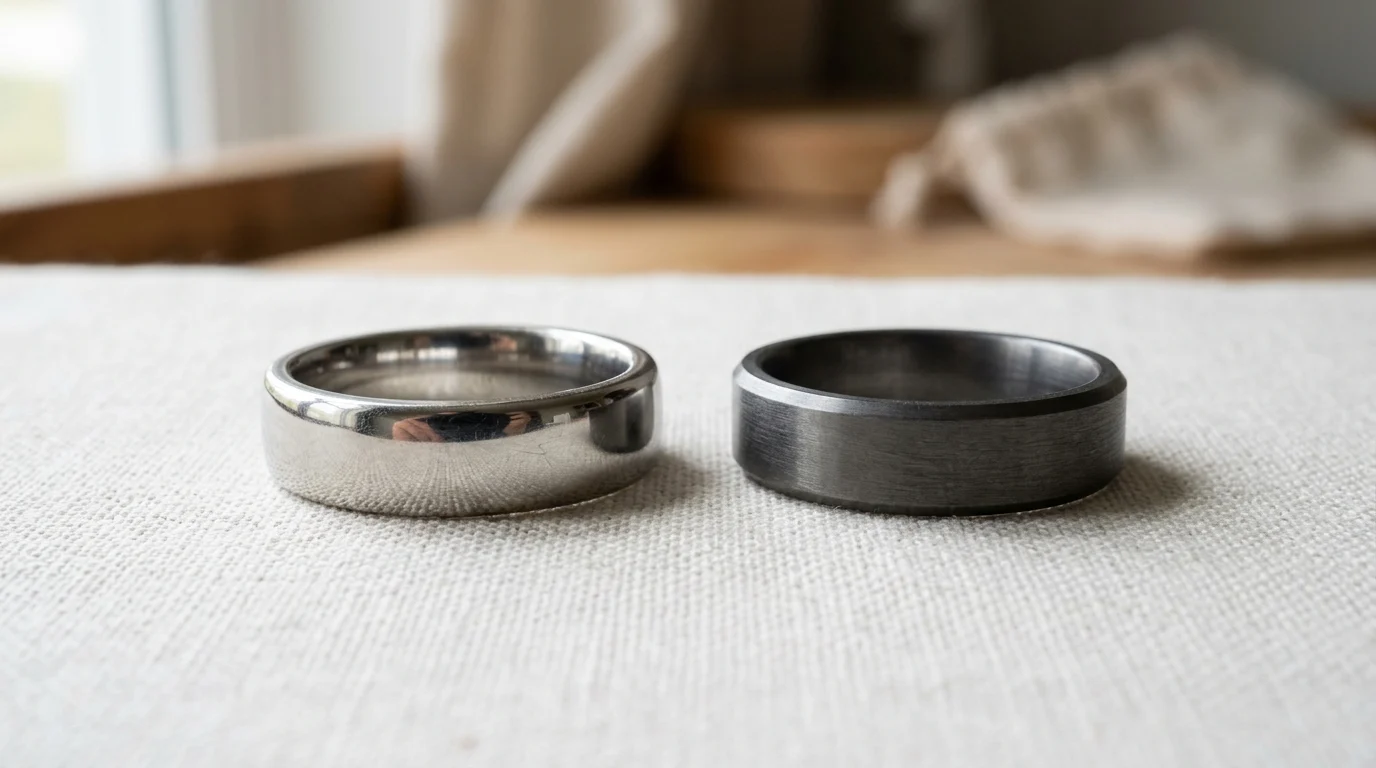
Choosing between modern non-precious ring metals is not just a style decision—it affects comfort, allergy risk, durability, and long-term value. 316L stainless steel and Grade 5 titanium both resist corrosion and offer strong everyday performance, but their engineering profiles are very different. Stainless steel delivers a heavier feel, accessible pricing, and a bright polished look, while titanium offers exceptional strength-to-weight performance, no nominal nickel content, and superior baseline hardness. This comparison breaks down the key material grades, density, scratch resistance, biocompatibility, and manufacturing factors so buyers, jewelers, and sourcing teams can make a practical, data-backed choice.
Stainless Steel vs Titanium Rings: Key Differences
In the contemporary jewelry market, stainless steel and titanium dominate the non-precious metal sector. Both alloys offer exceptional corrosion resistance and structural integrity, yet they exhibit fundamentally distinct mechanical behaviors. These differences directly influence comfort, manufacturing workflows, retail pricing, and the lifecycle durability of the finished ring.
Material Properties and Grades
The jewelry industry relies on highly specific alloy grades to balance mechanical workability with end-user safety. While other grades like 304 steel or Commercially Pure (CP) Grade 2 titanium exist, stainless steel rings predominantly utilize the 316L grade. This is an austenitic alloy containing 16% to 18% chromium, 2% to 3% molybdenum, and 10% to 14% nickel. The ‘L’ designates a low carbon content (strictly under 0.03%), which minimizes carbide precipitation during high-temperature forming or welding, thereby preserving its anti-corrosive properties.
Conversely, titanium rings are frequently machined from the stronger Ti-6Al-4V alloy, universally known as Grade 5. Grade 5 features an alpha-beta crystalline structure stabilized by 6% aluminum and 4% vanadium. Unlike 316L stainless steel, titanium alloys generally contain no nickel. This distinct metallurgical composition renders titanium highly biocompatible and better tolerated by the human body. However, it is worth noting that while 316L generally releases very little nickel, it is not guaranteed safe for every highly nickel-sensitive wearer, and while titanium is exceptionally safe, no metal is universally hypoallergenic.
Weight, Hardness, and Durability
Physical metrics dictate both the tactile experience of the jewelry and its long-term wear resistance under daily abrasion. Titanium is globally recognized for its exceptional strength-to-weight ratio. It exhibits a density of approximately 4.51 g/cm³, making it roughly 45% lighter than 316L stainless steel, which possesses a heavier density of 7.99 g/cm³. This weight discrepancy is immediately perceptible to the consumer and heavily influences men’s wedding band preferences, particularly for those unaccustomed to wearing heavy jewelry.
In terms of surface hardness and scratch resistance, Grade 5 titanium offers superior baseline durability. However, the specific manufacturing method, work-hardening processes, and surface finishes strongly affect the final hardness of both metals. Generally, Grade 5 titanium registers a Vickers hardness rating between 340 and 400 HV. By comparison, annealed 316L stainless steel typically yields a hardness of 150 to 190 HV, making it more susceptible to micro-abrasions over time.
| Metallurgical Property | 316L Stainless Steel | Grade 5 Titanium (Ti-6Al-4V) |
|---|---|---|
| Density | 7.99 g/cm³ | 4.51 g/cm³ |
| Vickers Hardness | 150 – 190 HV | 340 – 400 HV |
| Nickel Content | 10% – 14% | 0% (Nominal) |
| Tensile Strength | ~500 MPa | ~895 – 1000 MPa |
Manufacturing and Finish Considerations
The distinct thermal and mechanical profiles of stainless steel and titanium dictate how these rings are crafted and finished, which ultimately affects their retail price, aesthetic options, and availability.
Machining, Engraving, and Plating
Manufacturing details highlight the differing production demands of these metals. Titanium’s notoriously low thermal conductivity forces cutting heat directly into the tool edge, accelerating tool wear. Depending on the region and equipment used, machining Grade 5 titanium requires highly rigid setups and reduced cutting speeds—often restricted to 30–50 meters per minute (m/min)—compared to the 80–120 m/min typical for 316L stainless steel.
Surface treatments also require divergent approaches. Both metals readily accept Physical Vapor Deposition (PVD) plating to achieve specialized aesthetic finishes like matte black, rose gold, or gunmetal. However, consumers should note that PVD coatings on both metals can wear over time on high-contact surfaces, making warranty terms an important consideration. Furthermore, titanium develops a passive dioxide layer upon atmospheric exposure, necessitating stringent vacuum environments for PVD adhesion and higher-wattage fiber lasers for engraving to prevent heat tinting on the surrounding metal.
Quality Inspection and Compliance
Stringent quality control protocols are mandatory for both metals, particularly concerning dimensional tolerances and regulatory metallurgical compliance. CNC-turned ring blanks for both materials must consistently hold dimensional tolerances of ±0.05 mm to ensure accurate international sizing standards.
Regulatory compliance presents a sharper divergence between the two metals. The European Union’s REACH directive strictly regulates nickel release via the EN 1811 testing standard. Products intended for direct and prolonged skin contact must not release nickel at a rate exceeding 0.5 micrograms per square centimeter per week. High-quality 316L stainless steel generally passes this threshold because its tight crystalline structure effectively binds the nickel; however, improper casting, aggressive polishing, or subpar raw materials can lead to compliance failures. Titanium bypasses this specific regulatory hurdle entirely, consistently demonstrating negligible nickel release under EN 1811 testing.
How to Choose the Right Ring Material
Choosing between stainless steel and titanium requires balancing budget, comfort, and long-term wear. Whether purchasing for a retail supply chain or personal use, buyers must evaluate material costs against daily practicality, defect rates, and styling preferences.
Cost, Sourcing, and Logistics
For manufacturers and wholesale buyers, the cost delta between these two materials is substantial at the raw material procurement stage. While figures vary widely by region, supplier, volume, and market conditions, general industry benchmarks place 316L stainless steel bar stock at roughly $3 to $5 per kilogram, facilitating highly cost-effective, high-volume production runs. Conversely, Grade 5 titanium commands a significant market premium, frequently priced between $25 and $35 per kilogram depending on aerospace industry demand and global supply chain fluctuations.
This upstream cost disparity directly impacts Minimum Order Quantities (MOQs). Depending on the supplier, titanium ring MOQs often range from 300 to 500 pieces per design to properly amortize the higher tooling consumption, with production lead times extending to 4 to 6 weeks. Stainless steel variants, being easier on machinery, can often be sourced with MOQs as low as 100 pieces and faster 3 to 4 week turnarounds.
Decision Framework for Buyers
When deciding between stainless steel and titanium, buyers should weigh several practical factors alongside cost and aesthetics.
Resizing and Maintenance: A critical caution for consumers is that ordinary resizing is often impractical for
Key Takeaways
- Choose Grade 5 titanium if you want a ring that is about 45% lighter than 316L stainless steel and easier to wear all day.
- Avoid 316L stainless steel if you are highly nickel-sensitive, because it contains roughly 10% to 14% nickel even though release rates are typically low.
- Select titanium for stronger baseline wear resistance, as Grade 5 titanium commonly measures 340 to 400 HV compared with 150 to 190 HV for annealed 316L stainless steel.
- Use stainless steel when budget and a heavier traditional feel matter more than maximum strength-to-weight performance.
- Evaluate the actual grade before buying, because 316L stainless steel and Grade 5 titanium perform differently from lower-grade or unspecified alloys.
Frequently Asked Questions
Which ring is lighter, stainless steel or titanium?
Titanium is much lighter. Grade 5 titanium has a density of about 4.51 g/cm³, while 316L stainless steel is about 7.99 g/cm³, making titanium roughly 45% lighter on the finger.
Is titanium better for people with nickel sensitivity?
Usually, yes. Grade 5 titanium contains no nominal nickel, while 316L stainless steel contains about 10% to 14% nickel. Although 316L releases very little nickel, highly sensitive wearers often prefer titanium.
Which metal is more scratch resistant for daily wear?
Grade 5 titanium generally has better baseline scratch resistance, with a Vickers hardness of about 340 to 400 HV. Annealed 316L stainless steel is typically around 150 to 190 HV and may show micro-scratches sooner.
Are stainless steel rings more affordable than titanium rings?
Often, stainless steel rings are less expensive because the material is widely available and easier to process. Titanium can cost more due to machining demands, tool wear, and the use of stronger alloys like Ti-6Al-4V.
Can titanium and stainless steel rings both resist corrosion?
Yes. Both 316L stainless steel and titanium alloys offer strong corrosion resistance. Stainless steel relies on chromium and molybdenum, while titanium forms a stable oxide layer that protects the surface.