

[ Request an Instant Quote / Upload CAD ]
Titanium parts are often chosen when failure is not an option—but machining them can be costly, wasteful, and limiting for advanced geometries. Metal additive manufacturing changes that equation by building dense titanium components directly from CAD data, layer by layer, with features that conventional cutting tools cannot easily create. For engineers in aerospace, medical, automotive, and industrial markets, the value is not just faster prototyping; it is lighter assemblies, reduced material waste, fewer failure points, and application-specific performance. This article explains how custom titanium printing works, which alloys matter, and where precision additive manufacturing delivers measurable production advantages.
Why Custom Titanium 3D Printing Matters
Titanium has long been the gold standard for high-performance engineering, offering an exceptional strength-to-weight ratio, superior corrosion resistance, and excellent biocompatibility. However, traditional subtractive manufacturing methods often restrict the geometric complexity of titanium parts and generate substantial material waste.
Titanium additive manufacturing bridges this gap, combining the advanced material advantages of titanium with the geometric freedom of 3D printing. This synergy allows engineers to design for optimal performance rather than being constrained by the physical limitations of cutting tools.
Commercial Value Beyond Basic Manufacturing
The commercial viability of additive manufacturing extends far beyond simple rapid prototyping. For industries such as aerospace, medical, and automotive, titanium 3D printing fundamentally alters supply chain economics. By enabling part consolidation, engineers can replace assemblies of 10 to 20 individual machined components with a single, continuous printed structure.
This consolidation reduces assembly labor, eliminates multiple points of failure, and frequently achieves weight reductions of 30% to 50% without compromising structural integrity. Furthermore, the buy-to-fly ratio—a critical cost metric in aerospace manufacturing—drops from as high as 15:1 in traditional machining to ratios typically between 3:1 and 5:1 in additive manufacturing. While an ideal 1.5:1 ratio is theoretically possible, practical realities like support structure generation and base-plate consumption make material usage highly geometry-dependent, though it still drastically reduces raw material waste compared to subtractive methods.
What Custom Titanium 3D Printing Means
At its core, this capability refers to the layer-by-layer fabrication of titanium parts directly from digital CAD data, tailored precisely to specific application requirements. Unlike subtractive methods that carve away solid blocks of metal, the process utilizes fine titanium powder, selectively melted to form complex internal channels, lattice structures, and topological optimizations.
The process typically operates with layer thicknesses ranging from 20 to 60 microns, ensuring intricate detailing and high material density. This bespoke approach means that whether producing a patient-specific orthopedic implant or a specialized rocket engine injector, the manufacturing parameters can be precisely tuned to achieve the necessary mechanical properties and surface finish.
Titanium Materials and Printing Technologies
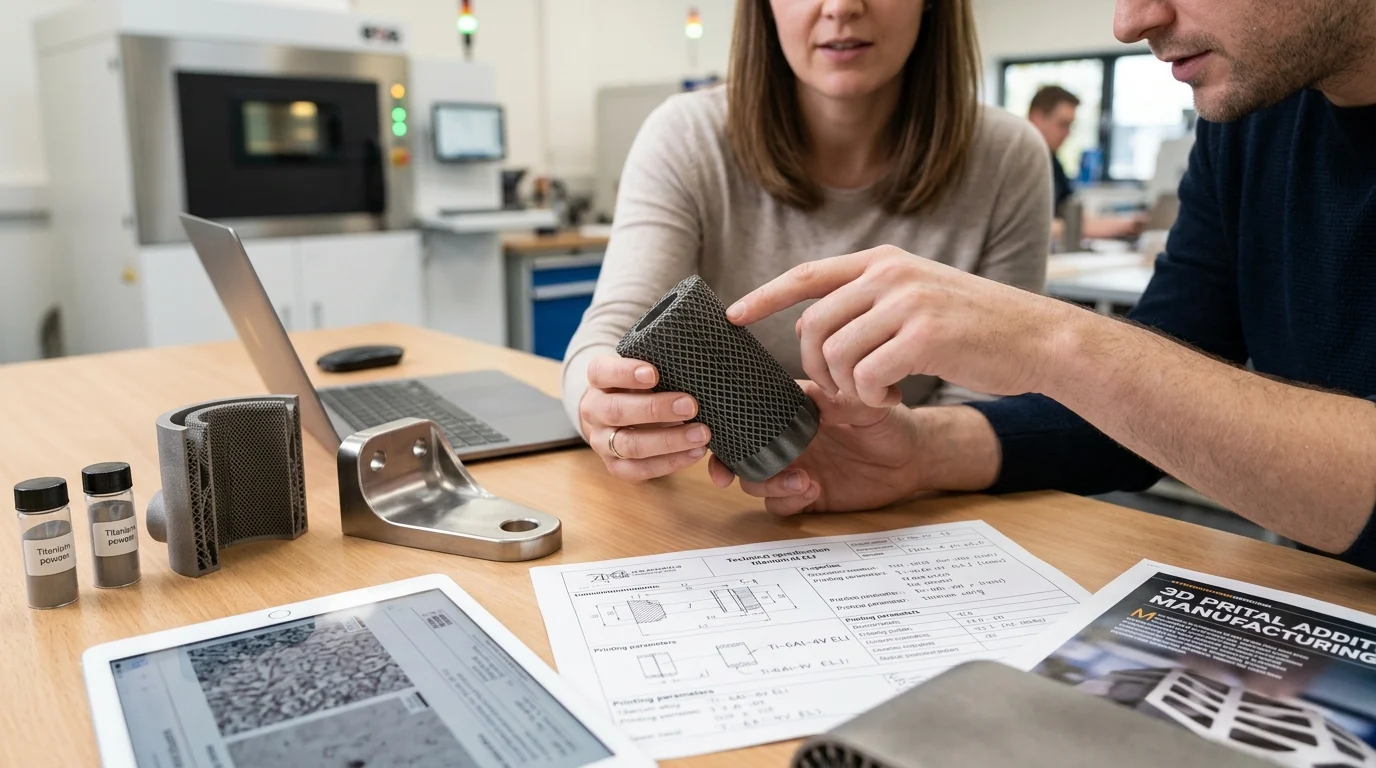
The success of titanium AM relies heavily on the selection of the appropriate alloy and the specific additive manufacturing technology utilized. Understanding the metallurgical properties of titanium powders and the thermal dynamics of different printing processes is essential for achieving parts that meet stringent industrial standards.
Ti-6Al-4V and Commercially Pure Titanium
The most prevalent titanium alloy in additive manufacturing is Ti-6Al-4V, commonly available in Grade 5 and the extra-low interstitial Grade 23. This alloy is prized for its remarkable tensile strength, which typically ranges from 900 to 1100 MPa, alongside excellent fatigue resistance. It is the default choice for highly stressed aerospace brackets and structural orthopedic implants. Conversely, Commercially Pure (CP) Titanium, spanning Grades 1 through 4, is utilized when maximum corrosion resistance and absolute biocompatibility are prioritized over ultimate tensile strength. CP Titanium is frequently selected for chemical processing equipment and specific maxillo-facial medical devices where ductility and tissue integration are paramount.
Laser Powder Bed Fusion vs. Electron Beam Melting
While Laser Powder Bed Fusion (LPBF) and Electron Beam Melting (EBM) are the two primary technologies for titanium 3D printing, LPBF is the dominant choice among service bureaus for general industrial applications. LPBF utilizes high-powered lasers to melt titanium powder in an inert argon atmosphere, producing parts with exceptional detail and a finer surface finish. However, LPBF parts often exhibit mechanical anisotropy, with slightly inferior properties along the Z-axis due to the layer-by-layer melting process.
EBM remains a more niche technology, highly valued for specific applications like orthopedic implants. It uses an electron beam in a vacuum chamber, operating at elevated ambient temperatures up to 1000°C. This high-heat environment acts as an in-situ heat treatment, significantly reducing residual thermal stresses in the printed part.
| Feature | Laser Powder Bed Fusion (LPBF) | Electron Beam Melting (EBM) |
|---|---|---|
| Energy Source | High-power laser | Electron beam |
| Environment | High-purity Argon gas | Vacuum |
| Build Chamber Temp | Low to moderate | High (up to 1000°C) |
| Typical Surface Finish | Ra 5 – 15 µm | Ra 15 – 30 µm |
| Residual Stress | Higher (requires post-heat treatment) | Lower (in-situ stress relief) |
Key Design Rules for Titanium Additive Manufacturing
Designing for titanium additive manufacturing requires strict adherence to specific geometric guidelines to ensure printability and structural integrity. Engineers must account for self-supporting angles, generally avoiding overhangs of less than 45 degrees without implementing removable support structures. Minimum wall thicknesses should typically be maintained above 0.4 mm to prevent warping or structural failure during the powder fusion process. Additionally, circular holes smaller than 1.5 mm in diameter may experience thermal shrinkage and require post-machining to achieve tight tolerances. Proper orientation of the part within the build chamber is also critical to minimize support material and mitigate the Z-axis anisotropy typical in LPBF.
Titanium 3D Printing vs. CNC Machining
The decision to utilize titanium 3D printing versus traditional CNC machining is a fundamental engineering choice that dictates a project’s cost, timeline, and final capabilities. While subtractive manufacturing remains a cornerstone of the metalworking industry, additive techniques offer distinct advantages for specific applications.
Lead Time, Cost, Precision, and Complexity
When evaluating lead time, cost, precision, and complexity, each method presents clear trade-offs. CNC machining excels in precision, routinely achieving tolerances as tight as ±0.005 mm, making it ideal for mating surfaces and bearing fits. In contrast, titanium 3D printing typically yields raw tolerances of ±0.1 mm to ±0.2 mm, often necessitating secondary CNC operations for critical dimensions. From a cost perspective, CNC machining is highly efficient for simple geometries produced in large volumes. However, as part complexity increases, CNC costs rise exponentially due to the need for multiple setups, custom tooling, and extended programming time. Additive manufacturing absorbs complexity without a proportional cost increase, offering faster lead times for intricate prototypes since it bypasses tooling entirely.
Where Titanium 3D Printing Has the Strongest Advantage
Titanium 3D printing demonstrates its strongest competitive advantage in applications requiring geometries that are physically impossible or prohibitively expensive to machine. The primary examples are parts utilizing topology optimization—where material is procedurally removed from digital designs in non-load-bearing areas to save weight—and the integration of complex internal features. For instance, fluid-handling components in aerospace or chemical processing can integrate conformal internal flow channels directly into the titanium structure, optimizing fluid dynamics while maintaining exceptional corrosion resistance. Additionally, the creation of porous lattice structures, which mimic human trabecular bone to promote osseointegration in medical implants, is exclusively achievable through powder-bed additive manufacturing.
From Design File to Finished Titanium Part
Transforming a digital concept into a physical, high-performance titanium component is a multi-stage process that extends far beyond the printing phase itself. A comprehensive titanium AM workflow manages rigorous protocols to ensure structural integrity, dimensional accuracy, and cost-efficiency.
File Review and Design Optimization
The production cycle begins with a meticulous file review and design optimization phase. Engineers analyze the initial CAD models—typically exported as STL or 3MF files—to identify potential printability issues such as thermal warping or inadequate support structures. Utilizing advanced simulation software, technicians can predict residual stress accumulation and deformation during the laser fusion process. This digital twin approach allows for pre-emptive modifications, such as adjusting the build orientation or adding sacrificial thermal anchors, ensuring that the first physical print is successful and costly material waste is minimized.
Quality Control and Traceability
Because titanium parts are often deployed in mission-critical environments, stringent quality control and material traceability are non-negotiable. Reputable service providers maintain comprehensive documentation for every powder batch, tracking chemical composition and particle size distribution. Post-print inspection frequently involves non-destructive testing (NDT) to verify internal integrity. Parts are expected to achieve a material density exceeding 99.5%, confirming the absence of critical voids or porosity that could lead to failure. For fatigue-critical aerospace components, Hot Isostatic Pressing (HIP) or specialized stress-relief heat treatments are virtually mandatory to eliminate internal micro-porosity and homogenize the grain structure.
| Quality Control Method | Objective | Typical Application Stage |
|---|---|---|
| Powder Characterization | Verify particle size and chemical purity | Pre-production |
| Dimensional Metrology | Confirm external geometries and tolerances (CMM) | Post-processing |
| X-Ray Micro-CT Scanning | Detect internal voids, porosity, and structural defects | Final inspection |
| Tensile Testing | Validate yield strength, ultimate tensile strength, and elongation | Batch sampling |
Key Cost Drivers for Buyers
Understanding the key cost drivers in titanium additive manufacturing helps buyers optimize their procurement strategies. The primary expense is the raw material itself; aerospace-grade titanium powder typically ranges from $200 to $400 per kilogram. Consequently, the total volume of the part directly dictates the base material cost. Machine time is the second major driver; taller parts require more layers and longer build times, increasing machine hourly rates. Finally, post-processing operations—including HIP, wire EDM for removing the part from the build plate, and final CNC machining for tight tolerances—can account for up to 50% of the total component cost.
How to Choose a Titanium Additive Manufacturing Partner
The rapid expansion of the additive manufacturing industry has led to a proliferation of service bureaus worldwide. However, successfully outsourcing complex metal production requires partnering with a vendor capable of delivering consistent, certified results across the entire product lifecycle.
Supplier Qualification Criteria
Evaluating a titanium 3D printing supplier begins with a rigorous assessment of their quality management systems and industry-specific certifications. For aerospace applications, AS9100 certification is mandatory, while medical device production requires compliance with ISO 13485. Buyers must also evaluate the supplier’s internal infrastructure. A qualified partner should possess in-house post-processing capabilities, including vacuum heat treatment furnaces and CNC machining centers, to maintain strict control over the production chain. Additionally, buyers must verify the supplier’s maximum build envelope size, as physical machine constraints can be a hard deal-breaker for larger structural components. The supplier’s ability to provide complete metallurgical traceability—from raw powder lot numbers to final part inspection reports—is a critical qualification criterion for any safety-critical application.
Prototype, Low-Volume, and Production Decision Framework
Establishing a reliable production decision framework requires aligning your project’s lifecycle stage with the supplier’s manufacturing capacity. For initial prototyping, flexibility and rapid turnaround times are paramount; buyers should seek partners whose economic models support low Minimum Order Quantities (MOQs), ideally starting at a single unit, and rapid iteration cycles. As the project transitions to low-volume production—typically defined in the metal additive space as 50 to 500 units per year—the focus shifts toward process repeatability and batch-to-batch consistency. For full-scale production scaling into thousands of units, buyers must verify that the partner operates a fleet of identical, calibrated 3D printers and has secured stable, long-term supply chains for aerospace-grade titanium powder to prevent critical production bottlenecks.
Key Takeaways
- Use titanium 3D printing when complex geometry, internal channels, lattice structures, or topology optimization can improve performance beyond what machining allows.
- Select Ti-6Al-4V Grade 5 or Grade 23 for high-strength aerospace and medical structural parts with typical tensile strength around 900 to 1100 MPa.
- Choose Commercially Pure Titanium Grades 1–4 when corrosion resistance, ductility, and biocompatibility are more important than maximum tensile strength.
- Evaluate part consolidation opportunities because additive manufacturing can replace 10 to 20 machined components with one printed titanium structure.
- Compare material efficiency early, as titanium additive manufacturing can reduce aerospace buy-to-fly ratios from up to 15:1 to about 3:1–5:1.
- Plan post-processing and parameter control carefully because final mechanical properties, density, and surface finish depend on the alloy, geometry, and printing process.
Frequently Asked Questions
What makes titanium suitable for 3D printed metal parts?
Titanium offers high strength-to-weight performance, corrosion resistance, fatigue resistance, and biocompatibility, making it ideal for aerospace, medical, automotive, and chemical processing components.
Which titanium alloys are commonly used in additive manufacturing?
Ti-6Al-4V Grade 5 and Grade 23 are the most common for high-strength parts, while Commercially Pure Titanium Grades 1–4 are preferred for corrosion resistance, ductility, and biocompatibility.
How accurate is titanium 3D printing?
Typical titanium additive manufacturing uses layer thicknesses of about 20 to 60 microns, enabling complex features, internal channels, lattice structures, and high-density metal parts when process parameters are properly controlled.
Can titanium 3D printing reduce manufacturing waste?
Yes. Compared with machining, titanium additive manufacturing can significantly reduce raw material waste, often improving aerospace buy-to-fly ratios from as high as 15:1 to around 3:1–5:1.
Is titanium 3D printing only useful for prototypes?
No. It supports both prototyping and production, especially when parts benefit from weight reduction, part consolidation, customized geometry, or performance-driven designs that are difficult to machine.