

Selecting between Ti-3Al-2.5V (Grade 9) and Ti-6Al-4V (Grade 5) is rarely just a strength comparison. In high-pressure tubing, aerospace hydraulic lines, marine conduits, and thin-wall assemblies, the winning alloy is the one that can be manufactured, inspected, bent, and sourced reliably. Grade 5 offers superior tensile capacity and broad availability in plate, bar, and forgings, but its work-hardening behavior makes seamless thin-wall tubing difficult and costly. Grade 9, often called half-6-4, sacrifices some peak strength to gain the formability and fatigue performance needed for practical tube production. This article compares composition, properties, fabrication risk, and procurement realities so engineers can specify the right titanium grade with fewer surprises.
Titanium Grade 9 vs Grade 5: Key Differences
Engineers specifying titanium for aerospace, marine, and chemical processing frequently evaluate the critical trade-offs between Grade 5 (Ti-6Al-4V) and Grade 9 (Ti-3Al-2.5V). While both alloys offer exceptional strength-to-weight ratios and corrosion resistance, their distinct microstructures and slight density variations (approximately 4.43 g/cm³ for Grade 5 and 4.48 g/cm³ for Grade 9) dictate entirely different manufacturing pathways.
This distinction is especially pronounced in the engineering of tubular, high-pressure, and fluid transfer applications, where material selection directly dictates both fabrication feasibility and supply chain stability.
Composition and Alloy Definitions
Titanium Grade 5 is a robust alpha-beta alloy containing 6% aluminum and 4% vanadium. It serves as the foundational workhorse of the titanium industry, accounting for over 50% of global titanium consumption. In contrast, Grade 9 is widely recognized in the industry as “half-6-4” due to its lean 3% aluminum and 2.5% vanadium composition. This near-alpha (or lean alpha-beta) alloy was specifically developed to bridge the mechanical gap between the sheer high strength of Grade 5 and the excellent cold formability of commercially pure (CP) titanium grades.
| Property / Feature | Titanium Grade 5 (Ti-6Al-4V) | Titanium Grade 9 (Ti-3Al-2.5V) |
|---|---|---|
| Aluminum Content | 5.5% – 6.75% | 2.5% – 3.5% |
| Vanadium Content | 3.5% – 4.5% | 2.0% – 3.0% |
| Primary Mill Forms | Plate, Bar, Forgings, Billet | Seamless Tubing, Thin-Wall Pipe |
| Microstructure | Alpha-Beta | Near-Alpha / Lean Alpha-Beta |
Commercial and Engineering Risk Factors
Commercial viability often supersedes theoretical mechanical advantages when specifying these alloys for production runs. Grade 5 is universally stocked in billet, bar, and thick plate forms. While it is sometimes utilized in welded or thick-wall tubular applications, manufacturing it into seamless thin-wall tubing is notoriously difficult due to its high work-hardening rate and poor cold formability. Consequently, engineers attempting to source custom Grade 5 seamless tubing often face extreme lead times ranging from 24 to 36 weeks, depending on supplier and market conditions, with minimum order quantities (MOQs) frequently upwards of 500 kilograms.
Grade 9, conversely, is explicitly optimized for rotary piercing and tube pilgering. Supply chains for this alloy are highly established, allowing for rapid procurement of standard aerospace hydraulic lines and subsea umbilical conduits without the prohibitive MOQs associated with custom Grade 5 extrusions.
Performance, Fabrication, and Inspection
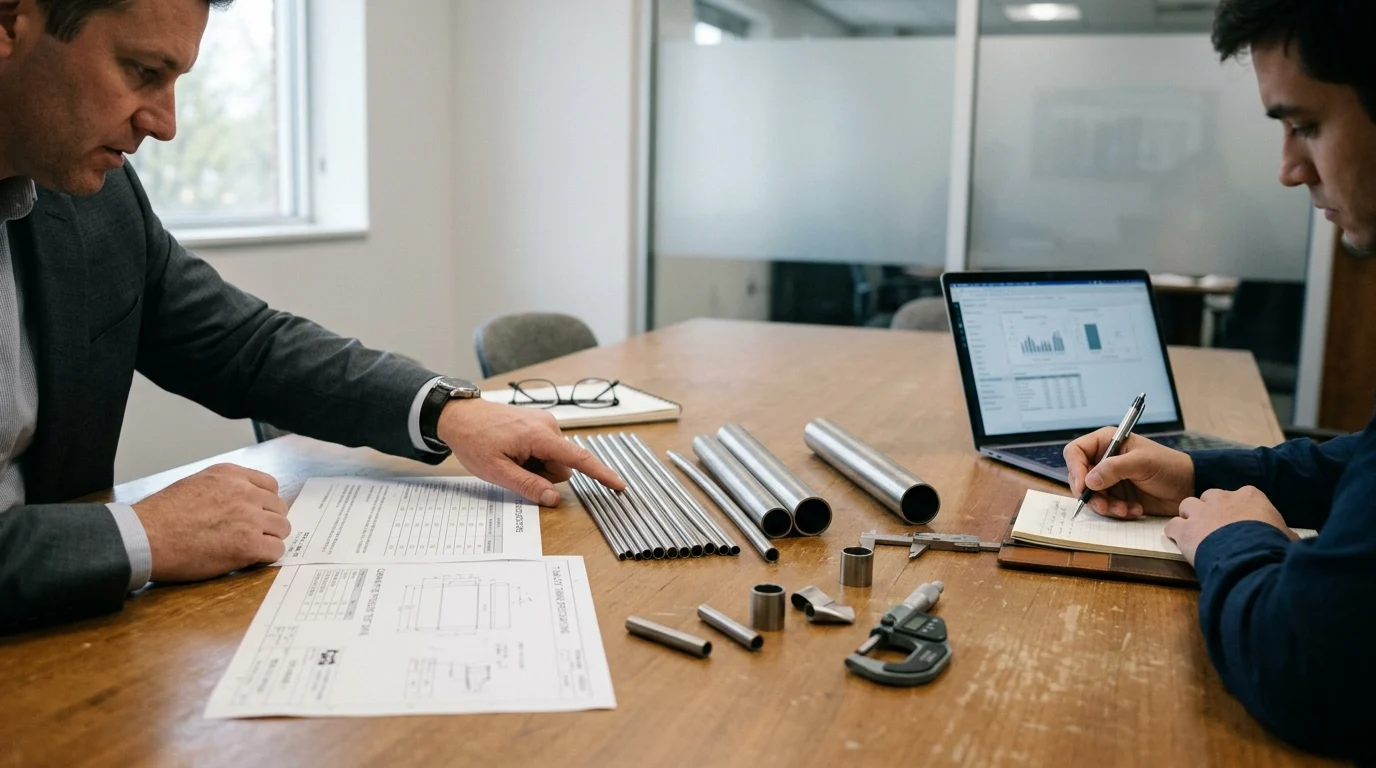
The physical performance limits and fabrication behaviors of these two alloys dictate their respective roles in advanced high-pressure engineering. While Grade 5 offers superior raw tensile capacity and higher service temperature limits, Grade 9 provides excellent fatigue resistance in tubular forms and the essential ductility required for complex routing.
Strength, Ductility, and Formability
The mechanical property disparity between the two grades directly impacts design allowable limits. Grade 5 in the standard annealed condition typically exhibits an Ultimate Tensile Strength (UTS) ranging from 895 to 1000 MPa, alongside a minimum yield strength of 828 MPa. However, this high strength comes at the cost of ductility; elongation is typically specified with a 10% minimum. While actual ductility can be higher, it remains significantly lower than that of Grade 9, making cold bending Grade 5 tubing nearly impossible without inducing critical stress fractures.
Grade 9 yields a UTS of approximately 620 MPa and a yield strength of 483 MPa in the annealed state, but it boasts a significantly higher elongation of 15% to 20%. This enhanced ductility allows Grade 9 tubing to be cold-formed around tight radii (often down to 3D, or three times the tube diameter), a strict requirement for aerospace fluid transfer systems and high-performance automotive plumbing.
Welding, Heat Treatment, Cleanliness, and Inspection
Welding and post-weld processing further differentiate the two materials on the factory floor. Grade 9 exhibits superior weldability compared to Grade 5, behaving similarly to CP titanium during autogenous Gas Tungsten Arc Welding (GTAW) processes, provided strict argon shielding is maintained.
To maximize the pressure rating of Grade 9 tubing, manufacturers frequently supply it in the Cold Worked and Stress Relieved (CWSR) condition. The CWSR process can elevate Grade 9 yield strength by 20% to 30% over the annealed state, pushing its performance metrics closer to Grade 5. Inspection protocols for thin-wall applications are universally stringent for both alloys. High-pressure tubing must undergo rigorous non-destructive evaluation (NDE), including ultrasonic testing (UT) and eddy current inspections, calibrated to detect microscopic surface defects with depths as minimal as 0.05 mm.
How Buyers Should Choose the Right Titanium Grade
Selecting the optimal titanium grade requires procurement teams and design engineers to navigate a complex matrix of industry specifications, dimensional constraints, and total lifecycle costs.
ASTM, AMS, and Supplier Verification
Rigorous supplier verification and adherence to specialized industry specifications are non-negotiable for high-pressure systems. Buyers must ensure that Grade 9 tubing strictly conforms to aerospace standards such as AMS 4943 for the annealed condition or AMS 4944 for CWSR material, alongside industrial standards like ASTM B338. Grade 5 procurement typically revolves around AMS 4911 for sheet and plate, or ASTM B348 for bar stock.
Mill Test Reports (MTRs) must be heavily scrutinized to verify that interstitial elements remain within strict tolerances. For example, the oxygen content in Grade 9 must typically remain below 0.12% (per AMS 4943) to preserve its critical cold-forming characteristics, while hydrogen must be kept under 0.0125% to prevent embrittlement. Buyers should mandate that suppliers maintain full traceability and NADCAP accreditations for any secondary thermal processing or NDE.
Decision Matrix by Application and Cost
The final decision matrix hinges on the specific geometry and loading conditions of the target application. Grade 5 remains the undisputed choice for static, high-load structural components, machined housings, and thick-walled pressure vessels where cold forming is entirely unnecessary. However, for applications requiring wall thicknesses below 1.5 mm, such as aircraft hydraulic lines, performance bicycle frames, and lightweight subsea heat exchangers, Grade 9 is the definitive standard.
From a cost perspective, while raw Grade 9 material carries a slight premium per kilogram over standard Grade 5 billet, its seamless manufacturing yield and cold-bendability deliver a significantly lower total cost of ownership for completed tubular assemblies.
💡 Sourcing High-Pressure Tubing or Precision Titanium Components?
Whether you need seamless Grade 9 (Ti-3Al-2.5V) tubing for hydraulic lines or Grade 5 (Ti-6Al-4V) precision CNC/3D printed parts, we provide full MTR certification, NDE testing, and DFM support.Request a Quote & Material Consultation
Key Takeaways
- Choose Grade 5 when maximum static strength is the priority, as annealed Ti-6Al-4V typically reaches 895–1000 MPa UTS and at least 828 MPa yield strength.
- Specify Grade 9 for seamless tubing and thin-wall pressure lines because Ti-3Al-2.5V is designed for rotary piercing, pilgering, and cold forming.
- Avoid assuming Grade 5 is commercially practical for all tube designs, since custom seamless thin-wall tubing may require 24–36 week lead times and MOQs above 500 kg.
- Use Grade 9 for routed hydraulic lines, subsea umbilicals, and fluid transfer systems where ductility, fatigue resistance, and bendability matter as much as strength.
- Match the alloy form to the supply chain: Grade 5 is commonly stocked as bar, billet, plate, and forgings, while Grade 9 is established for seamless tube products.
Frequently Asked Questions
Is Grade 9 titanium stronger than Grade 5?
No. Grade 5 has higher tensile and yield strength, with annealed UTS typically around 895–1000 MPa. Grade 9 is lower strength but offers better cold formability, making it more practical for seamless tubing and thin-wall pressure lines.
Why is Grade 9 preferred for titanium tubing?
Grade 9 was developed for applications needing both strength and formability. Its Ti-3Al-2.5V chemistry supports rotary piercing, pilgering, bending, and thin-wall tube production better than Grade 5, which work-hardens quickly.
Can Grade 5 be used for high-pressure tubing?
Yes, but it is often difficult and expensive to source as seamless thin-wall tubing. Grade 5 may work for thick-wall or welded tubular parts, while Grade 9 is usually the more practical choice for hydraulic lines and routed pressure systems.
Which alloy has better availability for standard tube sizes?
Grade 9 generally has better availability for seamless tubing and aerospace hydraulic lines. Grade 5 is widely stocked as bar, billet, forgings, and plate, but custom seamless tube orders can involve long lead times and high minimum order quantities.
What does “half-6-4” mean in titanium Grade 9?
“Half-6-4” refers to Grade 9’s leaner composition of about 3% aluminum and 2.5% vanadium, compared with Grade 5’s 6% aluminum and 4% vanadium. This chemistry improves formability while retaining useful strength.