

In titanium production, a few dozen parts per million of hydrogen can separate a compliant component from a brittle, high-risk failure. Titanium’s strength, low density, and corrosion resistance make it essential in aerospace, medical, and energy applications, but its tendency to absorb hydrogen during pickling and thermal exposure demands tight process discipline. Once solubility limits are exceeded, titanium hydrides can form, generating internal stress and reducing fatigue performance. This article explains where hydrogen enters the metal, why acid chemistry and heat treatment controls matter, and how specification limits such as 125 to 150 ppm guide quality assurance in certified titanium supply chains.
Hydrogen Embrittlement Risks in Titanium
Titanium alloys are prized for their exceptional strength-to-weight ratios and corrosion resistance, but their high reactivity with interstitial elements presents significant metallurgical challenges. Among these, hydrogen embrittlement stands out as a critical failure mechanism that can severely degrade the mechanical integrity of titanium components.
Because titanium acts as a strong hydride former, it readily absorbs hydrogen during various manufacturing stages, particularly chemical processing and thermal treatments. Understanding the thermodynamics of this absorption is the first step in mitigating catastrophic brittle failures in high-stress applications.
Key Definitions and Hydrogen Ingress Mechanisms
Hydrogen ingress in titanium is driven by the metal’s allotropic phases. At room temperature, commercially pure titanium and alpha-beta alloys like Ti-6Al-4V consist primarily of the alpha phase (hexagonal close-packed), which exhibits extremely low hydrogen solubility—typically reaching a maximum of approximately 20 to 50 parts per million (ppm) at ambient temperatures.
When local hydrogen concentrations exceed this solubility limit, the excess hydrogen reacts with the titanium matrix to precipitate titanium hydride (TiH2) platelets. This precipitation involves a volumetric expansion of approximately 18%, generating severe internal residual stresses. The brittle hydrides act as stress concentrators and crack initiation sites. Furthermore, hydride precipitation shifts the ductile-to-brittle transition temperature upward, making the material highly susceptible to sudden impact failures and drastically reducing fatigue life under cyclic loading.
Commercial Consequences and Specification Limits
The commercial ramifications of uncontrolled hydrogen absorption are profound, leading to stringent specification limits across the aerospace, medical, and energy sectors. Aerospace material specifications, such as AMS 4911 for Ti-6Al-4V sheet and strip, typically mandate a strict maximum hydrogen content of 125 ppm, whereas broader industrial standards like ASTM B265 may allow up to 150 ppm (0.015 wt%) to prevent delayed hydride cracking.
| Material Standard | Applicable Product Form | Max Allowable Hydrogen (ppm / wt%) | Quality Verification Protocol |
|---|---|---|---|
| AMS 4911 | Ti-6Al-4V Sheet, Strip, and Plate | 125 ppm (0.0125%) | Inert Gas Fusion (ASTM E1447) per lot |
| ASTM B265 | Industrial Titanium Strip, Sheet, Plate | 150 ppm (0.0150%) | Standard Heat MTR Certification |
| ASTM F136 | Medical Surgical Implant Ti-6Al-4V ELI | 120 ppm (0.0120%) | Mandatory Lot Certification & Photomicrographs |
| Aero-Engine OEM Specs | Rotating Compressor Disks & Blades | 100 ppm (0.0100%) | 100% Sacrificial Coupon Testing |
Effects of Pickling and Heat Treatment
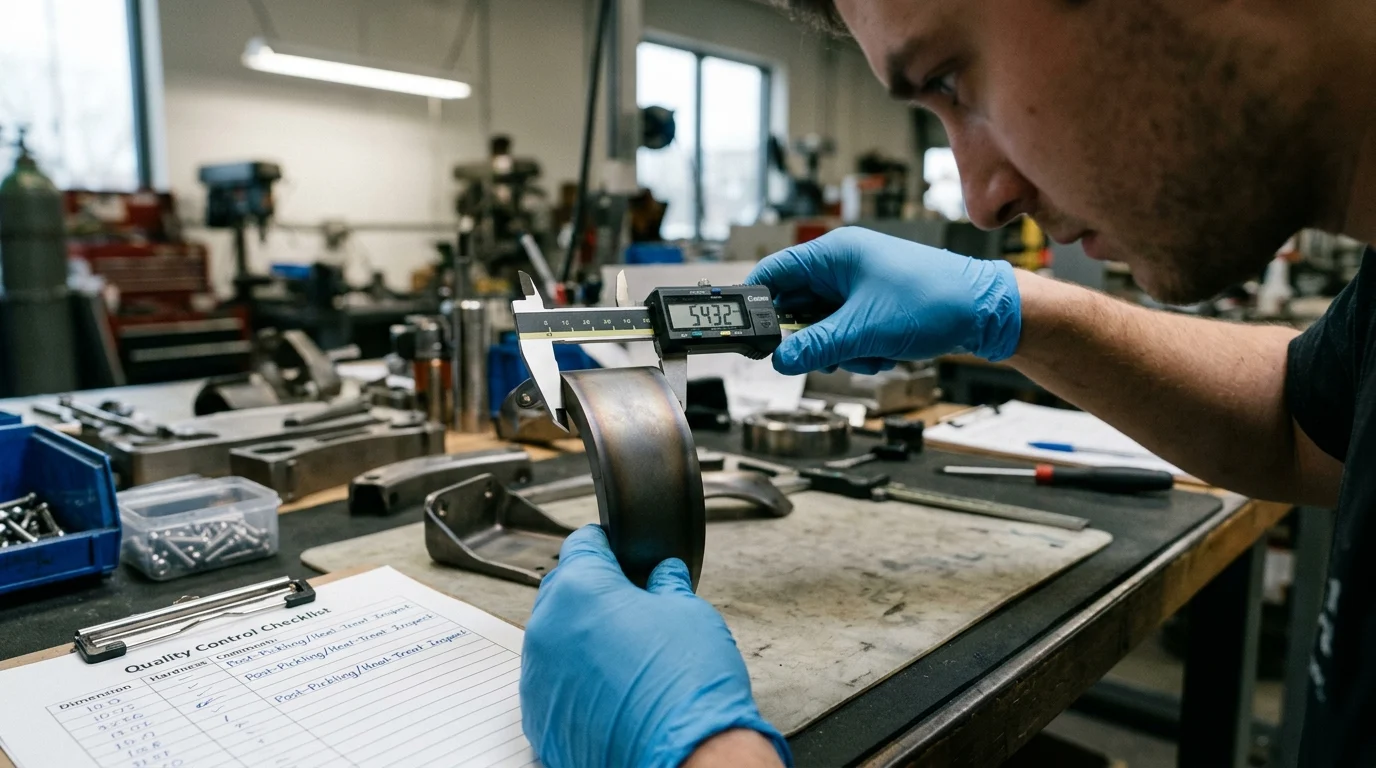
The majority of hydrogen pickup in titanium manufacturing occurs during intermediate processing steps designed to remove alpha case, scale, or residual stresses. Surface treatments and elevated temperature exposures must be meticulously engineered to prevent the thermodynamic conditions that favor hydrogen diffusion into the titanium lattice.
Acid Chemistry and Process Variables
Acid pickling is the most common chemical milling method used to remove the oxygen-enriched alpha case formed during forging or high-temperature processing. This process relies on an aqueous solution blending hydrofluoric acid (HF) and nitric acid (HNO3). The hydrofluoric acid dissolves the titanium oxide and base metal, releasing atomic hydrogen at the metal surface. To suppress hydrogen absorption, the nitric acid acts as an oxidizing agent, promoting the continuous formation of a protective titanium dioxide film that functions as a barrier to hydrogen diffusion.
Maintaining the correct acid ratio and bath temperature is paramount. Industry standards dictate a minimum HNO3 to HF ratio of 10:1 by volume to keep hydrogen pickup negligible. Furthermore, the exothermic nature of the dissolution requires strict temperature control; bath temperatures exceeding 60°C (140°F) exponentially increase the rate of hydrogen diffusion into the substrate.
| Pickling Parameter | Optimal Range | Risk Threshold | Potential Defect |
|---|---|---|---|
| HNO3:HF Volume Ratio | 10:1 to 15:1 | < 8:1 | Rapid hydrogen pickup, hydride precipitation |
| Bath Temperature | 35°C – 50°C | > 60°C (140°F) | Accelerated diffusion, thermal runaway |
| Immersion Time | 1 – 3 minutes | > 5 minutes | Excessive material removal, localized embrittlement |
| Dissolved Metal Ions (Ti, Fe) | < 15 g/L | > 20 g/L | Bath exhaustion, reduced etching efficiency, increased hydrogen risk |
Vacuum Annealing and Stress Relief Controls
When titanium must be subjected to elevated temperatures for stress relief or annealing, atmospheric conditions dictate the risk of hydrogen ingress. Above 427°C (800°F), titanium’s protective oxide layer becomes highly permeable, allowing rapid absorption of hydrogen from reducing atmospheres, water vapor, or hydrocarbon residues. Preventative atmospheric controls are therefore essential; these include avoiding reducing atmospheres, utilizing high-purity argon with strict dew point requirements, and implementing continuous moisture monitoring during thermal processing.
To counter contamination, vacuum annealing serves a dual purpose: it prevents atmospheric exposure and facilitates hydrogen outgassing for parts that have already exceeded specification limits. Effective outgassing typically requires heating the titanium to between 700°C and 850°C (1292°F – 1562°F) under a high vacuum environment, usually maintained between 10-4 and 10-5 Torr. However, care must be taken, as 850°C approaches the beta transus for commercially pure titanium and can alter mechanical properties; operators must confirm alloy-specific transformation temperatures before outgassing. Furnace leak rates are typically certified to approximately 5 microns per hour to prevent secondary contamination. Prolonged exposure at these parameters—often 2 to 4 hours depending on cross-sectional thickness—reverses the diffusion gradient, pulling hydrogen out of the lattice and restoring the alloy’s baseline ductility.
Control Plan for Prevention
Mitigating hydrogen embrittlement requires a holistic control plan that spans the entire manufacturing lifecycle. Relying solely on final chemical analysis is insufficient; manufacturers must implement preventative protocols covering surface preparation, environmental controls, and strategic material selection to ensure long-term structural integrity.
Cleaning, Handling, and Process Controls
Process controls begin with rigorous cleaning and handling protocols. Prior to any thermal processing or welding, titanium components must be thoroughly degreased to remove cutting fluids, oils, and fingerprints. Hydrocarbon residues left on the surface will decompose at elevated temperatures, serving as a concentrated source of nascent hydrogen directly at the metal-environment interface. Even alkaline cleaning solutions must be carefully controlled, as highly caustic environments can generate hydrogen if galvanic couples are present.
In the chemical processing department, standard operating procedures must mandate daily titration of pickling baths to verify that the HNO3 to HF volumetric ratio remains strictly at or above 10:1. Automated chiller systems with temperature interlocks calibrated to 50°C should be installed to prevent localized thermal runaway during etching. Furthermore, baths must be recharged when total dissolved titanium concentration approaches 15 to 20 g/L.
Quality Assurance and Testing
Final acceptance testing must be conducted per ASTM E1447 using Inert Gas Fusion Analysis (IGFA). Sacrificial test coupons processed alongside production batches must undergo quantitative testing to verify that final hydrogen levels remain compliant with AMS 4911 or ASTM B265 limits prior to final lot release.
Key Takeaways
- Keep hydrogen content below applicable limits, such as 125 ppm for AMS 4911 Ti-6Al-4V sheet and strip or 150 ppm for ASTM B265 material.
- Control nitric-to-hydrofluoric acid balance during pickling (HNO3:HF ≥ 10:1) so nitric acid can maintain a protective oxide film while HF removes scale and alpha case.
- Minimize hydrogen pickup during chemical processing and heat treatment because titanium hydride precipitation can cause about 18% volumetric expansion and severe internal stress.
- Use inert gas fusion analysis (ASTM E1447) as a mandatory quality check before releasing titanium for aerospace, medical, energy, or other critical applications.
- Treat elevated hydrogen readings early through approved rework such as vacuum outgassing (700°C to 850°C under 10-4 Torr) to avoid delayed hydride cracking or part rejection.
Frequently Asked Questions
Why is titanium vulnerable to hydrogen embrittlement?
Titanium readily forms brittle titanium hydrides (TiH2) when hydrogen exceeds its low room-temperature solubility, typically about 20 to 50 ppm in alpha titanium. These hydrides create internal stress and crack initiation sites.
What hydrogen limits apply to titanium alloys?
Common limits include 125 ppm maximum hydrogen for AMS 4911 Ti-6Al-4V sheet and strip, while ASTM B265 may allow up to 150 ppm. Critical aerospace parts often require even tighter controls.
How does acid pickling introduce hydrogen into titanium?
During pickling, hydrofluoric acid dissolves titanium oxide and base metal, generating atomic hydrogen at the surface. If not controlled by oxidizing nitric acid and proper bath conditions, hydrogen can diffuse into the metal.
Why is nitric acid important in titanium pickling baths?
Nitric acid acts as an oxidizer that helps maintain a protective titanium dioxide film. This barrier reduces hydrogen absorption while hydrofluoric acid removes scale, alpha case, or surface contamination.
What happens if hydrogen exceeds specification limits?
Parts may require vacuum outgassing, additional testing, or rejection. In high-value aerospace, medical, or energy components, exceeding hydrogen limits can lead to costly scrapping and supply-chain delays.