

A titanium part can look perfect on the outside and still contain microscopic defects that limit its real-world performance. That is especially true for additive manufacturing and metal injection molding, where residual pores, trapped gas, and lack-of-fusion defects can become crack starters under vibration or cyclic stress. Hot isostatic pressing is often used to close those voids and push Ti-6Al-4V components toward near-full density, but it also adds cost, lead time, and microstructural changes. This article explains when HIP is a smart requirement, when it may be unnecessary, and how engineers should weigh density, fatigue life, strength, and qualification demands before specifying it.
Why HIP Matters for Titanium Components
Hot Isostatic Pressing (HIP) is a critical post-processing technology for titanium components manufactured via Additive Manufacturing (AM) and Metal Injection Molding (MIM). While these advanced manufacturing methods offer unparalleled geometric freedom and material efficiency, they inherently leave microscopic voids within the material matrix. For demanding industrial and aerospace applications, HIP transforms a near-net-shape part into a near-fully dense, high-performance component capable of competing with or replacing traditional forgings.
How HIP Improves Microstructure and Reduces Porosity
The HIP process simultaneously applies elevated temperature and isostatic gas pressure to a component, fundamentally altering its internal structure. For standard titanium alloys such as Ti-6Al-4V, the process is typically executed in an inert argon environment at temperatures ranging from 895°C to 955°C, with pressures between 100 MPa and 200 MPa, held for 2 to 4 hours. Under these extreme conditions, the titanium yields plastically, causing internal voids to collapse inward. The sustained high heat then facilitates solid-state diffusion, permanently bonding the void surfaces together. This thermomechanical treatment results in a microstructure that achieves near-full density (typically >99.95%) and exhibits enhanced isotropic mechanical properties.
Common Defects in 3D Printed and MIM Titanium Parts
Without HIP intervention, both AM and MIM titanium parts exhibit characteristic defects that can compromise mechanical integrity. Laser Powder Bed Fusion (LPBF) often yields parts with 99.5% to 99.9% density, but the remaining 0.1% to 0.5% typically manifests as lack-of-fusion defects or trapped argon gas keyholes. Similarly, MIM titanium parts frequently retain 2% to 4% residual porosity after the binder removal and sintering phases. These microscopic voids act as severe stress concentrators. Under cyclic loading, they serve as prime initiation sites for micro-cracks, drastically reducing the component’s fatigue life and rendering the raw, as-processed state unsuitable for mission-critical dynamic applications.
How to Compare HIP, 3D Printed, MIM, and As-Processed Titanium
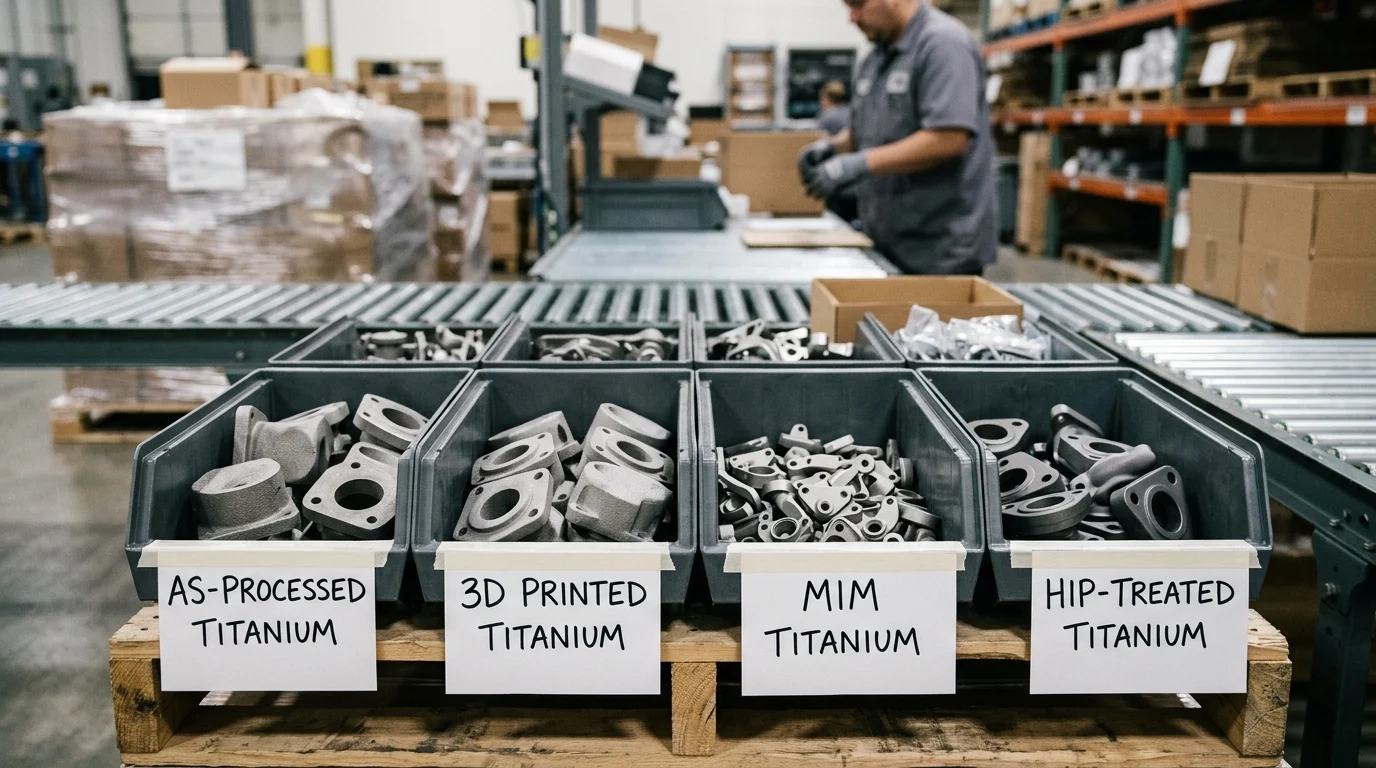
Determining the necessity of HIP requires evaluating the precise mechanical shifts that occur post-treatment compared to the raw manufacturing processes. Engineers must weigh the structural benefits of near-full density against the thermal effects the treatment imparts on the titanium microstructure, as well as the added logistical and financial overhead. Comparing the as-processed states of 3D printed and MIM titanium against their HIP-treated counterparts highlights the trade-offs between cost, lead time, and ultimate material performance.
Key Decision Factors: Density, Strength, Fatigue, and Cost
The most profound impact of HIP is on fatigue resistance. While as-built AM titanium exhibits high yield strength due to rapid cooling rates that form fine martensitic structures, its fatigue life remains unpredictable due to internal voids. HIP processing coarsens the microstructure, converting brittle alpha-prime martensite into a more ductile alpha-beta phase. This thermal exposure slightly reduces yield strength but significantly increases elongation and substantially boosts fatigue limits. Note that the specific mechanical properties and cost figures shown below are typical examples rather than universal guarantees. Fatigue limits and performance depend heavily on test conditions such as R-ratio, specimen size, build orientation, and surface finish.
| Material State (Ti-6Al-4V) | Relative Density | Yield Strength (MPa) | Fatigue Limit (10^7 cycles) | Relative Cost |
|---|---|---|---|---|
| MIM (As-Sintered) | 96.0% – 98.0% | ~800 | ~150 MPa | 0.6x |
| AM (As-Built LPBF) | 99.5% – 99.9% | ~950 – 1050 | ~200 – 300 MPa | 1.0x |
| AM + HIP | >99.95% | ~850 – 900 | ~500 – 600 MPa | 1.2x – 1.3x |
Effects of Alloy Grade, Geometry, and Wall Thickness
The efficacy of HIP is highly dependent on alloy grade, part geometry, and wall thickness. Because the process relies on isostatic pressure, any porosity connected to the surface will not collapse; the argon gas simply pressurizes the inside of the void equally, preventing closure. Therefore, parts with surface-breaking defects require prior encapsulation or surface sealing. Furthermore, thin-walled structures—often cited as those below a 1.5 mm threshold, though this depends on supplier capabilities and specific geometry—can be susceptible to microstructural distortion or dimensional warping during the high-temperature soak. Engineers must also strictly monitor processing environments; titanium is highly reactive at elevated temperatures, requiring high-purity argon gas (often 99.999% or better) to prevent oxygen contamination and the subsequent formation of a brittle alpha-case layer on the component’s exterior.
When HIP Is Necessary for Titanium Parts
The decision to implement HIP is ultimately governed by industry standards, part criticality, and economic feasibility. Procurement and engineering teams must align on whether the application strictly demands the metallurgical enhancements provided by HIP, or if as-processed properties are sufficient for the product’s lifecycle.
Qualification Steps for Engineering Teams
For the aerospace and medical sectors, qualification protocols heavily dictate post-processing requirements. While standards such as ASTM F2924 for AM Ti-6Al-4V provide the framework for HIP, the actual mandate for the process typically originates from OEM or program-specific specifications rather than the material standard itself. Engineering teams qualifying a new MIM or AM part generally follow a complex, iterative workflow to validate the cycle’s effectiveness. Although the following three steps represent the core testing phases, true aerospace and medical certification also requires rigorous OEM source qualification, process validation (PQ), and ongoing statistical process control (SPC):
- Non-Destructive Testing (NDT): High-resolution micro-computed tomography (micro-CT) scanning, capable of detecting internal voids as small as 10 to 20 microns, is employed to confirm complete consolidation.
- Dynamic Testing: The team conducts rigorous fatigue testing to verify mechanical performance under cyclic loads.
- Certification & Process Control: After statistical validation of void closure and fatigue resistance, the part is formally certified, with SPC implemented to ensure long-term production stability.
How Buyers Should Decide Based on Application Criticality
Buyers must categorize components by application criticality to optimize supply chains and manage budgets. Fatigue-critical aerospace or medical components (often termed Class 1) require HIP to significantly reduce the risk of internal defect-initiated failure. When evaluating the 1.2x to 1.
Key Takeaways
- Use HIP for titanium parts exposed to cyclic loading because internal pores are major fatigue-crack initiation sites.
- Expect typical Ti-6Al-4V HIP cycles to run in argon at 895°C to 955°C, 100 MPa to 200 MPa, and 2 to 4 hours of hold time.
- Do not judge AM titanium only by high as-built density, because even 0.1% to 0.5% residual porosity can compromise fatigue performance.
- Consider HIP especially for MIM titanium components, which may retain about 2% to 4% porosity after debinding and sintering.
- Account for trade-offs before specifying HIP, since it can improve ductility and fatigue resistance while slightly reducing yield strength and adding cost and lead time.
- Validate performance with application-specific testing because fatigue results depend on build orientation, specimen size, surface finish, R-ratio, and inspection criteria.
Frequently Asked Questions
What does HIP do to 3D printed titanium parts?
HIP applies high temperature and isostatic argon pressure to collapse internal voids, bond pore surfaces through diffusion, and raise titanium parts toward near-full density, typically above 99.95%.
Is HIP always required for Ti-6Al-4V components?
No. HIP is most justified for fatigue-critical, aerospace, medical, or dynamic-load components. For non-critical brackets, prototypes, or lightly loaded parts, as-built AM or sintered MIM titanium may be sufficient after inspection.
What HIP conditions are typical for titanium alloys?
For Ti-6Al-4V, typical HIP cycles use inert argon at about 895°C to 955°C, 100 MPa to 200 MPa, and a 2 to 4 hour hold, depending on specification and part requirements.
Why is porosity a problem in AM and MIM titanium?
Microscopic pores, lack-of-fusion defects, and trapped gas keyholes act as stress concentrators. Under cyclic loading, they can initiate micro-cracks and sharply reduce fatigue life.
How dense are titanium parts before HIP?
LPBF titanium parts often reach about 99.5% to 99.9% density, while MIM titanium can retain roughly 2% to 4% residual porosity after debinding and sintering.