

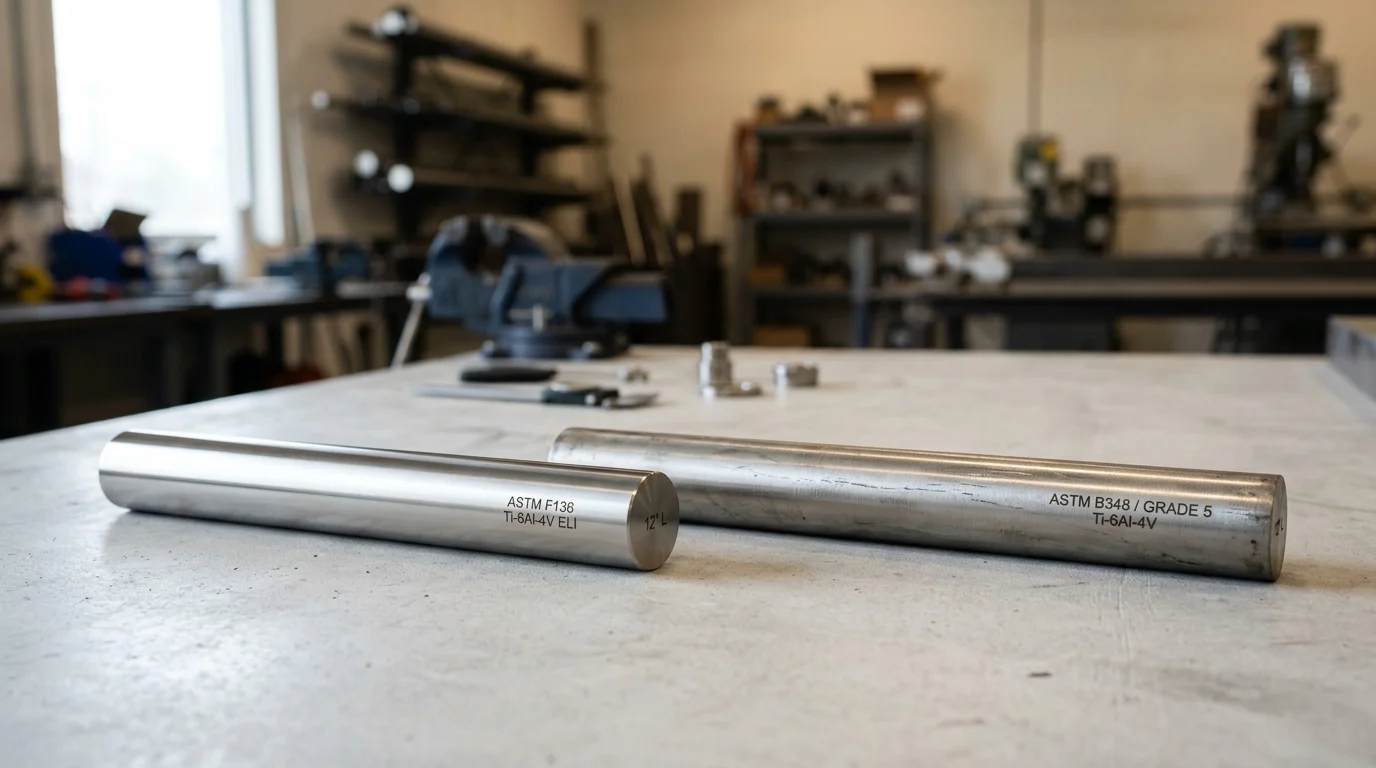
ASTM F136 vs. ASTM B348 represents the regulatory and metallurgical divide between medical implant-grade and commercial industrial titanium bars. ASTM F136 explicitly governs wrought Ti-6Al-4V ELI alloy with restricted oxygen (≤0.13%) and mandatory microstructural validation for surgical implants, whereas ASTM B348 covers general industrial grades (such as Grade 5 and Grade 23) used in aerospace, chemical, and marine applications.
Key Technical Takeaways:
- Oxygen Interstitial Limits: ASTM F136 caps oxygen at 0.13% max (ELI chemistry), while ASTM B348 Grade 5 permits up to 0.20% oxygen. Lower oxygen maximizes fracture toughness and damage tolerance in implants.
- Microstructural Validation: ASTM F136 requires fine equiaxed alpha-beta structures (grain size ≤5 per ASTM E112) with zero continuous prior beta grain boundary alpha networks and verified 100% alpha-case removal.
- Non-Destructive Testing: Medical bars under F136 undergo mandatory high-resolution ultrasonic inspection (typically AMS-STD-2154 Class A or AA) to eliminate internal voids that act as fatigue crack starters.
- Substitution Warning: ASTM B348 Grade 23 is NOT a direct substitute for ASTM F136 in implants because B348 lacks mandatory microstructural photomicrographs and implant-grade QA protocols.
- Traceability & MTRs: ASTM F136 requires unbroken heat-level traceability from vacuum melting (VAR or cold-hearth) to final grinding, supported by 3.1/3.2 Mill Test Reports detailing quantitative metallography.
ASTM F136 vs ASTM B348: Key Differences
Specifying titanium round bar requires navigating stringent material standards. While both ASTM F136 and ASTM B348 govern the widely used Ti-6Al-4V alloy system, they address fundamentally different risk environments. Selecting the wrong specification can either result in regulatory rejection of a medical device or unnecessary material cost overhead in a commercial application.
Understanding these standards requires evaluating chemical purity, mechanical damage tolerance, microstructural controls, and quality assurance traceability.
Medical-Grade vs Industrial Application Requirements
The primary divergence between these specifications stems from their end-use environment. ASTM F136 is engineered specifically for manufacturing surgical implants—such as orthopedic hip stems, spinal pedicle screws, trauma plates, and dental posts—that reside permanently or semi-permanently inside the human body. These components operate in highly corrosive, oxygenated biological fluids while enduring millions of cyclic fatigue loads over decades.
Conversely, ASTM B348 serves as a general-purpose industrial specification covering a broad range of unalloyed (Commercially Pure) and alloyed titanium bars and billets. Typical applications include aerospace airframe structures, marine propeller shafts, subsea valves, and chemical processing heat exchangers. While industrial titanium requires high strength-to-weight performance and general corrosion resistance, it is not subjected to biological biocompatibility mandates or human tissue exposure.
Chemistry, Oxygen Limits, and Mechanical Trade-Offs
The core metallurgical difference between ASTM F136 and ASTM B348 (specifically Grade 5) involves interstitial element limits—primarily oxygen, iron, carbon, and nitrogen. ASTM F136 mandates Ti-6Al-4V ELI (Extra Low Interstitial) chemistry, capping oxygen at a strict maximum of 0.13% and iron at 0.25%. Standard ASTM B348 Grade 5 permits oxygen levels up to 0.20% and iron up to 0.40%.
Interstitial oxygen atoms sit inside the titanium crystal lattice, acting as strong solid-solution hardenings. Increasing oxygen from 0.13% to 0.20% raises baseline tensile and yield strength but significantly reduces ductility, fracture toughness, and notch sensitivity resistance. In surgical implants, high fracture toughness is mandatory to arrest micro-crack propagation under fatigue. Therefore, F136 sacrifices a small degree of ultimate tensile strength to maximize structural damage tolerance.
| Chemical Element | ASTM F136 (Ti-6Al-4V ELI) Max % | ASTM B348 (Grade 5) Max % | ASTM B348 (Grade 23 ELI) Max % |
|---|---|---|---|
| Oxygen (O) | 0.13 | 0.20 | 0.13 |
| Iron (Fe) | 0.25 | 0.40 | 0.25 |
| Carbon (C) | 0.08 | 0.08 | 0.08 |
| Nitrogen (N) | 0.05 | 0.05 | 0.03 / 0.05 |
| Hydrogen (H) | 0.012 | 0.015 | 0.0125 |
| Titanium (Ti) | Balance | Balance | Balance |
Traceability, Certification, and Quality Controls
Quality assurance requirements represent another major divide. Standard industrial bars under B348 require basic chemical heat analysis and room-temperature tensile testing to issue a standard Mill Test Report (MTR). In contrast, ASTM F136 mandates exhaustive quality verification:
- Ultrasonic Inspection: F136 bars undergo mandatory 100% volumetric ultrasonic testing conforming to AMS-STD-2154 Class A or Class AA standards to detect sub-surface voids or hard-alpha inclusions that trigger fatigue failure.
- Alpha-Case Removal: During hot rolling and forging in air, a brittle, oxygen-rich surface layer called “alpha case” forms on titanium. ASTM F136 strictly requires complete chemical or mechanical removal of alpha case prior to final certification.
- Microstructural Evaluation: MTRs for ASTM F136 must include quantitative metallographic examination proving an equiaxed, fully recrystallized alpha-beta microstructure without continuous alpha networks along prior beta grain boundaries.
What ASTM F136 Defines
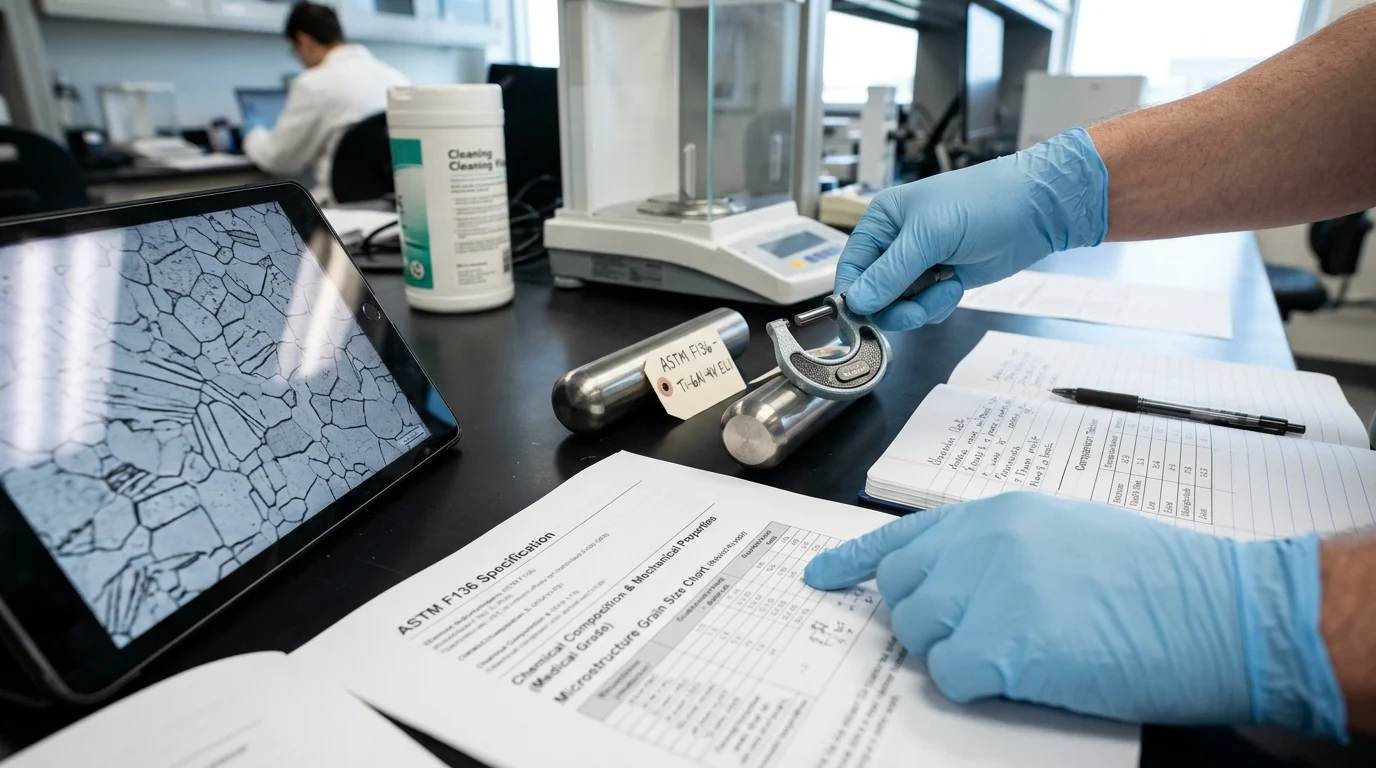
ASTM F136 is the definitive metallurgical specification for wrought Titanium-6Aluminum-4Vanadium ELI alloy designated strictly for surgical implant applications. It serves as the primary material baseline reviewed by regulatory bodies such as the US FDA (510(k) and PMA pathways) and European Notified Bodies under MDR 2017/745.
Scope for Wrought Ti-6Al-4V ELI Alloy
The scope of ASTM F136 is focused exclusively on the ELI variant of Ti-6Al-4V supplied as wrought bars, wire, forging stock, and sheets. Primary melting must utilize vacuum processes—typically multiple Vacuum Arc Remelting (VAR) cycles or Electron Beam / Plasma Cold Hearth Melting—to prevent oxide contamination and deliver chemical homogeneity across the heat ingot.
Internationally, ASTM F136 aligns closely with ISO 5832-3 (Implants for surgery — Metallic materials — Part 3: Wrought titanium 6-aluminum 4-vanadium alloy). Ensuring compliance with both standards simplifies global regulatory filings for medical device OEMs.
Implant-Grade Microstructural Expectations
Mechanical properties alone do not guarantee implant safety. ASTM F136 mandates precise grain size and phase morphology:
- Grain Size Control: Microstructure must conform to ASTM E112 standards, requiring a fine equiaxed grain size of 5 or finer (average grain diameter ≤ 0.0635 mm). Fine grain structures optimize high-cycle fatigue strength.
- Phase Distribution: The microstructure must consist of a uniform dispersion of alpha and beta phases. Coarse acicular (needle-like) structures or grain boundary alpha networks created by improper cooling are explicit cause for heat rejection.
Baseline Mechanical Properties and Documentation
For annealed titanium round bars under ASTM F136, standard baseline mechanical requirements specify:
| Mechanical Property | ASTM F136 Annealed Baseline | Engineering Significance |
|---|---|---|
| Yield Strength (0.2% Offset) | ≥ 795 MPa (115 ksi) | Resists permanent plastic deformation under physiological loads. |
| Ultimate Tensile Strength (UTS) | ≥ 860 MPa (125 ksi) | Determines peak static load limit prior to necking and fracture. |
| Elongation in 4D | ≥ 10% | Ensures adequate ductility for surgical contouring and impaction. |
| Reduction of Area (RA) | ≥ 25% | Verifies triaxial strain capability and resistance to notch tearing. |
Documentation requirements are comprehensive. Suppliers must deliver Mill Test Reports (MTRs) detailing quantitative chemical analysis, tensile testing, grain size ratings, ultrasonic compliance certificates, and representative photomicrographs at 100x to 500x magnification.
What ASTM B348 Defines
ASTM B348 is the foundational commercial specification covering titanium and titanium alloy bars, billets, and rectangular stock. Unlike F136, B348 is a broad umbrella specification serving diverse global industrial sectors.
Scope for Commercial Titanium Bars and Billets
ASTM B348 outlines manufacturing requirements, chemical limits, and tensile properties for general engineering applications. It permits primary vacuum arc remelting, plasma arc, or electron beam hearth melting. The document covers unalloyed commercial pure (CP) titanium as well as complex alpha, alpha-beta, and beta alloys across various heat-treat conditions (annealed, solution treated, and aged).
Key Industrial Grades (Grade 2, Grade 5, Grade 23)
ASTM B348 explicitly covers over 39 distinct titanium grades. The most frequently specified include:
- Grade 2 (CP Titanium): Unalloyed titanium offering moderate yield strength (~275 MPa) with supreme corrosion resistance in oxidizing acids and marine environments.
- Grade 5 (Ti-6Al-4V): The workhorse industrial alloy. Higher oxygen (0.20%) delivers a minimum yield strength of 828 MPa (120 ksi) and ultimate tensile strength of 895 MPa (130 ksi).
- Grade 23 (Ti-6Al-4V ELI): Industrial ELI grade matching F136 chemistry (O ≤0.13%), specified for cryogenic pressure vessels, subsea oil tools, and aerospace frames requiring high fracture toughness.
Typical Industrial, Defense, and Marine Uses
Materials certified under ASTM B348 drive demanding heavy industries. Grade 2 and Grade 7 bars are machined into chemical process pump shafts, heat exchanger tube sheets, and chlor-alkali valves. Grade 5 billets are forged into military aircraft structural bulkheads, gas turbine compressor blades, subsea riser couplings, and high-performance racing fasteners.
How to Source and Verify Material Compliance
Procuring titanium round bar requires rigid supply chain controls to eliminate material mix-ups, counterfeit certifications, or non-conforming interstitial chemistry.
Purchase Order Language and Specification Revision Years
A Purchase Order (PO) must state the precise standard, revision year, material condition, and dimensional tolerances. Simply stating “Ti-6Al-4V ELI” is insufficient. A compliant PO for medical implant stock must explicitly read:
“Ti-6Al-4V ELI Round Bar, Centerless Ground, Annealed condition, conforming strictly to ASTM F136-13 (or latest revision) and ISO 5832-3. Diameter tolerance ISO h9. Includes 100% AMS-STD-2154 Class A Ultrasonic Inspection, Microstructure Photomicrographs (ASTM E112 grain size ≤5), and EN 10204 3.1 Certified MTR.”
Red Flags: Why ASTM B348 Grade 23 Cannot Replace ASTM F136
A frequent procurement failure occurs when a distributor offers ASTM B348 Grade 23 as a direct substitute for ASTM F136. While the chemical composition ranges overlap, ASTM B348 Grade 23 is NOT a direct substitute for ASTM F136 in surgical implants.
The reasoning is clear: ASTM B348 Grade 23 does not mandate the mandatory microstructural evaluation, alpha-case removal verification, grain size limits, or high-resolution ultrasonic inspection required under ASTM F136. Accepting B348 material for surgical implants introduces severe regulatory compliance vulnerabilities during FDA or MDR quality audits.
When NOT to Substitute ASTM B348 for ASTM F136
To assist sourcing and design teams, the following decision criteria outline where material substitution is strictly prohibited versus where commercial standards are appropriate:
- DO NOT Substitute (ASTM F136 Mandatory): Permanent surgical implants (hip stems, knee joints, spinal cages), trauma fixation plates, dental implant posts, and high-cycle dynamic medical devices requiring ISO 13485 / FDA submission.
- ASTM B348 Permissible: External surgical instruments, retractor handles, diagnostic equipment housings, aerospace airframe brackets, marine shafts, chemical valves, and general industrial machined hardware.
💡 Need Certified Medical (ASTM F136) or Industrial (ASTM B348) Titanium Bars?
We supply precision centerless-ground Ti-6Al-4V ELI (ASTM F136 / ISO 5832-3) and Ti-6Al-4V Grade 5 / Grade 23 (ASTM B348) round bars with complete EN 10204 3.1/3.2 MTRs, AMS-STD-2154 UT reports, and metallographic photomicrographs.
Our engineering team reviews your drawing tolerances, ASTM specifications, and regulatory compliance requirements before shipment.Request a Material Quote & MTR Verification
Frequently Asked Questions
What is the primary difference between ASTM F136 and ASTM B348 titanium bars?
ASTM F136 specifically governs wrought Ti-6Al-4V ELI (Extra Low Interstitial) alloy designated for surgical implants, enforcing tight oxygen limits (≤0.13%), strict microstructural validation, and full vacuum melting traceability. ASTM B348 is a general industrial specification covering 39+ titanium grades (including Grade 5 and Grade 23) for aerospace, chemical, and marine uses without mandatory implant-level quality controls.
Can ASTM B348 Grade 23 be substituted for ASTM F136 in medical implants?
No. Although ASTM B348 Grade 23 shares the same basic chemical composition (Ti-6Al-4V ELI) as ASTM F136, it does not mandate the rigorous microstructural evaluation (ASTM E112 grain size ≤5, complete prior beta grain boundary alpha-network absence), mandatory alpha-case removal verification, or high-resolution ultrasonic inspection (AMS-STD-2154 Class A) required for surgical implants.
Why does ASTM F136 strictly cap oxygen content at 0.13%?
Oxygen acts as a potent solid-solution strengthener in titanium. Capping oxygen at 0.13% max in ASTM F136 (compared to 0.20% in ASTM B348 Grade 5) increases material ductility, fracture toughness, and cyclic fatigue resistance, which are critical for preventing catastrophic structural failure in load-bearing implants under multi-axial physiological stresses.
Is ASTM B348 Grade 5 stronger than ASTM F136 Ti-6Al-4V ELI?
Yes, in terms of baseline tensile and yield strength. ASTM B348 Grade 5 permits higher oxygen (up to 0.20%) and iron (up to 0.40%), yielding a higher minimum tensile strength (895 MPa vs 860 MPa) due to solid-solution hardening. However, this higher strength comes at the expense of reduced ductility, lower fracture toughness, and higher notch sensitivity compared to ASTM F136.
What quality inspection records must accompany an ASTM F136 Mill Test Report (MTR)?
An ASTM F136 MTR must include quantitative heat chemical analysis (confirming O ≤0.13%, Fe ≤0.25%), tensile testing metrics, microstructural reports with representative photomicrographs (100x to 500x magnification verifying recrystallized alpha-beta structure), alpha-case removal verification, and ultrasonic testing certificates conforming to AMS-STD-2154 Class A or Class AA.
Engineering Standards & Metallurgical References:
- ASTM F136-13(2021). Standard Specification for Wrought Titanium-6Aluminum-4Vanadium ELI (Extra Low Interstitial) Alloy for Surgical Implant Applications. ASTM International.
- ASTM B348/B348M-21. Standard Specification for Titanium and Titanium Alloy Bars and Billets. ASTM International.
- ISO 5832-3:2021. Implants for surgery — Metallic materials — Part 3: Wrought titanium 6-aluminum 4-vanadium alloy. International Organization for Standardization.
- AMS-STD-2154B. Inspection, Ultrasonic, Wrought Metals, Process for. SAE International.